• Public Gallery  • Help  
• Join Now!  • Log In  • Feature Tour
Select Category
Animals and Pets Arts and Crafts Cars and Transportation Events
Family Friends For Sale Holidays
Miscellaneous Nature and Landscapes Photography Schools and Organizations
Sports and Hobbies Travel and Vacation Weddings Most Recent
Search Public Gallery Albums: (keywords or username)
 Public Gallery | Home > Miscellaneous Prev 15 | Next 15 
Miscellaneous
2626 - 2640 of 3495 Total. Shared
950503 Flowers
2626. 950503 Flowers  (March 22, 2006)
20 Images
Linked Album
codomo
2627. The Empire Strikes Back 


Click Here for the The Empire Strikes Back IMDB Page


0 Images
Linked Album
afap
Umbrella on the Roof
2628. Umbrella on the Roof  (May 1, 2010)
Patio Umbrella blown on top of the roof of the house.
3 Images
Linked Album
cg07446
2629. The village of Aston le Walls 
The village of Aston le Walls in Northamptonshire, UK, resting gently almost midway between the conurbations of Banbury and Daventry on the A361.  The M40 is within easy reach if required!

My wife and I moved here in September 2007 and found that the village community is quite unique.  

Why, because it stll retains that special community relationship that was present in English villages when I was a boy, but by general concensus has disappeared or at least diminished throughout the UK.

There are numerous evening entertainments, I know virtually everyone who lives here, if not by name, at least as nodding acquaintances and friendly greeters.

There is neither shop nor pub and a bus might come through now and then!  It is of no consequence because almost all you need can be found within a 10 mile radius.  

In the first few weeks of living here we frequently found vegetables left by our back door.  When I was incapacitated after 2 major operations, a neighbour mowed the lawn without being asked and the offer of help, if needed, is only a stones throw away.

Please feel free to make comments, I would welcome the opportunity to read of others impressions, good or bad!
0 Images
Linked Album
petersplatters
Ferrari-Carano
2630. Ferrari-Carano  (Spring 2010)
What can be done when money is not a concern. From Barrel room, villa Fiori, itself with the tasting room and the merchandising area, the Reserve tasting facilities, to Rhonda's fantastic gardens it is all done with elevated style but not opulence. Enjoy.
29 Images
Linked Album
heinz57
2631. Harry Potter and the Deathly Hallows 


Click Here for the Deathly Hallows Site


0 Images
Linked Album
afap
960628白河蓮花
2632. 960628白河蓮花 
135 Images
Linked Album
codomo
960417 Flowers
2633. 960417 Flowers 
58 Images
Linked Album
codomo
960327 Flowers
2634. 960327 Flowers 
19 Images
Linked Album
codomo
960202 中社
2635. 960202 中社  (March 22, 2006)
67 Images
Linked Album
codomo
El Caballo
2636. El Caballo  (July 2008)

The Andalusian horse has a long and distinguished history as a riding horse of excellence. The first Spanish horses arrived in Australia in 1972 and were brought to the El Caballo Blanco complex at Wooroloo, Western Australia, by the late Mr Ray Williams. He imported the well known stallion Bodeguero and a number of mares, as the foundation of the 'Bodeguero Stud'. Many of the present day Andalusian (Spanish) horses in Australia trace back to Bodeguero and those first mares. El Caballo Resort was established in 1974 and the Dancing Horses were enjoyed by all who saw them. After many years absence, the Spanish Dancing Stallions have now returned to entertain with their amazing movements. Here are some scenes from the show which was performed under difficult conditions in rain and mud.

121 Images
Linked Album
gladysclancy
X
2637. X 

- CLICK ON IMAGES TO ENLARGE -

1986 Bertone X 1/9 FIAT

Sign the Guest book if you know of this cars whereabouts. - Thanks

54 Images
Linked Album
xfactor
2638. Bonus Euro Images  (December 25, 2010)
Several images and HDRs from our trip back in September that I held back for the book that I created (http://www.adoramapix.com/eremin/book/in-europe-2010).  Some made the final cut, some did not.
0 Images
Linked Album
eremin
Will the real Laura Bush please stand up
2639. Will the real Laura Bush please stand up  (October 17, 2003)
All of these images of Laura Bush were taken during the Bush presidency. In some of the images she looks pert and youthful.  In other images she looks at least a decade or so older. In some the nose has a slight hook to it in other images the nose is more turned up.  It appears that the former first lady had several stand ends as I find it hard to believe that all these images are of the same woman.  But which is the real Laura Bush?
24 Images
Linked Album
firesat
On Floating Opals
2640. On Floating Opals  (December 1, 2010)

— Welch’s Floating Opal —

by Meg Andrews

COPYRIGHT© MEG ANDREWS 2010. ALL RIGHTS RESERVED.


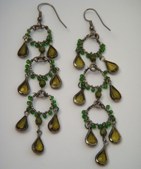
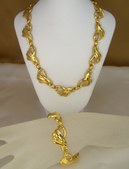
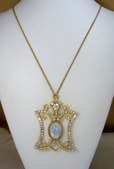
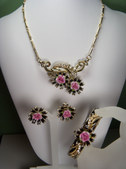
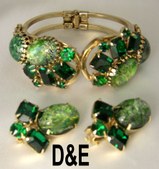
Photo of double pendant necklace I have vivid childhood memories of looking through my mother’s jewelry box and being transfixed by her floating opal earrings. Time seemed to stand still as I turned them over and over to see their fascinating displays of color and motion. Recently, after purchasing an enchanting double floating opal necklace, I found myself transfixed once again. And I began to wonder: who had created such an intriguing and unusual form of jewelry, and when was it first made? Little did I know that finding the answers to those simple questions would take months of research, and would lead to the discovery of a quite remarkable and nearly forgotten story.

Appearing much like a miniature snow globe, the floating opal is essentially comprised of small chips of opal encased in a liquid-filled glass orb. Although floating opals are still manufactured today,  the jewelry we recognize as vintage reached the peak of its demand in the 1950s, ’60s and ’70s. Floating opal jewelry, in the form of pendant necklaces and earrings, was enormously popular during that period and was manufactured by innumerable companies. Surprisingly though, it was decades earlier that the floating opal was first introduced. And remarkably, its inventor was not a jeweler, but a 50-year-old, Stanford-educated, patent-holding mechanical engineer. Beginning in 1920, in a venture that would take him through the rest of his life, Horace H. Welch patented, perfected, manufactured, and marketed his invention—transforming it, and himself, along the way. 


Horace H. Welch: Mechanical Engineer/Inventor

One has to wonder what would prompt a man, whose previous patents included carburetors, speedometers, fuel indicators, an early car alarm, and a mechanical pencil, to invent and patent a process for manufacturing jewelry. Was it a mid-life crisis? Was it a woman? The truth is that we may never know. What is known is that within two years of receiving his first patent for what would become the floating opal, Horace Welch left a seemingly successful career in Chicago and moved to New York City to begin manufacturing and selling his “Gem.”

patent drawing of car alarm 1913Horace Herbert Welch was born in 1871, the second son of a country doctor, in La Cygne, Kansas. Census data show the family living in Kansas through the year 1885, but by 1900, much of his family had moved to Los Angeles, California. Within that time frame, Horace attended Harvard University for a year (1892-93) and graduated from Leland Stanford Junior University (1897) with an A.B. degree in physics. Little is known of him from that time until August of 1910, when at the age of 39, he filed for his first patent. In that application for the patent of a ”Speed Indicator,” Welch acted as assignor to the Stewart-Warner Speedometer Corporation of Chicago.  In the following years through 1920, Welch applied for no less than thirteen1 mechanical and electrical patents from various locations including Chicago, Detroit, Los Angeles, and Milwaukee.

That Horace was an intelligent man is without question. One has only to read the multitudinous pages of his 24 known patents to observe his quite brilliant and meticulous mind. His dramatic pen style revealed also a great capacity for showmanship and promotion — qualities that would serve him well in the jewelry industry. Because he never married and lived so far away from his California relatives, living family members know little of him but do report that the family considered him eccentric.


Welch’s Patents: The Development of The Floating Opal

Chart shows patent filing and issuance datesFor an accurate timeline of the development of “The Floating Opal,” it is best to look at the patents2 in the order that they were filed rather than when they were issued. (See chart.) Welch’s first application for what would become the floating opal was filed in January of 1921, and was entitled simply …“Gem.” It was approved swiftly by U.S. patent standards in June of 1922 and given the number 1,421,329.

The patent was very general in nature and consisted of a single page of drawings and only two and a half pages of description. In flowery language, Welch wrote that his invention pertained “to a novel and pleasing type of gem or jewel adapted for many and varied uses, particularly in the production of jewelry.” He mentioned opals only in passing, and described instead that the shell could be filled loosely with  “the well-known sparkling granular ‘metallics’ of the trade, or...crumpled pieces of gold leaf, tinsel or the like.” He stated that the jewelry could be made with or without liquid using a single loose gem or a number of display elements, and he included the rather impractical examples of a ring and a strand of beads.

Even before that first patent was granted, a May 1922 publication of The Stanford Illustrated Review noted its alumnus as follows:

’97-Horace H. Welch, mechanical engineer, originally of Los Angeles, and for the last few years of Chicago,
has invented and patented more than twenty mechanical devices for electrical and other machinery.
One of his latest inventions is a heavy colorless liquid in a tiny glass globe holding minute bits of
colorful opal to be used for cheap rings and necklace pendants. 

There, for the first time, was the commitment to opals and necklace pendants. Sometime in the year and a half between his patent application and that publication, Horace’s tinsel-filled novelty had made the leap toward becoming a floating opal. Just how he came to conclude that opal fragments should be the display elements is hard to guess. It is likely that he was searching for something attractive yet inexpensive, as his goal was to produce a new and cheaper form of “high-grade” jewelry. The opal, with its history of being both prized and shunned, was enjoying a new wave of popularity, and owing to its fragility, fragments were “common and of low cost.” Whatever it was that led Horace to the opal, his subsequent applications show a definite shift in focus and a significant concentration on displaying the opal’s colors most advantageously.

Apparently, there were initial production problems related to the gem’s fragility and its tendency to break. In August and November of 1924, Welch filed his second and third patent applications, in which he de...

39 Images
Linked Album
vintagegems
 
 Prev 15 | Next 15 

Share images with friends & family, Send Invitation or Share URL: