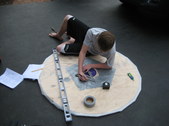
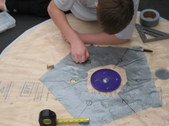
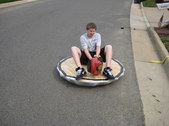
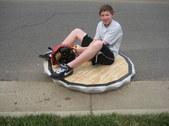
I built a hovercraft for a school science project. Using a 48" diameter piece of 3/8" plywood, .6 mil plastic sheeting for the skirt and a gas leaf blower for power, the hovercraft successfully carried me down the road on a cushion of air.
Date(s): 3/21/2010. Album by Ryan Vierregger. Photos by The Vierregger's. 1 - 28 of 28 Total. 767 Visits.
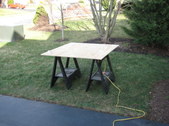
1 A 48" x 48" piece of 3/8" plywood is a soon-to-be hovercraft.
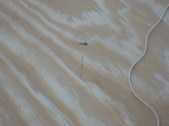
2 The hovercraft is supposed to be round, so we need to make a 48" diameter circle. I started by finding the center, using two strings run from corner to corner.
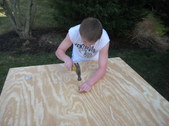
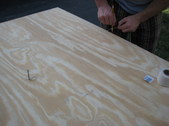
3 I pounded in a nail to mark the center of the circle.
4 Next, I measured a 24" piece of string and tied it to the nail. We used the string to draw a 48" diameter circle.
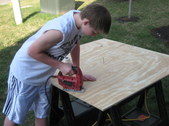
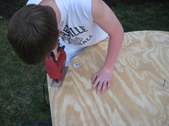
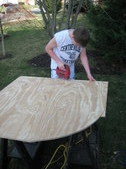
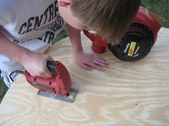
5 I used a saber saw to cut out the circle.
6
7
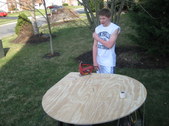
8 Almost done.
9 To make sure the edges of the hovercraft don't tear the plastic skirt, I sanded them smooth.
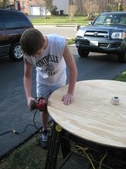
10 The gas engine from our leaf blower will power the hovercraft. I outlined the blower hole on the plywood, then used the sabre saw to cut out the opening.
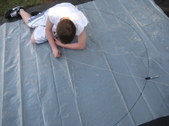
11 I am using a sheet of .6 mil thick plastic sheeting for the skirt of the hovercraft. I used a string to mark off a 6 ft diameter circle on the plastic.
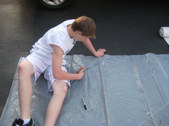
12 I used scissors to cut out the circle.
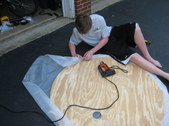
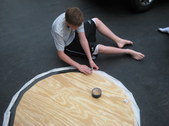
13 I laid the plywood on top of the plastic, then folded the plastic up and stapled it to the top of the hovercraft using an electric staple gun. I left about 1" of slack around the outside to allow room for the skirt to expand.
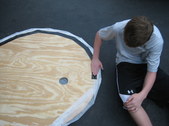
14 To keep air from escaping, I used duct tape to seal the plastic sheeting to the top of the hovercraft.
15
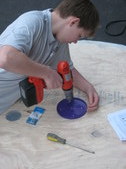
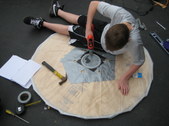
16 I flipped the hovercraft over and attached a plastic reinforcing disc to the center. I used 4 1/4" screws to secure the disc.
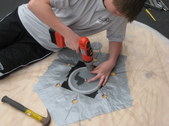
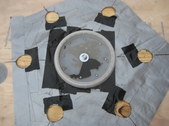
17 My experiment involves evaluating the effect of different size vent holes in the skirt. I used duct tape around the center disc to reinforce the areas where I will cut the skirt vents.
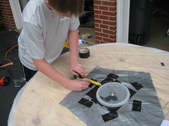
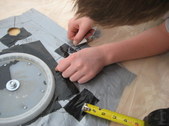
18 The plan uses 6 vent holes spaced evenly around the plastic disc, 3" away from the disc. I used my geometry to mark vent holes every 60 deg.
19 My experiment will use 1" vent holes, then 1.5, 2, 2.5 and finally 3" vent holes. I will evaluate the effect of increasing vent holes on the operation of the hovercraft. I used to razor blade to cut out the vent hole openings.
20 Trial run with 1" holes is a success!
21 Steering is a problem, and I found I have to make sure I'm sitting near the center of the hovercraft to lift evenly. Otherwise, the hovercraft rides along smoothly using the leafblower engine. Stopping on the road involves lifting the motor out of the blower hole.
22 After the trial run, I discovered that the skirt ripped around the center disc, because the disc wasn't rigid enough. I repaired the tears using duct tape, then went looking for another disc to use. I found and used the top to a small bucket of baseballs instead. This time, I used eight screws to attach the disk, along with a carriage bolt and washer in the middle.
23
24 The new disc was slighly bigger so I covered the original 1" vent holes and made the new 1.5" vent holes 3" from the new disc.
25 I used a razor blade to cut out the larger vent holes for the 2nd experiment.
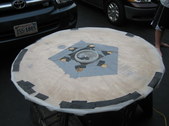
26 This is a picture of the skirt with 2" vent holes. 1", 1.5" and 2" vent holes all worked. 2" was the best of the three. I was able to easily travel about 50 yards down the road.
27 One problem with testing the hovercraft on the road is that every time I stop, the skirt deflates and the hovercraft skids to a stop. The contact with the asphalt makes holes in the plastic skirt. You can see where I used duct tape to seal the holes. I need to continue my tests with 2.5" and 3" vent holes to complete my experiment.
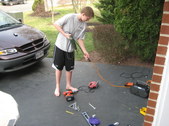
28 Putting the tools away at the end of the day is as bad as cleaning my room!