 Lima - Plaza Mayor Lima - Plaza Mayor
Plaza Mayor - the heart of the historic center of Lima - is flanked on one side by the Palacio de Gobierno (President's Palace), one side by the Catedral and the other sides by commercial buildings.
|  Lima - Archbishop's Palace Lima - Archbishop's Palace
Constructed in 1924, the Archbishop's Palace is located on the same side of the Plaza Mayor as the Catedral.
|  Lima - Archbishop's Palace Lima - Archbishop's Palace
The Archbishop's Palace features several Moorish-style, wooden balconies. There are free walking tours (in English) of the downtown area that are given twice daily.
|  Lima - Archbishop's Palace Interior Lima - Archbishop's Palace Interior
The Palace has recently been reopened after extensive interior renovation work.
|
 Hostal El Patio - Lima Hostal El Patio - Lima
View of the courtyard at Hostal El Patio - where we stayed for a few nights. But the other recommended place we stayed was Hotel San Antonio Abad also in Miraflores area. Although El Patio has a more central location, San Antonio -with free airport pick-up and a terrific breakfast - just may edge out El Patio.
|  Lima - Huaca Pucllana Lima - Huaca Pucllana
An ancient ceremonial center - built about 400 AD - is located in the heart of the Miraflores area of Lima.
|  Lima - Huaca Pucllana Lima - Huaca Pucllana
The adobe bricks are assembled in a V-shaped pattern to strengthen the wall's structure.
|  Lima - Peruvian Hairless Dog Lima - Peruvian Hairless Dog
The Peruvian Hairless Dog has been around Peru for at least 4,000 years. They were revered by the ancient cultures as both guardians and guides of the dead.
|
 Lima - Peruvian Hairless Dog Lima - Peruvian Hairless Dog
They have often been used as animal bed warmers because the dogs have an unusually high body temperature. They also make excellent sight dogs for the blind. It was declared a distinct breed in 1986.
|  Lima - Larco Museum Lima - Larco Museum
Museo Larco contains the largest collection of Peruvian ceramics in the world. The mitt-shaped ceramic depicts sacrificial victims being tossed off a mountainside.
|  Cajamarca - Iglesia San Francisco Cajamarca - Iglesia San Francisco
Nestled in the northern range of the Andes, Cajamarca sits at about 9,000 feet above sea level. The San Francisco church borders the Plaza de Armas (visible in the front of the photo). Although church construction began in the 17th century, it has only recently been completed.
|  Cajamarca - Street scene Cajamarca - Street scene
Cajamarca is often compared to Cusco - the Cusco of 30 years ago. Don Paco is our choice for the best eats in town. Find it at the street address: Puga 726.
|
 Banos Del Inca - Outside Cajamarca Banos Del Inca - Outside Cajamarca
These thermal baths were being used by the Inca king Atahaulpa at the time Pizarro arrived in 1532. Only a 10-minute taxi ride from Cajamarca.
|  Banos Del Inca - Outside Cajamarca Banos Del Inca - Outside Cajamarca
View across the thermal baths. There are private bathing rooms and public thermal pools. Click here to watch this steamy video
|  Banos Del Inca - Outside Cajamarca Banos Del Inca - Outside Cajamarca
Sign above an outdoor thermal bath warning caution - about 106 degrees Fahrenheit. Click here to watch a bubbling video
|  Los Pinos Inn - Cajamarca Los Pinos Inn - Cajamarca
The place we stayed - Los Pinos Inn - is a gilded mirrored oddity with superb rooms on its top floor. A view of one of common area parlors - complete with a suit of armor and a deer in the fireplace.
|
 Cumbe Mayo - Outside Cajamarca Cumbe Mayo - Outside Cajamarca
A few miles southwest of Cajamarca is the highland area known as Cumbe Mayo. The area contains many strange rock formations collectively known as the Bosque de Piedras (Forest of Stone).
|  Cumbe Mayo - Outside Cajamarca Cumbe Mayo - Outside Cajamarca
Constructed in approximately 1000BC, the pre-Inca canal/ aqueduct may be among some of the oldest man-made structures in South America. The canal runs for about 5 1/2 miles.
|  Cumbe Mayo - Outside Cajamarca Cumbe Mayo - Outside Cajamarca
Cumbe Mayo (Quechua for "well made water channel") carried water - through a series of tunnels and canals - from the Atlantic to the Pacific watershed (from the east to west side of the Andes range).
|  Cumbe Mayo - Outside Cajamarca Cumbe Mayo - Outside Cajamarca
Local woman selling food and drink the Cumbe Mayo area.
|
 Cajamarca - The Ransom Chamber Cajamarca - The Ransom Chamber
El Cuarto del Rescate was the room where Inca leader Atahaulpa was imprisoned by the Spanish. It is the only surviving Inca construction in Cajamarca. The room was to house Atahaulpa's gold ransom; this has since been disputed.
|  Ventanillas de Otuzco Ventanillas de Otuzco
Located a few miles further from Cajamarca than the Banos, the "windows" were actually pre-Inca burial chamber.
|  Ventanillas de Otuzco Ventanillas de Otuzco
The tombs, where Cajamarca chiefs were supposedly buried, were carved into the hillside's volcanic stone.
|  Ventanillas de Otuzco Ventanillas de Otuzco
|
 Ventanillas de Otuzco Ventanillas de Otuzco
The Ventanillas can be seen via a well marked walking path in from the main roadway.
|  Museo de las Tumbes Reales de Sipan - Lambayeque Museo de las Tumbes Reales de Sipan - Lambayeque
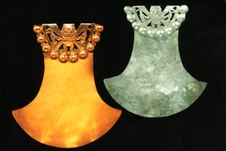
Renowned as one of the best museums in South America, Museo Tumbes Reales de Sipan is a recent addition to Peru's museum scene. It is built in a style reminiscent of a Moche pyramid.
|  Museo Tumbes Reales de Sipan - Lambayeque Museo Tumbes Reales de Sipan - Lambayeque
In 1987, an undisturbed royal tomb was found on the outskirts of Chichlayo. One enters the museum on the top floor, only to work your way down to the tomb on the bottom floor.
|  Museo de las Tumbes Reales de Sipan - Lambayeque Museo de las Tumbes Reales de Sipan - Lambayeque
|
 Museo Tumbes Reales de Sipan - Lambayeque Museo Tumbes Reales de Sipan - Lambayeque
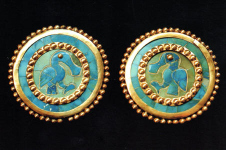
Earrings or - more accurately - ear studs from the royal tomb.
|  Museo Tumbes Reales de Sipan - Lambayeque Museo Tumbes Reales de Sipan - Lambayeque
|  Museo Tumbes Reales de Sipan - Lambayeque Museo Tumbes Reales de Sipan - Lambayeque
Gold spider necklace. The reverse design has serpent and cross forms.
|  Museo Tumbes Reales de Sipan - Lambayeque Museo Tumbes Reales de Sipan - Lambayeque
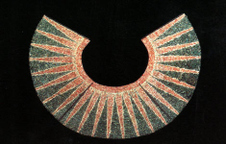
Beaded neck piece.
|
 Mercado Modelo - Mercado de Brujos - Chiclayo Mercado Modelo - Mercado de Brujos - Chiclayo
The entrance to the witches market in the Mercado Modelo in Chichlayo. It is one-stop shopping for any local shaman.
|  Mercado Modelo - Mercado de Brujos Mercado Modelo - Mercado de Brujos
A wide assortment of charms and amulets are available as well as hallucinogenic cacti (San Pedro cacti) as pictured here.
|  Mercado Modelo - Mercado de Brujos Mercado Modelo - Mercado de Brujos
They have a medicine or an herb for whatever ails you - from pain relievers to love potions.
|  Tucume - Valley of the Pyramids Tucume - Valley of the Pyramids
This area - about 20 miles north of Chichlayo - is home to 26 pyramids, in various states of erosion.
|
 Tucume - Valley of the Pyramids Tucume - Valley of the Pyramids
El Purgatorio (the place to purge) has the best views in the area - as can be seen from this vulture's point of view. This spot is still used by local curanderos (healers) for shamanic rituals. Tucume has a reputation among locals as magical place.
|  Tucume - Valley of the Pyramids Tucume - Valley of the Pyramids
All were made with adobe (mud, straw and water) bricks. The Sican culture began here in about 1100 AD. There is evidence that the Sican people traded with others in what is modern-day Ecuador and Columbia. They were expert seafarers.
|  Tucume - Valley of the Pyramids Tucume - Valley of the Pyramids
At its peak in the 13th and 14th centuries, Tucume was probably a pilgrimage site. It was later conquered by the Chimu and the Inca. But by the time the Spanish arrived, it was already in ruins.
|  Tucume - Valley of the Pyramids Tucume - Valley of the Pyramids
An owl in the woods bordering Tucume. Thor Heyerdahl found at Tucume inspiration to support his theory that there was a link between coastal Peruvian cultures and south Pacific peoples.
|
