 Petronas Towers, Kuala Lumpur Petronas Towers, Kuala Lumpur
At the time, they were considered to be the tallest buildings in the world (if you include their antenna-like masts). Completed in 1998, these 88-story buildings are the symbol of the "new Malaysia".
|  Kuala Lumpur train station Kuala Lumpur train station
Built in 1911, this British-constructed train station is a Moorish-inspired melange of spires, towers and arches.
|  Batu Caves Batu Caves
The Batu Caves are the site of a yearly masochistic ritual where hundreds of Hindu devotees pierce their skin with hooks (that attach to small pots of milk!) and trek up this 272-step entry. A Hindu shrine awaits inside.
|  Bako National Park, Borneo Bako National Park, Borneo
On the way to Sarawak's oldest national park - Baku. Over 50 miles of trail wind through Baku's dense jungle. Long-tailed macaque monkeys can be seen in abundance. But be warned that they are aggressive theives -slyly snatching bags and cameras away from the unaware.
|
 Kuching, Borneo Kuching, Borneo
Early morning view taken from our hotel room window (through glass).
|  Orangutans Orangutans
Orangutans heeding the feeding call at the Semenggok Wildlife Rehabilitation Centre, located a few miles outside the city of Kuching. It is only one of three orangutan rehabilitation centers in the world.
|  Close encounter Close encounter
Visitors are not permitted to feed or touch the orangutans. But that doesn't stop you from getting close to them. As in this photo, sometimes you'll even share a walkway with one.
|  Photo Op Photo Op
The Centre seeks to rehabilitate orangutans, monkeys and other animals that have been orphaned or injured by poachers.
|
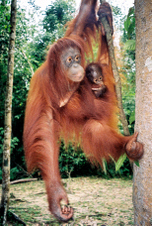 Ready for a close up Ready for a close up
Mother and baby orangutan just hanging out. Orangutans can weigh up to 220lbs and have an armspan of 8 feet. They are the only species of 'great ape' to be found outside of Africa.
|  Batang Ai Reservoir Batang Ai Reservoir
In motorized boats we head out to visit nearby Iban longhouses in Batang Ai National Park. The longhouses are a half hour journey by boat from the only hotel in the park.
|  Welcome to the longhouse Welcome to the longhouse
Gifts are a must for any longhouse visit. Cigarettes and alcohol are preferred but any food item is appreciated.
|  Iban longhouse greeter Iban longhouse greeter
The Ibans are the single largest ethnic group in Sarawak (one of the two Malaysian states on Borneo). The Iban tribespeople used to be headhunters. Emphasize "used".
|
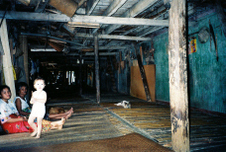 Inside the longhouse Inside the longhouse
The longhouses are traditionally constructed of ironwood. Shoes must be removed once inside. Each family occupies a separate apartment that opens to a central common room which runs the length of the house.
|  Longhouse traditional dance Longhouse traditional dance
|  Ceremonial dress Ceremonial dress
|  Pepper drying on longhouse deck Pepper drying on longhouse deck
Pepper is one of Sarawak's main export.
|
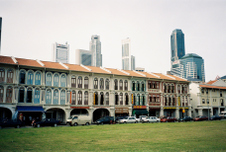 Singapore Singapore
Singapore is located just 1 degree north of the equator. This island country, with a population of 2.7 million, is comprised of one large island and 58 outlying islands.
| 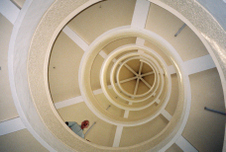 Chinese Gardens, Singapore Chinese Gardens, Singapore
Tower staircase in a building in the Chinese Gardens.
| 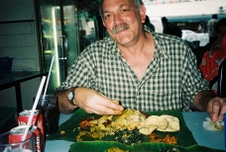 Indian meal served on a banana leaf Indian meal served on a banana leaf
A typical meal at a vegetarian Indian restaurant in Johor Bahru -a Malaysian border town with Singapore.
| 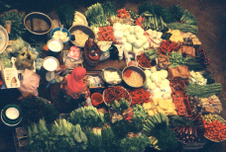 Market view in Kota Bahru Market view in Kota Bahru
The central market in Kota Bharu. Produce is sold on the first floor; clothes and spices are for sale on the two upper levels.
|
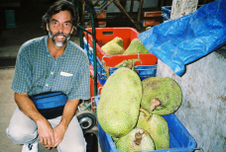 Jackfruit Jackfruit
The fruit of the jackfuit is often combined in ice cream and other desserts in southeast Asia.
| 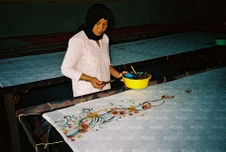 Batik painter in Kota Bahru Batik painter in Kota Bahru
Batik is made by drawing in wax on cloth. The material is then dyed. The wax is melted away. Another wax design can be drawn and another dye applied - depending on the number of colors the painter chooses to include.
| 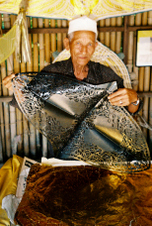 Kite maker Kite maker
Custom-made kites are a specialty of the Kota Bharu area - on the northeastern coast of mainland Malaysia. They are made by applying colored paper over a split bamboo frame.
| 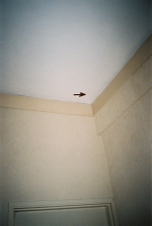 Which direction is Mecca? Which direction is Mecca?
How do you know which direction to pray when you are in a hotel room? Simple. Look for the arrow on the ceiling.
|
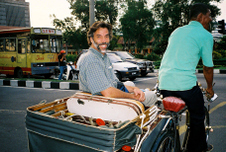 Transport in Kota Bahru Transport in Kota Bahru
A trishaw ride is best and most fun way to travel through the streets of Kota Bharu.
| 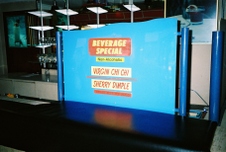 Welcome drink choice at our hotel Welcome drink choice at our hotel
Which would you choose? Alcohol was prohibited in our hotel and in most places - except Chinese restaurants - in Kota Bharu. It was one of the most conservative Moslem cities in Malaysia that we visited.
| 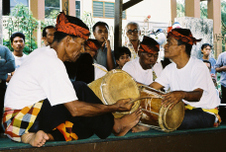 Drumming demonstration Drumming demonstration
At the Gelanggang Seni (cultural center) in Kota Bharu, we were treated to a drumming demonstration.
| 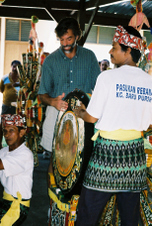 Drumming demonstration Drumming demonstration
The traditional giant drums are made from chisel-cut logs. Each drum requires two players.
|
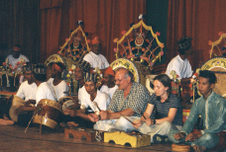 Concert Concert
An evening concert in Kota Bharu where guests are encouraged to participate.
| 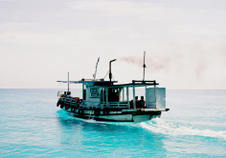 Boat to Perhentian Islands Boat to Perhentian Islands
This is the ferry that you take from the east coast of the Malaysian mainland to the Perhentian Islands. There are no airports on the islands. Besides hitching a ride on the back of a giant sea turtle, this is the only way to get there.
| 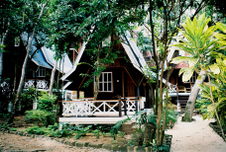 Cottage at the Coral View Inn Cottage at the Coral View Inn
One of the places we stayed on the Perhentian Islands. There are no cars on the islands because there are no roads. You either walk, take a boat or stay put.
| 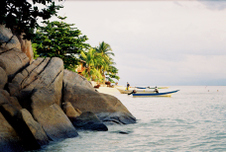 Coast of Perhentian Besar Coast of Perhentian Besar
The Perhentian Islands are composed of two islands - Besar (large) and Kecil (small). Most accomodations are found on Besar.
|
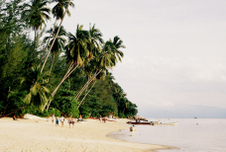 Perhentian Beach View Perhentian Beach View
The crystaline waters of the Perhentians are home to a multitude of otherworldly-colored fish as well as giant sea turtles.
| 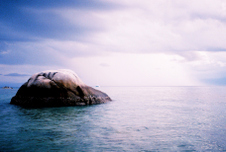 Looming storm Looming storm
During our stay, every evening was puncuated by at least one tropical downpour. A looming storm at sea is approaching in this view.
| 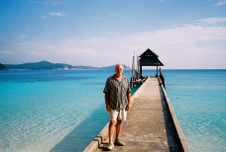 Ferry dock Ferry dock
Ferry dock for the daily boats going to and from the mainland.
| 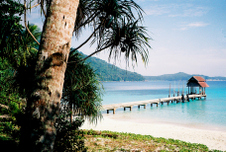 Classic beach view Classic beach view
The Perhentians truly felt like an island paradise. White sand, turquoise water and no nightlife -except for the nocturnal thunderstorms.
|
