 Front of the Central Train Station, Helsinki Front of the Central Train Station, Helsinki
The Art Nouveau front of Helsinki's Rautatieasema (Central Train Station).
|  Tower of the Central Train Station Tower of the Central Train Station
Designed by Finnish architect Eliel Saarinen and completed in 1919, this train station is landmark in downtown Helsinki.
|  Detail of Train Station front Detail of Train Station front
These stone figures, designed by Emil Wikstrom, guard either side of the entrance to the station. Known as lantern bearers, these stone statues are the unofficial mascots of Helsinki.
|  Front of the Central Train Station, Helsinki Front of the Central Train Station, Helsinki
The station has a private 50-square-metre (540 sq ft) waiting lounge exclusively for the use of the President of Finland. The lounge was first completed in 1911 and was originally intended for the private use of the Emperor of Russia. According to Kari Pekka Rosenholm, the former station manager, the lounge is the only one of its kind in the entire world.
|
 Buildings along the Bulevardi Buildings along the Bulevardi
The late 19th and early 20th century stately buildings that line the Bulvardi were originally all private residences. Now the ground floor areas of these buildings are filled with fashionable shops and cafes.
|  Glimpse of the Tuomiokirkko Glimpse of the Tuomiokirkko
The Tuomiokirkko (Lutheran Cathedral) can be glimpsed through the narrow street near the waterfront.
|  Kauppatori Stall Kauppatori Stall
In the summer, outdoor eating stalls fill the kauppatori or central market square.
|  Reindeer kebabs for sale Reindeer kebabs for sale
One of the many signs advertising reindeer meat kebabs - cooked fresh and accompanied by french fries. A recent article suggests that the Nordic diet -consiting of reindeer meat - may be even healthier than the Mediterranean diet!
|
 Kauppatori Stall Kauppatori Stall
On warm summer days, the kauppatori is the place to eat lunch or an early dinner. Reindeer meat, salmon steaks, tiny potatoes and salmon soup are some of the most common food offerings.
|  Reindeer meatballs Reindeer meatballs
Reindeer meatballs served the baby potatoes and string beans. Meals are served on paper plates; patrons eat their dinners at one of the picnic tables adjacent to the stand.
|  Kauppatori Stall Kauppatori Stall
Besides cpooked food, the stalls at the kauppatori sell plenty of fresh berries, fruits, vegetables and herbs. On weekends, souvenir stands predominate.
|  Lower overhead; sell from your boat Lower overhead; sell from your boat
Some vendors sell fish and vegetables directly from their boats moored along the wharf.
|
 Gravlox for sale in the kauppahalli Gravlox for sale in the kauppahalli
In the harborside kauppahalli (a market in a large brick building), many stands sell various forms of gravlox. This one was selling gravlox with peppercorns.
|  Berries are king! Berries are king!
In the summer, Helsinki outdoor stands sell an astonishing assortment of berries - blueberries, wild strawberries, raspberries, etc. Because of the long summer days, the growing season is also long.
| 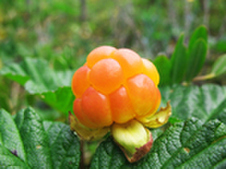 Cloudberry Cloudberry
There are 37 edible species of wild berries in Finland. But only about twenty species are picked for consumption. The cloudberry, one the most popular and among the most expensive berry in Finland. It is rich in vitamin C. When eaten fresh, cloudberries have a distinctive tart taste.
|  Salted licorice ice cream Salted licorice ice cream
Dark, salted licorice ice cream on a stick and covered with a licorice coating. You either love it or hate it.
|
 Licorice sundae Licorice sundae
Salty licorice or salmiakki is a variety of licorice that gets its name from the relatively large amount of sal ammoniac (Latin traditional name for ammonium chloride, a salt of ammonia) that it contains in addition to the liquorice root extract, sugar and starch or gum arabic that constitute regular liquorice.
|  Exterior of the Strand Hilton Exterior of the Strand Hilton
Our first two nights were spent at this bayside Hilton. It was close to downtown and had a terrific view.
|  Moonlight in Helsinki Moonlight in Helsinki
This was taken after 10:00 at night on our first night in Helsinki from a balcony of the Hilton Strand.
| 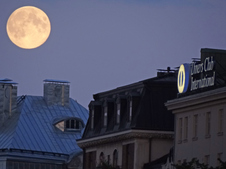 Moon rising over Helsinki Moon rising over Helsinki
Just a little later that night.
|
 View of Suomenlinna Island View of Suomenlinna Island
A short ferry ride takes you to the harbor's Suomenlinna Island - home to Helsinki's 18th century fortress.
|  Fortress View Fortress View
A view from the fortress looking away from Helsinki and toward the Baltic Sea. Situated on a group of islands off Helsinki, Suomenlinna was built during the Swedish era as a maritime fortress and a base for the Archipelago Fleet.
|  Sea from from Suomenlinna Sea from from Suomenlinna
The Swedes did not last long. Shortly after completion - in 1808, the Russians invaded and held control of the fortress unless Finnish independence.
|  Gun powder cellars Gun powder cellars
A gun powder cellar covered
in turf. Inside is a vaulted chamber for gunpowder barrels surrounded by a vaulted ventilation corridor. The gunpowder cellar was built from 1776 to 1778 and covered in turf on three sides.
|
 Suomenlinna cannon Suomenlinna cannon
Work on the fortress was begun in the mid-18th century. Today, it is a UNESCO World Heritage Site. Suomenlinna is also a district of the city of Helsinki, with a permanent population of more than 800.
|  Entrance to Temppeliaukio Kirkko Entrance to Temppeliaukio Kirkko
The "Rock Church" was conceived of by Tim and Tuomo Suolmalainen and completed in 1969.
|  Rock Church interior Rock Church interior
The brothers Suomalainen literally blasted the church out from a large rock outcropping in a residential district of Helsinki.
|  Rock Church interior Rock Church interior
The interior carved rock walls are joined at the top by a dome created with copper wire dividing and supporting 180 slabs of glass.
|
 View through the dome View through the dome
The residential buildings and blue sky appear through the blinds of glass and copper. We also spend a night at the nearby Hostel Academica. The hostel is in a university dorm and subsequently only open in the summer.
|  Interior of the Rock Church Interior of the Rock Church
The excellent acoustic quality of the church is ensured by the rough, virtually unworked rock surfaces. The architect brothers consulted conductor Paavo Berglund and acoustical engineer Mauri Parjo to achieve the best acoustical conditions for musical performances.
|  An exterior view of the dome An exterior view of the dome
The dome - from the outside - has been said to look like a flying saucer that just happened to land on this giant rock pile.
|  Exterior of the Parliament Buiding Exterior of the Parliament Buiding
The Finnish Parliament Building was completed in 1931 to celebrate the new republic. Free, one-hour tours in English are given every Monday.
|
 Plenery Session Hall Plenery Session Hall
The Finnish Parliament(Eduskunta) is a unicameral legislature. The Eduskunta's 200 representatives are elected directly by secret ballot on the basis of proportional representation. The term of office is four years.
|  Cafeteria for the members of Parliament Cafeteria for the members of Parliament
The main dining hall for the members of Parliament - simple, functional and unpretentious.
|  Session Hall Session Hall
The President consults the Speaker of Parliament and with representatives of the parliamentary groups about the formation of a new Council of State (Government). According to the constitution, the Eduskunta elects the Prime Minister, who is appointed to office by the President.
|  Paternoster Elevators in Parliament Hall Paternoster Elevators in Parliament Hall
The paternoster lift consists of a series of open elevator compartments (each usually designed with space for only two persons) that moves slowly -in a continuous loop - between floors without stopping. Passengers can step on or off at any floor - but they have to be careful to time it just right.
|
 Helsinki Arts Festival Helsinki Arts Festival
The Helsinki Arts Festival is the largest arts festival in Finland. The festival's aim is to make art accessible for all. On Friday August 26, was the Night of the Arts Parade.
|  Creating animal puppets for the Night of Arts Creating animal puppets for the Night of Arts
Free public workshops were run across the city on the afternoon preceding the evening's parade. Anyone - of any age - was welcome to create their own animal/creature.
| 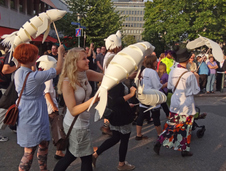 Animals Visiting the City Parade Animals Visiting the City Parade
When the workshops ended, the festival culminated in an open air procession - beginning at about 7:00 pm - throughout the city.
|  Animals Visiting the City Parade Animals Visiting the City Parade
South African artist Roger Titley and Airan Berg from Israel helped participants bring to life the animals of Finland's forests -bears, wolves, moose and owls - as well as other fantastic creatures.
|
