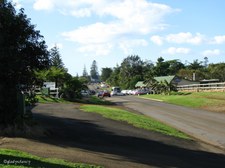
 Approaching Burnt Pine Township Approaching Burnt Pine Township
Walking along Taylors Road and utilizing free time to attempt to reach the Botanic Gardens.
| 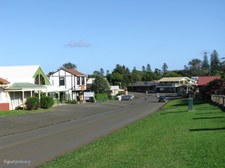 Passing through Burnt Pine Passing through Burnt Pine
After looking at the Sunday Local Markets, continued walking up Grassy Road.
| 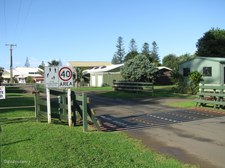 Cattle Grid Cattle Grid
Cattle are now kept out of the central business area by these cattle grids which were installed across the roads about 10 years ago. Prior to that, cattle roamed through the shopping area.
|  Burglars Lane Burglars Lane
Couldn't resist a pic of this sign!
|
 Macadamia Nut Tree Macadamia Nut Tree
The mature tree grows to a height of 12-15m, with dark shinny leaves and branches that bear long sweet smelling racemes of creamy white flowers. Come summer each spray of 40-50 flowers produces 4-15 ‘nutlets’ which, eventually ripen into large clusters of nuts flowers. The macadamia kernel is safely stored within a hard shell.
|  Macadamia Nuts Macadamia Nuts
|  Epiphytes on the Macadamia Nut Tree Epiphytes on the Macadamia Nut Tree
Epiphytes are plants which grow above the ground surface, using other plants or objects for support. They are not rooted in the soil nor are they parasitic (ie they do not directly harm the other plant). By growing on other plants, the epiphytes can reach positions where the light is better or where they can avoid competition for light.
|  Epiphytes on the branches Epiphytes on the branches
Most Epiphytes are found in tropical and sub-tropical climates where they thrive on humidity and fresh air.
|
 Colourful new growth Colourful new growth
Macadamia Nut Tree.
| 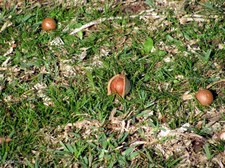 Fallen Macadamia Nuts Fallen Macadamia Nuts
Macadamias are considered the world’s finest nut and are the only native Australian plant to become an international food.
|  Pampas Grass Pampas Grass
Standing proud and tall.
|  Naked Frangipani Naked Frangipani
The Frangipani looses it leaves during winter.
|
 Large Poinciana Tree Large Poinciana Tree
|  Two friendly Horses Two friendly Horses
|  Hello Horse Hello Horse
|  Horses in dappled sunlight Horses in dappled sunlight
|
 Goodbye Horses Goodbye Horses
Time to leave the horses and keep walking up the hill.
|  Orb Weaver with Cocoon Orb Weaver with Cocoon
|  Looking back down the hill Looking back down the hill
|  Entrance to Whispering Pines Entrance to Whispering Pines
The National Park can be seen in the distance.
|
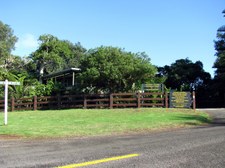 Entrance to the Botanic Gardens Entrance to the Botanic Gardens
This was a 45 minute walk from the Hotel.
| 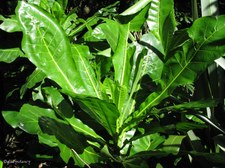 Broad-Leafed Meryta (Meryta latifolia) Broad-Leafed Meryta (Meryta latifolia)
One of Norfolk's rare endemic species, the Meryta has the added disadvantage of being dioecious, which means it has separate male and female plants. When numbers become low this can be a critical factor, if trees of both sexes are not growing close enough for the female flowers to be pollinated by the male. This woody plant grows with a single stem or very few branches, up to 3 or 4m and bears its leaves in a clump at the end. It is endemic to Norfolk Island, as is its relative Meryta angustifolia, which has much narrower leaves. Convicts are recorded as having used the large leaves of Meryta to wrap up dough to bake in the ashes.
|  Broad-Leafed Meryta (Meryta latifolia) Broad-Leafed Meryta (Meryta latifolia)
Meryta latifolia. Very rare and endangered.
|  Twisted Vines Twisted Vines
|
 Young Norfolk Island Pine Young Norfolk Island Pine
Araucariaceae: Araucaria heterophylla. Endemic to Norfolk Island and has self-sown on Lord Howe Island.
|  Golden Orb Weaver Golden Orb Weaver
|  Norfolk Treefern (Smooth Treefern) Norfolk Treefern (Smooth Treefern)
This attractive treefern is common in the gullies of the National Park and is occasionally seen elsewhere on the island. The trunk is usually up to 5m but heights of 20m have been recorded in the past and it is in the Guiness Book of Records as the tallest treefern species in the world. It is distinguished from the Rough Treefern by the smoother trunk.
|  Norfolk Treefern (Smooth Treefern) Norfolk Treefern (Smooth Treefern)
Cyatheaceae: Cyathea brownii. Endemic to Norfolk Island and common in the gullies of the National Park.
|
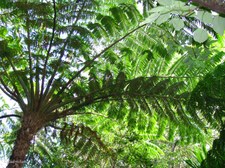 Norfolk Treefern overhead Norfolk Treefern overhead
This attractive fern is common in the gullies of the National Park. Early settlers found that the treeferns provided good food for hogs, sheep and goats.
| 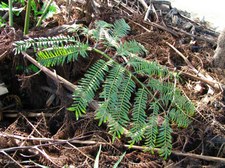 King Fern (Marattia salicina) King Fern (Marattia salicina)
Native to Norfolk Isalnd and New Zealand. A large robust fern found in the vicinity of Mt Pitt.
|  Phillip Island Hibiscus Phillip Island Hibiscus
Malvaceae: Hibiscus insularis. Endemic to Norfolk Island.
|  Phillip Island Hibiscus Phillip Island Hibiscus
The entire wild population of this plant is confined to just two patches on Phillip Island.
|
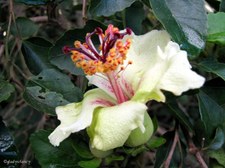 Phillip Island Hibiscus Phillip Island Hibiscus
Flowers are cream to light green coloured when they first open, with a dark magenta centre, but turn reddish as they age.
|  Norfolk Island Palm Norfolk Island Palm
Arecaceae: Rhopalostylis baueri. Endemic to Norfolk Island. This stout palm was named in honour of the artist Ferdinand Lucas Bauer who accompanied Lieutenant M. Flinders on his Australian voyage of exploration and who collected specimens on Norfolk Island in 1804-1805.
|  Epiphytes on trunk of Norfolk Island Palm Epiphytes on trunk of Norfolk Island Palm
|  New Frond on Fern New Frond on Fern
|
 Sub-tropical Rainforest Sub-tropical Rainforest
|  Feral Fowl on Forest Floor Feral Fowl on Forest Floor
| 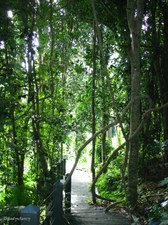 Boardwalk through the Forest Boardwalk through the Forest
| 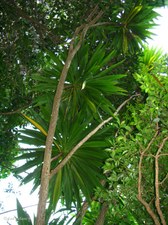 Green canopy overhead Green canopy overhead
|
