 1 1
Baby Tasmanian Devil
A cute baby Tasmanian Devil (Sarcophilus harrisii) at East Coast Nature World.
|  2 2
Tasmanian Devil
A battle-scarred Tasmanian Devil at East Coast Nature World. The Tasmanian devil cannot be mistaken for any other marsupial. Its spine-chilling screeches, black colour, and reputed bad-temper, led the early European settlers to call it The Devil. Although only the size of a small dog, it can sound and look incredibly fierce.
|  3 3
Tasmanian Devil
The world's largest surviving carnivorous marsupial, the Tasmanian Devil has a thick-set, squat build, with a relatively large, broad head and short, thick tail. The fur is mostly or wholly black, but white markings often occur on the rump and chest. Body size also varies greatly, depending on the diet and habitat. Adult males are usually larger than adult females. Large males weigh up to 12 kg, and stand about 30 cm high at the shoulder.
|
 4 4
Tasmanian Devil
Devils are widespread in Tasmania from the coast to the mountains. They live in coastal heath, open dry sclerophyll forest, and mixed sclerophyll-rainforest -- in fact, almost anywhere they can hide and find shelter by day, and find food at night.
|  5 5
Tasmanian Devil
The Tasmanian Devil is mainly a scavenger and feeds on whatever is available. Powerful jaws and teeth enable it to completely devour its prey, bones, fur and all. Wallabies, and various small mammals and birds, are eaten, either as carrion or prey. Reptiles, amphibians, insects and even sea squirts have been found in the stomachs of wild devils. Carcasses of sheep and cattle provide food in farming areas. Devils maintain bush and farm hygiene by cleaning up carcasses. Devils are famous for their rowdy communal feeding at carcasses, the noise and displays being used to establish dominance amongst the pack.
|  6 6
Forester Kangaroo
Forester Kangaroo (Macropus giganteus) is the largest marsupial in Tasmania and the second largest in the world -- males can reach over 60 kg and, when literally on tippy toes, stand 2 m tall! Colour varies from light brownish grey to grey. They have relatively large ears and differ from the other two species in having hair between the nostrils and upper lip. They often make clucking sounds between themselves and give a guttural cough when alarmed. The Forester kangaroo is restricted to northeastern Tasmania and small areas in central Tasmania. The species is common on mainland Australia, where it is commonly known as the grey kangaroo.
|
 7 7
Bennetts Wallaby
Bennetts Wallaby (Macropus rufogriseus) is also known as the Red-necked Wallaby on mainland Australia.
|  8 8
Bennetts Wallaby
Bennetts Wallabies are found throughout Tasmania, including the Bass Strait islands. The species is largely solitary, allthough loose groups, known as mobs, often share common feeding areas. They feed at afternoon and dusk, generally grazing on grass and herbs. There is a distinct breeding season, with births occuring late summer to early autumn. This is in contrast to mainland populations of the same species, where births occur year round. The gesatation period is 30 days. Pouch life is about 280 days and weaning occurs at 12-17 months.
|  9 9
Sleepy Koala
The Koala has been introduced to Tasmania from mainland Australia and is one of Australia's best known animals. They are very placid animals, do not move around much and are only active for about 2 hours of the day.
|
 10 10
Tasmanian Pademelon
The Tasmanian Pademelon (Thylogale billardierii) is a stocky animal with a relatively short tail and legs to aid its movement through dense vegetation. It ranges in colour from dark-brown to grey-brown above and has a red-brown belly. Males, which are considerably larger than females, have a muscular chest and forearms, and reach up to 12 kg in weight and 1 - 1.2 m in overall length, including the tail. Females average 3.9 kg in weight.
|  11 11
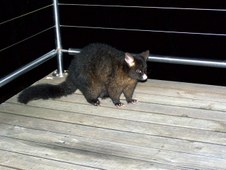
Brushtail possum (Trichosurus vulpecula)
The brush tailed possum is one of seven species and is about the size of a cat. It has a pointy snout and a pink nose. Its whiskers are long. They can grow to as big as 550mm long plus a tail which is another 250-400mm long. The tail is prehensile and assists the sharp claws in climbing trees. They are furry and those in Tasmania are furrier as they have adapted to the colder climate.
|  12 12
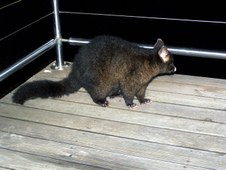
Brushtail possum (Trichosurus vulpecula)
These possums live in gum trees, their nests usually hidden away in the forks of branches.
|
 13 13
Tiger Snake
Tiger Snake (Notechis scutatus) at East Coast Natureworld. Tasmania has three species of Snake, the Tiger Snake is the most common and hard to distinguish from the Lowlands Copperhead, and the third species is the Whip Snake.
|  14 14
Tiger Snake
Tasmanian Tiger Snake has recently been shown to be the the same species as that which occurs on the south-eastern Australian mainland, (Notechis scutatus). The markings are extremely variable and should not be used in isolation to identify snakes. Colours range from jet black, through yellow/orange with grey bands to sandy grey with no bands. There are unconfirmed reports of red-bellied Tiger snakes in north-east Tasmania. Typical forms are of a black snake with either no bands or faint yellow to cream bands. Dark olive snakes with yellow bands are fairly common.
|  15 15
Tiger Snake
Generally the belly is pale yellow, white or grey, the enlarged ventral scales often edged with black. The head is broad and blunt. It can be difficult to distinguish the Tiger Snake from the Copperhead since sizes, habitat preferences and behaviour overlap somewhat. Tiger Snakes have 13 - 19 rows of scales around the middle of the body, the usual number being 17. On the mainland of Tasmania Tiger snakes reach a length of 1 to 1.8 m. Male tiger snakes reach a greater size than females and have larger heads.
|
 16 16
Climbing Wall of Snake-Pit
Tiger snakes feed mainly on mammals and birds under 300 g in weight. Tiger snakes habitually raid birds nests and have been found climbing trees to a height of 8 m. A good indicator of the presence of a Tiger snake is the alarm calls of small birds such as honeyeaters and thornbills. They also eat other vertebrates including lizards, smaller snakes, frogs and occasionally fish. Juvenile tiger snakes will use constriction to subdue struggling skinks, a principal food of smaller snakes. Adult snakes are also known to use constriction on larger prey as well. Tiger snakes are important predators of introduced rodent pests and readily enter the burrows of mice, rats and even rabbits in search of their quarry.
|  17 17
Underside of Snake
The underside of the Snake as seen through the clear panel in Snake-Pit Wall at East Coast Natureworld.
|  18 18
Snake Head
The highly toxic venom of Tiger Snakes is produced in large amounts. The venom is mainly neurotoxic, affecting the central nervous system, but also causes muscle damage and affects blood clotting. The breakdown of muscle tissue can lead to kidney failure.
|
 19 19
Tasmanian Pademelon (Thylogale billardierii)
The Tasmanian Pademelon is a stocky animal that weighs up to 10 kilograms, and has thick grey to brown fur with a reddish coloured belly, (the reason it is sometimes called the red bellied Pademelon).
|  20 20
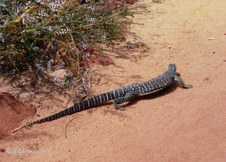
167-Goanna
Australian Wildlife at Kalbarri.
|  21 21
168-Goanna
Australian Wildlife at Kalbarri.
|
 22 22
169-Goanna
Australian Wildlife at Kalbarri.
|  23 23
170-Goanna
Australian Wildlife at Kalbarri.
|  24 24
171-Goanna
Australian Wildlife at Kalbarri.
|
 25 25
Quokka (Setonix branchyuras)
The Quokka is found in Western Australia, mainly on Rottnest Island. Quokkas usually feed at night on grasses or leaves, however they can go for long periods of time without feeding or water.
|  26 26
Quokka (Setonix branchyuras)
Quokkas resemble a small wallaby, with small rounded ears, and brown or greyish fur. These animals breed year round, and have a gestation period of 4 months before a new joey is born. The joey lives in its mother's pouch for the first 25 weeks of its life. After leaving the pouch, the joey continues to suckle at its mother's teets for a further 10 weeks.
|  27 27
A friendly Quokka
On Rottnest Island, Western Australia.
|
 28 28
Kangaroo Breakfast
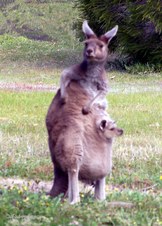
Mother with baby Joey in pouch.
|  29 29
Mother with Joey
A baby Kangaroo is called a Joey.
|  30 30
Both Eating
Mother and Baby both nibbling grass.
|
 31 31
Baby Eating Grass
The Joey is enjoying the grass too.
|  32 32
Smile for the Camera
|  33 33
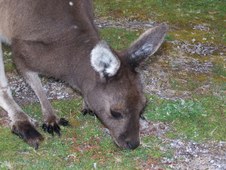
Kangaroo close-up
|
 34 34
Mother and Joey
|  35 35
Kangaroo
|  36 36
Kangaroo in Scrub
Kangaroo looking to see who is coming.
|
 37 37
Kangaroo in the Wild
Another Kangaroo nearby at Pt Ann.
|  38 38
Bobtail Lizard
This one was basking in the Sun on the edge of the road.
|  39 39
Bobtail Lizard
Not happy at being disturbed!
|
 40 40
Bobtail Lizard
Open Wide!! See my Blue Tongue!!
|  41 41
Koala
(Phasclarctas Cinereus). The name Koala comes from an Aboriginal word. It means "no drink", as Koalas get enough fluids through the eucalyptus leaves they feed on.
|  42 42
White Kangaroos
At Wave Rock Wildlife Park, Hyden, Western Australia.
|
 43 43
White Kangaroos
At Wave Rock Wildlife Park, Hyden, Western Australia.
|  44 44
Kangaroo Resting
At Wave Rock Wildlife Park, Hyden, Western Australia.
|  45 45
Red Kangaroo
At Wave Rock Wildlife Park, Hyden, Western Australia.
|
 46 46
Friendly Kangaroo
This Kangaroo species is called a Euro. Such an honour for the Australian Kangaroo to have the European Currency named after it. Millstream-Chichester National Park.
|  47 47
Kangaroo with Joey
This Euro has a Joey in her pouch. Millstream-Chichester National Park.
|  48 48
Kangaroo Close-up
These kangaroos at the Homestead have been orphaned and hand-reared before being re-introduced to the wild. Millstream-Chichester National Park.
|
 49 49
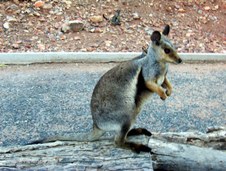
Black-footed Rock-wallaby
The population of this Australian marsupial is now concentrated mostly in the arid regions of central Australia. They live on rocky hills near some sort of vegetation, (a source of food). During the day they will hide out in caves or crevices to escape the heat and will only come out to feed at dusk and dawn when the temperature is cooler.
|  50 50
Black-footed Rock-wallaby
Black-footed Rock Wallabies grow to be about half a metre high and have a long tail up to 52 cm long to secure their balance. Their feet are textured to prevent them from slipping on rocks and they have been seen jumping up to 4 metres to reach another rock.
| |
