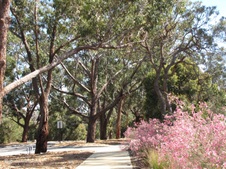
 1 1
Tree-lined path to Naturescape
Come on a photographic journey as I explore this new area.
|  2 2
Pink Geraldton Wax beside the pathway
|  3 3
Sandhill Spider Flower
Grevillea stenobotrya, found in the North West of Western Australia.
|
 4 4
Naturescape poster 1
|  5 5
Naturescape poster 2
|  6 6
Pedestrian entrance to Naturescape
Rio Tinto Naturescape Kings Park covers 60,000 square metres of previously seldom utilised bushland.
|
 7 7
Vegetation viewed from entrance
|  8 8
Massive Ironstone Pillar near "Welcome Sign"
|  9 9
Map of Naturescape
Naturescape comprises a series of unique zones including hidden thickets, a creek, lookouts, a cubby building area, upside-down trees and a wetland. These areas are connected by meandering paths, boardwalks and bridges which offer a feeling of immersion in the bush.
|
 10 10
Walkway to Conservation Area and Prickly Thicket
|  11 11
Conservation area vegetation
|  12 12
Bushland of Conservation Area
|
 13 13
Play area in Prickly Thicket
A place for imaginative play activities, or sit quietly to listen to the sounds of the bush.
|  14 14
Cubby House in Prickly Thicket
Sticks are provided for children to place on the frame to build a Cubby House.
|  15 15
Mangles Kangaroo Paw
Conservation area.
|
 16 16
Green Mulla Mulla
Ptilotus polystachyus.
Conservation area.
|  17 17
Green Mulla Mulla
Ptilotus polystachyus.
Conservation area.
|  18 18
Clumps of Kangaroo Paws surrounded by invasive Freesias
Freesias are not native wildflowers, they are an introduced species which have escaped domestic gardens and spread through bushland areas threatening native species.
|
 19 19
Mangles Kangaroo Paw
Conservation area.
|  20 20
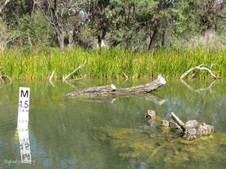
The Billabong
Spot tadpoles and dragonflies here.
|  21 21
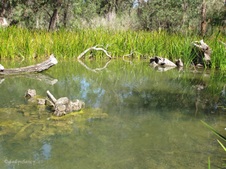
The Billabong
Listen for Frog calls.
|
 22 22
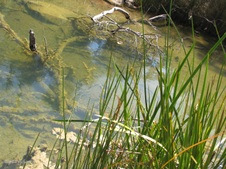
Peering into the Billabong
A place to look for frogs and tadpoles.
|  23 23
Sunlit Woolley Bush behind Ironstone Boulder
|  24 24
Ironstone near the Billabong
|
 25 25
Close up of Ironstone
|  26 26
Where does this Ironstone come from?
The ironstone you see in the site was gifted by the Eastern Guruma people to the Nyoongar community and Kings Park. The red rocks travelled on 10 trucks over 1,440km from Rio Tinto's Tom Price iron ore mine in the Pilbara.
|  27 27
Ironstone from the Pilbara
|
 28 28
Climb a Tree Hide
What can you see?
|  29 29
Tall Tree Hide with view over the park
|  30 30
Use this Log to cross the stream
Or wet your toes in Paperbark Creek..
|
 31 31
Dip your toes in the shallows
|  32 32
The Jetty Wetlands outdoor classroom
A dedicated education zone provides school students with a number of ‘outdoor classrooms’, with tree logs for seating under shady trees, a jetty in the Water Corporation Wetland and a fire pit for evening activities around a camp fire. Kings Park Education explores the interconnected world of plants, animals and people for students from kindergarten to adulthood.
|  33 33
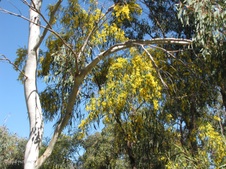
Yellow Wattle blooms overhead
|
 34 34
The Jetty Wetlands
|  35 35
Bridal creeper (Asparagus asparagoides)
Bridal Creeper is a serious, highly invasive environmental weed, destroying large areas of the native vegetation in southern Australia. Native to Ethiopia, Swaziland and the Cape Province, Natal, Orange Free State and Transvaal regions of South Africa. This plant, currently naturalised in Australia, was introduced into the country as a garden plant during the 1870s. It proved popular in floral arrangements, in particular bridal bouquets, giving rise to its common name, and also as a plant for hanging baskets. Bridal creeper is a Weed of National Significance.
|  36 36
Introduced Species, Bridal Creeper, twines over twigs
Bridal creeper (Asparagus asparagoides)
|
 37 37
Invasive Species -- Bridal Creeper
Bridal creeper (Asparagus asparagoides)is a 'Declared Plant' in Western Australia.
|  38 38
A Hide for children to play in
|  39 39
Entering Kulunga Gulley
|
 40 40
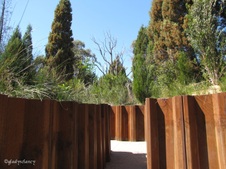
Kulunga Gulley is like a maze
|  41 41
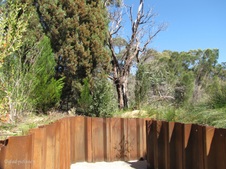
Walking through Kulunga Gulley
|  42 42
Colourful Banksia Bloom
|
 43 43
The Tangle
Climbing Ropes attached to upturned trees.
|  44 44
Upturned Tree makes an anchor post for The Tangle
|  45 45
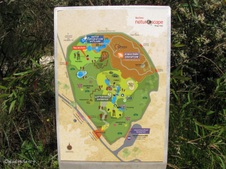
Naturescape Map
|
 46 46
Stinkwood
Jacksonia stembergiana.
|  47 47
Grasstree surrounded by Introduced Freesias
|  48 48
Trampled Plant on a well-trodden path
Although Naturescape has only been open for a few months, I can't help but wonder how the vegetation will cope with all the pedestrian traffic when this plant has been so badly trampled already.
|
 49 49
Plant survival is a struggle
Another plant struggling to survive being trampled by many feet.
|  50 50
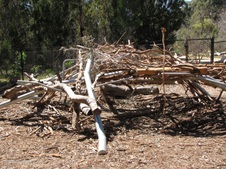
Logs to sit on, sticks for construction
Logs to sit on, a pile of sticks for use by children to build cubby houses, etc.
|  51 51
A Cubby House made of sticks
|
 52 52
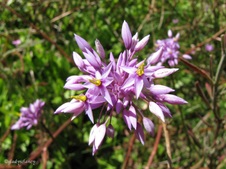
Purple Tassels
Sowerbaea laxiflora
|  53 53
Stinkwood
Jacksonia stembergiana.
|  54 54
Sand Pit and River Rocks for play
|
 55 55
Log makes a Bridge
|  56 56
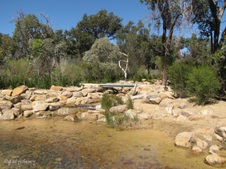
A Paddling Pool
|  57 57
Crawl into the Dingo's Lair
|
 58 58
Another view of Dingo's Lair
|  59 59
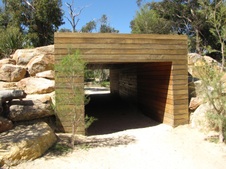
Tunnel through the Hill of Stones
|  60 60
Looking back into the Tunnel
|
 61 61
Milkmaids
Burchardia umbellata.
|  62 62
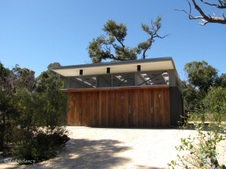
Yes, there are even Toilets!
|  63 63
And a Drinking Fountain!
|
 64 64
Illyarrie Shelter
|  65 65
Illyarrie Shelter
An outdoor classroom where school groups can learn about the environment.
|  66 66
Illyarrie (not in flower at the moment) surrounding shelter
Eucalyptus erythrocorys.
|
 67 67
Logs for Stepping Stones or Seats
|  68 68
Milkmaids
Burchardia umbellata.
|  69 69
Pink Geraldton Wax in surrounding area
|
 70 70
Vegetation includes Pink Geraldton Wax
|  71 71
Red Pokers
Hakea bucculenta.
|  72 72
Weed -- Four O'clock
Oxalis purpurea - Four O'clock - is a small low growing weed to 10cm high.
|
 73 73
Weed -- Four O'clock
Oxalis purpurea
|  74 74
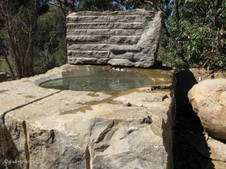
Large Granite Rocks mark the source of The Spring
|  75 75
Water at the top of The Spring
|
 76 76
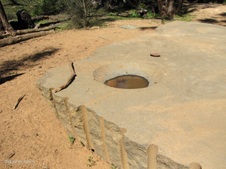
Slab of Granite with Rock Holes for play
|  77 77
Rock Hole in the Granite
Use a stick and mix a magic potion!
|  78 78
Climb another Tree Hide
|
 79 79
Large Granite Boulder
|  80 80
Fumaria capreolata L.
Alien to Western Australia.
Origin. Northern Africa, temperate Asia, Europe Macronesia, northern Africa, Temperate and western Asia, Europe. Similar exotic species. Fumaria muralis.
|  81 81
Weed -- Watsonia species
It saddens me to see so many Introduced Invasive Species and Environmental Weeds in what was once pristine Western Australian Bushland.
|
 82 82
Cowslip Orchid
Caladenia flava.
|  83 83
Milkmaids
Burchardia umbellata.
|  84 84
Donkey Orchid
Diuris corymbosa.
|
 85 85
Donkey Orchid
Diuris corymbosa.
|  86 86
Donkey Orchid
Diuris corymbosa.
|  87 87
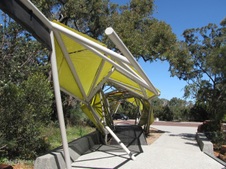
Pedestrian Exit
An interesting experience to bring people to an under-utilised section of Kings Park, but I do wonder how the natural vegetation will withstand the pedestrian wear and tear, and I am horrified at the amount of Environmental Weeds and Introduced Invasive Species that have spread throughout the area.
|
