Perth Zoo began operations in October 1898 and now features magnificent gardens spread over 19 hecares and is home to around 1800 amimals representing 230 different exotic and Australian species. Perth Zoo is a leading conservation agency with successful breeding programs for threatened exotic and native animal species. These photos were taken during visits between 2003-2008.
Showing 1-180 of 18049933 visitsAlbum by gladysclancyPhotos by Gladys
Welcome to Perth Zoo1
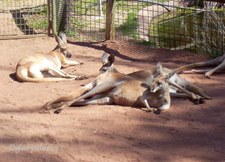
Kangaroos2
Feeding Time for Kangaroos3
Kangaroos4
Australian DingoAustralian Native Dog.5
Southern Hairy-nosed Wombat6
Koala7
Bush Thick-kneeBurhinus grallarius8
Black-necked StorkEphippiorhynchus asiaticus. Often known as Jabiru and grows to 130 cm.9
Cheetah in the GrassThe name cheetah comes from an Indian word meaning 'spotted one'.17
Sumatran Tiger18
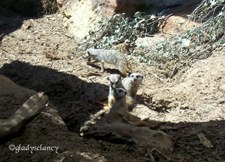
Slender-tailed Meerkats19
Slender-tailed Meerkats20
Australian Native Frangipani(Hymenosporum Flavum). Many colourful species of plants can be seen in the well-maintained gardens at Perth Zoo.21
Orange Clivia22
Wedding Bush (Ricinocarpos pinifolius)23
Clivia24
Little PenguinsEudyptula minor novaehollandiae25
Little Penguins swimming in Pool26
Black Swans and other Waterbirds27
Brolga and other Waterbirds28
Brolga and Waterbirds29
Brolga ReflectionsGrus rubicundus30
Waterbirds31
Australian Pelicans32
Motorbike FrogLitoria moorei33
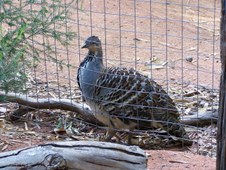
MalleefowlLeipoa ocellata34
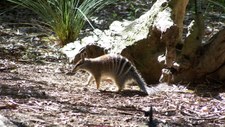
Numbat (Myrmecobius fasciatus)Numbats (also known as Walpurti) are small marsupials, which feed almost solely on termites and consume about 20,000 per day. Because of this, they are also known as the Banded Anteater. When fully grown, they reach about 40 cms from nose to tail.35
Numbat (Myrmecobius fasciatus) (Walpurti)They inhabit woodlands in Western Australia which is the only state where they are found in the wild. To improve numbat numbers, they are bred in captivity at the Perth Zoo and released into selected locations.36
Rock Wallaby37
Dingo resting on the Rock38
Dingo on the Rock39
Australian Boab TreeAdansonia gregorii40
Elephant plays with Blue Drum41
Elephants at Play42
Elephants Playing43
Elephant close-up44
Slender-tailed Meerkat on 'Sentry Duty'45
Here comes the Sumatran Tiger46
Face to Face with Sumatran Tiger47
Sumatran TigerUnfortunately, there are less than 500 Sumatran Tigers left in the wild.48
Pygmy Marmoset (Callithrix pygmaea)Found in the Upper Amazon basin, Pygmy Marmosets are the world’s smallest true monkeys.49
Pygmy Marmoset (Callithrix pygmaea)The fur of this little monkey is a streaked, tawny brown on the back and drab yellow to white on the underside. Unlike most monkeys, the tails of pygmy marmosets are not prehensile - they cannot use their tails to swing from trees or grab objects.50
Ring-tailed Lemur (Lemur catta)51
CheetahThe cheetah is the world’s fastest land animal. Over short distances, it can sprint up to 70 miles per hour.52
Cheetah resting in the Grass53
Cheetah close-up54
Cheetah close-up55
Southern White Rhinoceros56
Southern White Rhinoceros57
Southern White Rhinoceros58
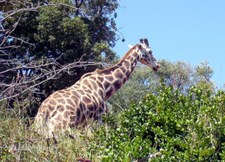
Rothschild's Giraffe59
Colourful Aloe Flowers in Zoo Gardens60
Chamelon Dragon (Chelosania brunnea)61
Carpet python (Morelia spilota imbricata)Largest python found around the Perth hills area. Grows to approx 250cm.62
Pilbara Death Adder(Acanthophis wellsi)63
Dugite (Pseudonaja affinis)Most common venomous snake found in the Perth area. This reptile belongs to the brown snake family.64
Dugite (Pseudonaja affinis)It is very shy and will avoid contact with humans at all costs. If you are bitten, then seek medical attention immediately. Grows to approx 2 metres.65
Woma Python ( Aspidites ramsayi )66
Olive Python (Morelia olivaceus)67
Perentie (Varanus giganteus)The Perentie (Varanus giganteus) is the largest monitor lizard or goanna native to Australia.68
Perentie (Varanus giganteus)The lizard can grow up to 2.5 metres (8 ft) in length although the average length is around 1.75-2 metres (5.5-6.5 ft) and weigh up to 15 kg (33 lb),maximum weight can be over 20 kg.69
Perentie (Varanus giganteus)The largest monitor lizard or goanna native to Australia.70
Australian Pelicans71
Double-wattled CassowaryThe Double-wattled Cassowary (Casuarius casuarius) is one of the largest birds in the world.72
A Squirrel on the Pathway73
Radiated Tortoise (Geochelone radiata)Much of the central habitat of the radiated tortoise is also the land of the Antandroy and Mahafaly people of Madagascar. In terms of traditional social values, both tribes respect the tortoise above all animals except cattle or zebu.74
Radiated Tortoise (Geochelone radiata)'Tortoises bring the rains – God sends rains, not for the humans, who can look after themselves, but for the animals, like the tortoises, who need the rain and God’s help. When there are no more animals there will be no more rain'. (Mahafaly story)75
Rothschild's Giraffes in widescreen76
Rothschild's Giraffe Family77
Rothschild's Giraffe Family78
Rothschild's Giraffe 'Mum and Dad'79
Rothschild's Giraffe 'Mum and Dad'80
Rothschild's Giraffe 'Baby'81
Grant's ZebraThe Grant's zebra is the smallest subspecies of the Plains Zebra.82
Grant's Zebra83
Grant's Zebra84
Slender-tailed Meerkat85
Slender-tailed Meerkat86
Spotted Hyena (Crocuta crocuta)Spotted Hyena (Crocuta crocuta) inhabits most of Africa.87
Spotted Hyena (Crocuta crocuta)The spotted hyena has the strongest jaws in the animal kingdom.88
Spotted Hyena (Crocuta crocuta)Different from most other animals, female spotted hyenas are dominant over the males and outweigh them by about 3 pounds.89
Hamadryas Baboon (Papio hamadryas)The Hamadryas Baboon was a sacred animal to the ancient Egyptians as the attendant of Thoth, and so, is also called the Sacred Baboon.90
Hamadryas Baboon opening Cardboard BoxThe Keeper had just thrown these Boxes and Pipes in for the Baboons.91
Hamadryas Baboon playing with BoxThe Keeper hides Treats in Boxes and Pipes to provide stimulation and play for the animals.92
Hamadryas Baboons with Boxes and Pipes93
Hamadryas Baboon (Papio hamadryas)94
Hamadryas Baboon playing with Water95
Hamadryas Baboon finding Treats in Pipe96
Hamadryas Baboon finding Treats in Pipe97
Hamadryas Baboon finding Treats in Pipe98
African Painted DogsIt is also called the African hunting dog, the Cape hunting dog, the spotted dog, or the painted wolf in English, Wildehond in Afrikaans, and Mbwa mwilu in Swahili.99
African Painted DogThe African wild dog has a pelage with an irregular pattern of black, yellow, and white, distinctive for each individual. The scientific name Lycaon pictus is derived from the Greek for 'painted wolf'.100
Asian Elephant101
Asian Elephant crawling in the SandOn instruction from Keeper.102
Keeper with Asian ElephantThe Keeper stimulates the Elephants by a regular program of exercises and tricks.103
Keeper rewards the Elephant104
A friendly pat from the Keeper105
Elephant doing a Hand Stand106
Asian Elephant and Keeper107
Galapagos TortoiseFully grown adults can weigh over 300 kilograms (661 lb) and measure 1.2 meters (4 ft) long.108
Galapagos TortoiseThe Galápagos tortoise (or Galápagos giant tortoise), is the largest living tortoise, native to seven islands of the Galápagos archipelago.109
Galapagos TortoiseThey are very long-lived with a life expectancy in the wild estimated to be over 150 years.110
Galapagos Tortoise close-upThey have become one of the most symbolic animals of the fauna of the Galápagos Islands.111
Galapagos Tortoise in a Hurry112
Sumatran Orang-utan with Baby113
Sumatran Orang-utanMother up high on the climbing tower.114
Baby Sumatran Orang-utanClimbing up the high tower.115
Baby Sumatran Orang-utanNearly to the top of the Tower.116
Baby Sumatran Orang-utanDon't fall....117
Baby Sumatran Orang-utanStill hanging on ...118
Baby Sumatran Orang-utanHigh on the Platform ....119
Sumatran Orang-utanBaby now safe with Mother...120
Sumatran Orang-utanMother and Baby exercising on the ropes...121
Otter drying on the Rocks122
Male Sun BearThe sun bear (Helarctos malayanus), also known as the dog bear or honey bear, after its love of honey, is the smallest of the eight bear species.123
Male Sun Bear124
Male Sun BearThe Sun Bear is black with a golden crescent marking on its chest which, in ancient Eastern folklore, represents the sun.125
Female Sun BearRed Glow is a Heat Lamp in Cave.126
Female Sun Bear finds Bag of FeedYoung Baby Bear was camouflaged at rear of yard.127
Dinner Time for Female Sun BearYoung Baby stayed at rear of yard.128
Silvery Gibbon129
Silvery Gibbon with small BabyShe put her leg across to prevent baby falling off platform..130
Nepalese Red PandaThe red and white colouring of the Nepalese Red Panda plays and important part in its survival. It provides protection by enabling the panda to camouflage with reddish moss and white lichen found in its natural habitat.131
KoalaActive through the night and resting most of the day, the Koala spends much of its time eating eucalypt leaves.132
Dingo (Canis lupus dingo)Dingoes have pricked ears, bushy tails and a distinctive trotting gait. Their coats are typically ginger but some are sandy-yellow, red-yellow or occasionally black and tan. Most have white markings on their feet, tail tip and chest.136
Dingo Yawning...Dingoes don’t bark, they howl. They have 3 different types of howls: moans, bark/howls and snuffs. Howling is used for long distance communications to attract pack members and repel rivals.137
Dingo Looking...Although dingoes are often seen alone, many belong to socially interacted packs whose members meet every few days.138
Dingo Listening...Dingo life span is 8-10 years, they grow to 60 cm high and weigh up to 15 kg.139
Black-and-white Ruffed Lemur at Play(Varecia variegata)140
Black-and-white Ruffed Lemur at Play(Varecia variegata)141
Black-and-white Ruffed Lemur at Play(Varecia variegata)142
Long Bushy Tail of Black-and-white Ruffed Lemur(Varecia variegata)143
Western Swamp Tortoise(Pseudemydura umbrina). The Western Swamp Tortoise is one of Australia's most endangered reptiles. It has the smallest surviving population of any Australian reptile.148
Western Swamp Tortoise(Pseudemydura umbrina). Western Swamp Tortoises are very small, growing up to 15 centimetres in shell length.149
Western Swamp Tortoise(Pseudemydura umbrina). The Western Swamp Tortoise is unique, with an ancestry that dates back 15-20 million years.150
Western Swamp Tortoise(Pseudemydura umbrina). Restricted to only two wild populations, there are less than 200 endangered Western Swamp Tortoises left. These are found near Perth in Western Australia.151
Black-necked Stork(Ephippiorhynchus asiaticus). Often known as Jabiru and grows to 130 cm.152
Brolga at water's edge(Grus rubicundus).153
Black-necked Stork often known as Jabiru154
Black Brittern in the Shadows155
Pied Cormorant and Black Brittern156
IMG 3460157
Plumed Whistling-Duck(Dendrocygna eytoni).158
Feather Detail of Plumed Whistling-Duck159
Young Plumed Whistling-Duck(Dendrocygna eytoni).160
Black-necked Stork often known as Jabiru161
Black-necked Stork often known as Jabiru162
Striated Heron (Butorides striatus)163
Striated Heron (Butorides striatus)164
Striated Heron (Butorides striatus)165
Black Cormorant166
Brolga and other water birds167
White Egret168
White Egret169
Brolga(Grus rubicundus).170
Little Penguins(Eudyptula minor novaehollandiae). The smallest of all penguins.171
Little Penguin(Eudyptula minor novaehollandiae).172
Two Little Penguins173
Little Penguin(Eudyptula minor novaehollandiae).174
Bear Caves from the PastFirst built in 1898, these caves were used to house not only bears but foxes, dingos and jackals as well. They are a relic from a time when zoos were simply places for collecting and displaying animals as spectacles.175
Bear Caves built in 1898Since that time, the role of zoos has changed and animal wellbeing is of the highest importance. Today Perth Zoo's purpose is to conserve species and habitat and involve the community in conservation action.176
Bronze MonkeyPermanently resting on the seat near exit as visitors leave for home.177