
1
MIRACLE JEWELRY
Scottish design "cairngorm" type
brooch
Compliments of the Carole Morris Collection
For more information about Miracle Jewellery and other Items, visit and join
Miracle Collectors Group
| 
2
Miracle bar pin in pink.
Carole:
"The bar pin is design 405 in a colour scheme which is probably after 1980, but before
2000, by which time it had been "rested". The small cabochons were referred to by the
company as MS/ i.e "moonstone". The pink mottled ones are not 1960's/1970's when a
different type of pink marbled stone in a much more coral-coloured shade was used.
As a design it was very popular in the 1970's and came in 6 colourways:
(i) P/Amethyst, Multi and Rose Quartz in an antiqued silver-coloured setting, or
(ii) Brown c, Crysopras (sic) or Lapis in an antiqued gold-coloured setting.
At this point it is probably useful for me to state another basic fact - that most Miracle
pieces use faux stones not real ones, and the high quality glass cabochons and inlays are
often referred to by "gemstone" names. In the list above "P/" stands for "porphyr" and
refers to a marbled stripey glass cabochon; Multi refers to ...
| 
3
Miracle-style bracelet, unsigned.
Carole:
"The bracelet is a lookalike/wannabe. It uses a type of glass cabochon which was often
referred to in England in the 1970's and 1980's as "picasso glass" although this was just a
trade name. It is essentially white glass with a marbled wash. Although Miracle pieces
occasionally have this type of glass, they are not common, and most pieces using it are
lookalikes from companies such as Exquisite, Jacobite, Gem and Sphinx. The terminal on
the extender chain in your bracelet is very characteristic of one of the companies making
lookalikes and they nearly always used the same terminal on all their bracelets. Miracle
bracelets have extender chains with different terminals, usually matching the theme of the
bracelet."
Courtesy of Linda Jo Mitchell
|

4
Signed Miracle pin with colorful cabochons, carnelian, simulated turquoise, malachite, and more centered with a large faceted amethyst stone and smaller amethyst chatons in between.
Carole: "Your circular brooch is a classic Miracle Scottish "cairngorm" type made throughout the 1960's/1970's from when this one comes. It is design code 316 in a M/amethystcolourway. M/ here means "Multi" in the other faux agate cabochons.Just for those who are not too sure what a
cairngorm is - it's a colloquial name for citrine or smoky brown-yellow quartz,
often facetted, but not always, and a native stone to Scotland.
"
Compliments of Jan Gaughan
Eclectic Vintage
| 
5
Clip back earrings in a Maltese cross with simulated carnelian center cabochons. Unsigned and quite possibly made by Miracle.
Carole:
"The back view does confirm that these are Miracle earrings - this clip-on fitting
is very typical of those used by the company in the 1960's and 1970's and that's when I'd
date these to.
It is a Celtic cross design which matches a ring (693) and bracelet
(575) neither of which were signed. There are unsigned Miracle designs, but they are not
common - far less than one may think. There are also necklaces using this equal-armed
"celtic" cross design as one of their elements."
Courtesy of Jan Gaughan
| 
6
pic of back of earrings
|

7
Signed Miracle Celtic cross pin designed with simulated turquoise glass stone set in an antiqued silver tone. From the 70's.
The design is considered a fusion with Celtic and moderne design. Circa 1970's.
Courtesy of Jan Gaughan
"have the same cross it comes up pos..."
View Comments...
| 
8
Carole:
"This is design 826 and is sometimes refered to in company records as St Margaret's
Cross and can be regarded as a Scottish design. St Margaret of Scotland was the wise and
gentle wife of King Malcolm III who lived at the end of the 11th century. She was canonised
(made a saint) in 1249 AD.
There are two versions of this particular design in Miracle's range. This is the larger of the
two - unique design code 826. your example has a green marble or "Iona" colourway.
Design 826 is still being made today, and I think your pendant is later 20th century rather
than 1960's/1970' s by the particular colour of the cabochons and inlays."
Karla Wacker's Client
| 
9
1 5/8 inch wide thistle brooch with what I think are imitation agates (not sure). Signed Miracle.
Carole:
"Two lovely pieces - both fairly recent I would guess (last 20 years). The thistle brooch
seems to have those translucent dark brown cabochons which imitate
tortoiseshell
(sometimes referred to as "shell" colourway by Miracle)"
Compliments of Dotty Stringfield
Illusion Jewels
|

10
Almost 2 inches wide and has a large imitation stone, maybe agate? Signed Miracle.
Carole:
"I would guess you are right on
this one - imitating a large stripey brown agate."
Courtesy of Dotty Stringfield
| 
11
Signed Miracle Brooch
Compliments of Lilly Vittetow
Lilly's Vintage Jewelry
| 
12
A pebble necklace that may be the lesser quality that Carole has metioned.
Courtesy of Lilly Vittetow
|
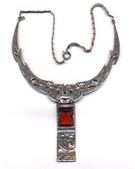
13
(Click on picture of item to read entire summary)
Carole says:
"Necklet with Early Anglo-Saxon style animal ornament, sometimes called the 'Pictish' Necklet by A Hill & Co, the manufacturers. Unique design code 299, designed and first produced in the 1970's and still in production at the present day. Retails at the present time for £30 (manufacturer's price) or about $58 (19 Feb 2008 exchange rates), and therefore the value of $500-$575 suggested in a recently published book - Brilliant Rhinestones by Ronna Lee Aikins - is misleading. This book also suggests that the piece dates from the 1930's which is not correct."
"Something else to look out for on the Pictish necklet piece is the quality of the signature,
as older pieces from the 1970's are likely to have crisp clear signatures, whereas the
pieces made very recently from the old moulds can have less distinct and often smudged
and "worn" looking signatures - the moulds are coming to t...
| 
14
Art Nouveau style bracelet design 754
Compliments of the Carole Morris Collection
| 
15
Charm Bracelet in English Baroque Style with seven different charms, often see as fobs or dangles on other Miracle Baroque pieces. 1950's.
Courtesy of the Wendy Buck Collection.
|
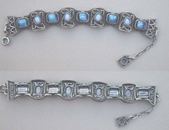
16
Medieval Gothic "church window" design
Courtey of Carole Morris
| 
17
The amazing Sealife bracelet, originally 1960's, this is a new version from old moulds
Courtesy of Carole Morris
"I have one of these beautiful bracel..."
View Comments...
| 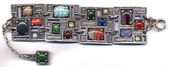
18
Moderne design bracelet - 1960's or 1970's. Different sizes and shapes of faux agate cabochons set into 4 interlinked rectangular panels. Cabochon set on each side of fob on extender chain.
Courtesy of Carole Morris
|
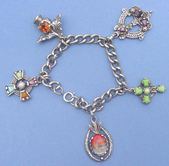
19
Miracle Charm Bracelet 766 (which had 5 charms - Scottish thistle, Irish Celtic Pennanular Brooch, 'Celtic' Wheel-head Cross 1, Oval 'Fruit'? Pendant & 'Celtic' Wheel-head Cross 2).
Compliments of Carole Morris
| 
20
Signed Miracle Heart with crown pin with blue lapis stone
Compliments of Rosie Dyer
Carole:
"This is an example of "hearts with crown" pins and are "luckenbooth" brooches, and very Scottish in style. Miracle made many variations of luckenbooth brooches over the years
and these are some of the most popular design - 404.
The name Luckenbooth brooches comes from the fact that they were sold from
'locked booths' or small street market stalls in the Royal Mile, adjacent to St. Giles
Cathedral in Edinburgh, which could be locked at night. Among the wares sold at these
stalls were heart-shaped brooches in many variations of design and size, with or without
precious stones; a most elegant love token from a young man to his sweetheart.
They were popular in the early 1700's, although they have a long history dating
from about the late 1600's. They were traditionally exchanged between lovers on
betrothal, and subsequently pinn...
| 
21
Dirk or Dagger Pin signed Miracle
Compliments of Rosie Dyer
Carole:
"Scottish style brooch in the form of a dirk (dagger). The oldest
original (medieval) dirks had carved knotwork pommels, plain scabbards and simple
ornamentation, but in the 18th century variants often had embellished scabbards to
accommodate hardstones or even a matching knife and fork. Like the cairngorms and the
luckenbooths, Miracle have made many variations of dirk brooches over the years. This one is design 410, and is still made today, although I believe yours is not a very recent
piece."
|

22
Pseudo Penannular pin
Compliments of Lorna Breshears
Jewelry Addiction
Carole:
"The pseudo-penannular with Connemara marble is a genuine Miracle piece made by A Hill & Co for the Irish market - one of the very few unsigned pieces, and it's reasonably early -probably early 1960's."
| 
23
Miracle pendant Necklace
Compliments of Pat Seal
Treasures From Yesterday Vintage Jewelry
"This is cross design 355. As the cro..."
View Comments...
| 
24
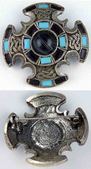
Flat slabs of opaque turquoise glass and translucent red glass are inlaid around the edges and around the central black and white glass faux agate. Pewter-colored metal is decorated with Anglo-Saxon designs. Marked MIRACLE.
Compliments of Cheri Van Hoover
Milky Way Jewels
"Carole Morris:
This cross brooch (..."
"Sorry, Cherri, Design 239 (not 329)"
View Comments...
|

25
Miracle Buckle Motif Brooch
Courtesy of Cheri Van Hoover
"This is an example of garter design ..."
View Comments...
| 
26
Miracle Gold & Blue Anglo Saxon Brooch
Courtesy of Cheri Van Hoover
"Another lovely example of an Anglo-S..."
View Comments...
| 
27
Huge Miracle Cairngorm Brooch
Courtesy of Cheri Van Hoover
"This is Scottish traditional 'cairng..."
View Comments...
|

28
Fabulous Miracle Bracelet
Compliments of Debi Reed
My Vintage Jewels
"Indeed fabulous! And a good example ..."
View Comments...
| 
29
Lovely Miracle Brooch
Courtesy of Debi Reed
"An oval version of a Scottish tradit..."
View Comments...
| 
30
Miracle brooch pendant
Courtesy of Debi Reed
"This is Celtic Miracle design 6676/B..."
View Comments...
|

31
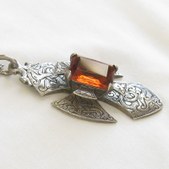
Miracle pendant Necklace
Courtesy of Debi Reed
"This is large 3-dimensional Miracle ..."
View Comments...
| 
32
Side view
| 
33
back view
|
34
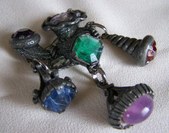
Signed A Miracle Creation
Compliments of the Jane Quirt collection
"Baroque brooch with pendant fobs, ea..."
View Comments...
| 
35
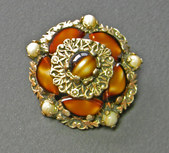
Lovely Miracle brooch
Compliments of Linda Vogue
VogueVille Vintage
"This is Miracle design number 233 wh..."
View Comments...
| 
36
Miracle dirk or dagger pin
Courtesy of Linda Vogue
"This is traditional Scottish dirk/da..."
"How much is this brooch worth"
View Comments...
|

37
Miracle Viking brooch
Compliments of Winnie Lambert
Sweet Lenas Retro
| 
38
pic of mark
| 
39
Miracle brooch with purple stones
Courtesy of Winnie Lambert
|

40
Miracle pin
Courtesy of Winnie Lambert
| 
41
pic of back
| 
42
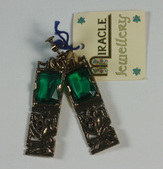
Fabulous Miracle Earrings
Compliments of Nancy Brace
Splendors Of the Past
|

43
Large Miracle Brooch
Compliments of Nancy Brace
| 
44
Gorgeous Miracle Glass Opal Bracelet
Compliments of Erin Buffaline
"I am hoping someone can tell me abou..."
"I am hoping someone can tell me abou..."
View Comments...
| 
45
Miracle Brooch With Sol D'or (Sun of Gold) Marking
Compliments of Kathy Small
Smal Treasures on Etsy
|

46
Miracle Brooch
Courtesy of Lee Lowe
4lllls Auctions
| 
47
Miracle Thistle Brooch
Compliments of Susan Corwin
Eureka I Found It!
| 
48
This one was part of Miracle's Anglo-Saxon collection designed in 1967 and presented to the world in January 1968. It was also one of the pieces showcased by A Hill and Company at the Wholesale Buyers' Gift Fair (held at the Mount Royal Hotel, probably in London, in November and December 1969) as was Cheri's cross-shaped brooch/pin. Its Miracle unique code number is 729 (729P if you have one which is also a pendant).
Compliments of Carole Morris
|

49
Miracle Scottish Earrings
Compliments of Yolanda Dewijk
YosFinds
| 
50
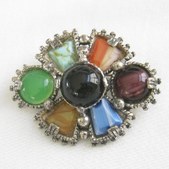
Miracle brooch
Compliments of Betsy Keep
Christian Ridge Collectibles
| 
51
Miracle Celtic brooch
Courtesy of Betsy Keep
|

52
Miracle earrings
Courtesy of Betsy Keep
| 
53
Miracle bracelet
Courtesy of Betsy Keep
| 
54
Pretty Miracle brooch
Courtesy of Betsy Keep
|

55
Three Miracle pins
Compliments of Kathy Small
Small Treasures on Etsy
| |
