 1 1
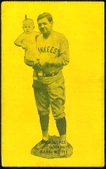
1921 Exhibit Babe Ruth. This uncharacteristic fielding pose is one of my favorites from the innagural ESCO baseball issue.
|  2 2
This advertising header for an ESCO machine solves one of the mysteries of Exhibit boxing card collecting. ESCO issued cards in sheets of 32. The 1921 set, which this card advertises, has 58 known boxers. Where are the other 6 has long bedeviled collectors. This broadside answers the question: the other 6 are wrestlers! Note the header is printed on scrap stock--its back is a partial sheet of postcard back art.
|  3 3
Ca. 1931 or 1932 4 on 1 arcade card with postcard back. Dated based on O'Doul's October 14, 1930 trade to Brooklyn from Philly. Only a few known cards and only a few known examples of each.
|  4 4
1931-32 4 on 1 PC backed card with Gehrig, Cochrane, Grove. The key to this elusive issue. No one knows much about them. They used images from the earlier individual PC-backed sets. I have only seen a few different cards from the set.
| 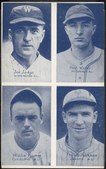 5 5
Here is another. For more info and images please see my page dedicated to these cards.
|  6 6
Babe Ruth-Rogers Hornsby-Mickey Walker-Georges Carpentier
An earlier group of 4 on 1's are shown on this and the next four images. These are multisport, covering baseball and boxing, and there are also entertainment cards and entertainment-baseball mixed cards, and are drawn from images used in the 1925 issue of the postcard-backed Exhibit set.
|  7 7
Walter Johnson-Al Simmons-Gene Tunney-Benny Leonard
|
 8 8
Eugene Criqui-Dave Shade-Joe Judge-Ty Cobb
|  9 9
Jack Dempsey-Rocky Kansas-Heinie Groh-Bucky Harris
Note the back: it has a "not to be used in exhibit machines" notation and a coupon, proving that this is indeed an ESCO issue.
|  10 10
Here is a blended subjects (baseball and entertainment) card. Note the two ink colors and the upside down printing.
|  11 11
|  12 12
Here is an uncatalogued (until now) 4 on 1 from the same batch that has rare baseball-boxing-entertainment mixed cards. It has Harold Lloyd, Buster Keaton, and two no-name actors. The Keaton image tends to narrow the date on the card issue. It is a still from a 1925 film called "Go West." Since the Cobb is shown with Detroit and drawn from the PC back set issued in 1925-1926, a 1925-1926 date is likely for the four on 1 issue as well.
|  13 13
|  14 14
Ty Cobb strip card made from the same art as the 4 on 1s
|
 15 15
Original art for Sammy Bohne arcade card. Photograph and ink on board. Bohne ne Cohen was an early Jewish player from California. Bohne was traded to Brooklyn late in 1926 and was out of the majors by 1927, indicating that this image was created in 1925 or 1926.
|  16 16
Here is the actual card, purple ink variation. Note that the field of the card is smaller than the field of the image
|  17 17
Original art for the Speaker card. Note the whited out logo on the sleeve.
|  18 18
1928 PC backed Tris Speaker. Cobb and Speaker rigged a game in 1926. Judge Landis did not ban the men but their teams traded the aging stars. Speaker went to Washington for 1927 then on to the A's for 1928 where he joined Cobb in the outfield.
|  19 19
Original art for the Harry Heilmann card.
|  20 20
The card.
|  21 21
Original art for the first-run Waner card
|
 22 22
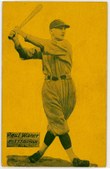
There are three versions of Paul Waner's card in the PC-Backed issue. The first shows Waner batting.
|  23 23
ESCO cut away the background to produce this silhouette image of Waner batting.
|  24 24
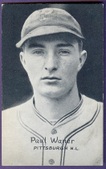
The last of the PC-Backed Waner cards shows an unsmiling Waner in portrait. It is the most common of the three.
|  25 25
|  26 26
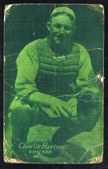
Gabby Hartnett, background removed variation. On 8 of the Postcard-backed baseball cards, the company cut away the background and kept the player silhouette. This is a prime example. Very tough to find in any condition.
|  27 27
Here is what it looks like with the background
|  28 28
ca. 1928 Rogers Hornsby. On 5 of the postcard-backed baseball cards, to reflect player trades the issuer pasted a label over the legend on the original art and ran new cards. Hornsby, Cobb, Rouch [sic], Frisch and Peckinpaugh have this rare variation. Hornsby was traded twice in three seasons because he was an obnoxious jerk.
|
 29 29
The last of 3 Hornsby cards in the PC back set, this one is the most elusive.
|  30 30
I really liked the color on this Eppa Rixey card.
|  31 31
Ralph Pinelli in a tougher yellow with orange print variety.
|  32 32
Edd Roush PC backed card with correction label. They still managed to misspell both of his names!
|  33 33
ca. 1927-28 Ty Cobb. As noted in the correction label, Cobb finished his career with the A's in 1927-28.
|  34 34
ca. 1928-29 Babe Ruth. Definitely the best Ruth Exhibit pose. A classic Ruth pose that has found its way onto posters.
|  35 35
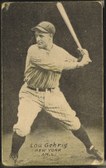
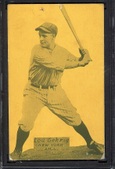
PC-backed Lou Gehrig batting. There are two versions of this card; one with the background removed and this one. The portrait card of Gehrig uses the image on card #3 above, as does the W517
|
 36 36
|  37 37
|  38 38
ca. 1926 Walter Johnson. The greatest pitcher of all time.
|  39 39
ca. 1929 or 1930 Lefty O'Doul, dated by team designation (he was traded to the Phillies October 29, 1928 and to the Dodgers October 14, 1930).
|  40 40
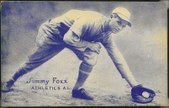
Rookie card of HOFer Jimmie [sic] Foxx, this PC backed card dates to about 1927-28.
|  41 41
Hack Wilson from the PC-Backed set. A moderately difficult one to locate.
|  42 42
Very rare Exhibit card of Tom Mix, western star, who had a semi-pro baseball team. I learned from one of Mix's biographers that the team was composed of movie folks and competed in a league of movie people that was organized for fun, not for charity or publicity.
|
 43 43
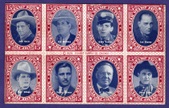
This 8 image card from 1929 is part of a series of cinema star cards. In addition to Babe Ruth, Jack Dempsey is depicted (both starred in lousy movies). Also comes in red print on a pink stock. The other subjects of the card are the cream of the ESCO subjects at the time: Chaplin, Jolson, Lindbergh, Mix, Lloyd and Fairbanks.
|  44 44
The 2nd most sought-after Exhibit 8 image movie star stamps card, an undated version with Lon Chaney as a vampire in London After Midnight.
|  45 45
Another Chaney card, not as sought after since he is not in make-up. Also has WC Fields and Eddie Cantor.
|  46 46
Another desirable card, this one depicting several of the Little Rascals.
|  47 47
This one features silent star Buster Keaton.
|  48 48
Very rare 1928 Pacific Coast League Exhibit of Hal Rhyne. PCL Exhibits are among the scarcest of Exhibit issues. Key cards in the 32-card set are Earl Averill and Jimmy Reese. Only a few sets are known.
|  49 49
Here is the 1928 PCL Exhibit Earl Averill. It is the key card in the set. I'd say it is one of the two or three most sought after Exhibit baseball cards.
|
 50 50
1921 Exhibit of Earl "Greasy" Neale. Not many people realize that Mr. Neale is in the Hall of Fame. The Football Hall of Fame. Along with other former MLB players Ernie Nevers and Jim Thorpe.
|  51 51
Heinie Groh shows his famous bottle bat. One of my favorite images. 1921 Exhibit card. According to many collectors of the set this is one of the toughest 1921s to locate.
|  52 52
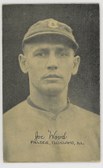
Ray Schalk's 1921 Exhibit card. The PC sized medium is a great way to view old players and equipment.
|  53 53
Perhaps my alltime favorite image from an Exhibit card. 1928 Frankie Frisch, the Fordham Flash.
|  54 54
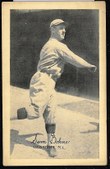
1921 Dickie Kerr. One of the honest Black Sox, Kerr was the stopper of the series for the Sox. Look at his expression; I like to think it was in reaction to a question about his teammates' betrayal.
|  55 55
Another of my alltime favorite poses, Harry Heilmann on the 1922 card. This image is used in several other sets but it is best shown on the PC-sized Exhibit card.
|  56 56
1922 Exhibit Joe Wood. One of my favorite cards because of the history. Wood had two careers in baseball. In his first incarnation as Smoky Joe Wood, he had a few seasons as one of the finest pitchers in history. "Can I throw harder than Joe Wood? Listen, my friend, there's no man alive can throw harder than Smoky Joe Wood."---Walter Johnson. Wood blew out his arm, went back to the minors, and restructured his career as an outfielder. He is shown here on his only Exhibit card.
|
 57 57
1922 Exhibit Ross Youngs [sic]. Considered one of his rookie cards, the ill-fated HOF outfielder died young and suddenly.
|  58 58
1922 Eastern Exhibit Company Tris Speaker. The Eastern Exhibit Company was absorbed by the "regular" Exhibit Supply Company and put out only 1 set of cards.
|  59 59
1922 Eastern Exhibit Supply Dave Bancroft. There are two versions of each arcade card, one with the eastern company's Philadelphia address and one with the Philly address blocked out and replaced with the Chicago ESCO address.
|  60 60
1922 Exhibit Sammy Bohne. Another tough and popular card of the Jewish star.
|  61 61
1923 Gabby Hartnett. While reputed to be the toughest of the major league baseball series from the 1920s, in actuality the 1926 set is even more difficult.
|  62 62
1923 Joe Sewell
|  63 63
1923 Al Simmons. Considered Bucketfoot Al's rookie card.
|
 64 64
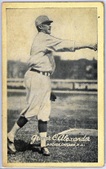
1927 Grover Cleveland Alexander, towards the tail-end of his illustrious career.
|  65 65
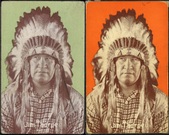
Another of my alltime favorite cards. This Indian chief is none other than Jim Thorpe, making a living in the early 1930s in bad westerns playing...an Indian. A very rare PC-backed card from a set of movie stars issued approximately 1931. There is a set of strip cards, very rare, in the same style and with some of the same images. I can confirm Thorpe cards in all three sizes of the strip cards.
|  66 66
Here is the Exhibit Thorpe side by side with three of the four types of strip cards made with the same art, the large strip card (middle right) the tab-sized (middle left), and the monotone small card (left). The size not shown is the same height as the tab sized but a bit wider. The cards are approx. to scale. The tab sized cards were issued with a lettered tab at the bottom that could be cut off for redemption (I suspect in an arcade or candy store). The other small strip cards came in vertically oriented strips. I am not sure of the orientation of the larger cards; I suspect vertical strips of 3 like W517.
|  67 67
Here is the Thorpe with tab intact.
|  68 68
This card shows cowboy actor William Desmond. The Indian chief on the left is Jim Thorpe. This is the second Thorpe pose from the set. The other Indian in the image went by the stage name "Chief Thunderbird" (real name Richard Davis Thunderbird). The card helps narrow down the issue date. Thorpe, Thunderbird and Desmond appeared together in the 1931 film "Battling With Buffalo Bill."
|  69 69
This Jack Dempsey card relates to Jack's movie career. Probably issued around the time of his 1920 serial "Daredevil Jack". I suspect that this card is Dempsey's true "rookie" card.
|  70 70
A very rare card of star Rudolph Valentino working out with pro boxer Gene Delmont and Jack Dempsey. There are a few candid type cards of stars and athletes together.
|
 71 71
Another rarity, this one Tom Mix working out with boxer Newsboy Brown. Note the big Star of David on Brown's shorts; he is one of many Jewish boxers.
|  72 72
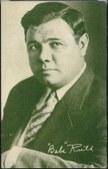
1931-32 Babe Ruth card from a set of movie-related Exhibit cards. One of the rarest Exhibit cards of Ruth and definitely one of the most desirable. He appeared in 5 films in 1932, all as himself.
|  73 73
Jack Dempsey looking dapper, probably from another movie set.
|  74 74
Shortly before his late 1926 fight with Jack Dempsey, light-heavyweight champ Gene Tunney went to Hollywood and filmed an atrocious western called "The Fighting Marine". A few Exhibit cards relating to the film were issued.
|  75 75
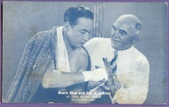
Jim Jeffries was the heavyweight champion until 1904, when he retired undefeated. He came out of retirement in 1910 and lost to Jack Johnson. He then settled in Burbank, California, near the film studios, and ran many businesses including a boxing venue. Jeffries Road in Burbank pays tribute to him. He played a ref in this Monte Blue vehicle.
|  76 76
|  77 77
1925 Benny Leonard in Flying Fist [sic; Fists]. Leonard made a serial in New York while at the height of his popularity.
|
 78 78
There are numerous boxing-themed Exhibit movie cards--the trick is tracking down the names of the participants. When I saw the nose on this opponent I knew he had to be a real pug. I researched it and discovered that it is HOFer Ted "Kid" Lewis.
|  79 79
Another movie card featuring Kid Lewis.
|  80 80
1930s Victor McLaglen. Many people do not realize that McLaglen was a professional boxer who fought Jack Johnson in 1909 in a six-round exhibition match in Vancouver. His fight with fellow former pug John Wayne in "The Quiet Man" has quite a bit more grit and realism than most film fights of the era, which remind me of ladies swinging pocket books at each other.
|  81 81
1926 Red Grange in "One Minute To Play". The Galloping Ghost went Hollywood for a dreadful film about a collegiate footballer. There are a few cards known from the film including a nice action shot.
|  82 82
1926 Red Grange in "One Minute To Play" in-action shot. Grange is kicking.
|  83 83
|  84 84
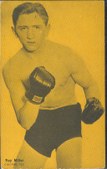
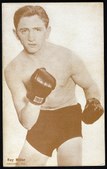
1928 Exhibit Ray Miller, #1 lightweight contender. The only man who KO'd Jimmy McLarnin. Ray is my first cousin twice removed. Exhibit boxing cards from the 1920s generally have biographies, fight records and copyright dates on the backs. The next four show some of the variety available in the 1928 set.
|
 85 85
|  86 86
|  87 87
|  88 88
|  89 89
|  90 90
This Dempsey card is from a set of world champions issued in 1923 or 1924. For many years it was misattributed to the 1932 World's Fair. I researched the subjects in the cards and it is clear that the set was from the mid 1920s, as many of the athletes were long retired or replaced as champions by 1932.
|  91 91
1923-4 Champions Anders Haugen. Another from this scarce and diverse series. Check out the skis; they look like 2 x 4 lumber!
|
 92 92
1923-4 Champions Gene Sarazen. A very desirable early golfing card and 1 of only 2; the other is a 1948 Ben Hogan (Max Schmeling's card with his golf bag doesn't count).
|  93 93
1923-4 Champions Charlie Paddock. Called the fastest man in the world, he was the 100m champion at the 1920 Olympics and finished 2nd at the 1924 Olympics.
|  94 94
Edward O. Gourdin is a African/Native American (Seminole/Cherokee) and has one of the most remarkable backstories in sports. He is one of the first athletes of color on a sports card outside of boxing. He was a long jumper for Harvard University in the 1920s. After graduating he medaled in the 1924 Olympics, practiced law, was appointed as an Assistant US Attorney, commanded the 372nd (Colored) Infantry in WWII as a colonel, became only the second man of color appointed a full time judge in Massachusetts, and served as president of the United States Olympians Association.
|  95 95
In addition to being Tarzan in Hollywood, Johnny Weissmuller won 3 gold medals in the 1924 Olympics for swimming. This and a number of other cards in the series led me to the realization that the 1932 date on this set was dead wrong. So many of the athletes achieved fame in the 1924 Olympics and were long-gone to other professions by 1932.
|  96 96
Strangler Lewis.
|  97 97
|  98 98
|
 99 99
|  100 100
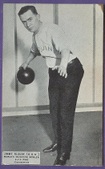
Anyone have any idea who this guy was? None of the hockey afficionados I checked with could tell me a thing about him, yet he made it into the 1923-4 Exhibit Champions issue.
|  101 101
|  102 102
|  103 103
|  104 104
|  105 105
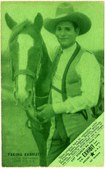
Yakima Canutt from a western issue, ca 1928. This issue is printed on two-sided stock and has different people on each side. Note the coupon at the bottom. kids could obtain premiums for the coupons. Many cards are found with corners lopped off as a result.
|
 106 106
Here are both sides of a westerns doubleheader from the late 1920s.
|  107 107
Another really innovative 1920s issue, this western card and the next one have 4 portraits on one side and 4 action shots on the reverse. I wish they'd done these with baseball cards.
|  108 108
1920s 8 image western card. I'd not seen this format of card before acquiring the two depicted here at the National.
|  109 109
|  110 110
|  111 111
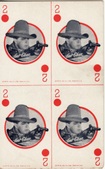
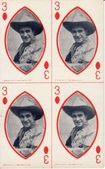
One of the first cut-apart game sets from ESCO, this copyrighted 1928 issue pictures the same western star four times on each card, presumably to be cut up for some kind of card game. I have seen numbers as high as 28 so I assume there were at least 32 issued.
|  112 112
|
 113 113
|  114 114
|  115 115
|  116 116
One of the innovative designs for western cards from ESCO. With the start of the Great Depression ESCO began issuing cards that could be cut up for game playing. This 1929 series (dated on front) has instructions to cut out the "chips" for playing. Not a lot of these cards survived as a result.
|  117 117
|  118 118
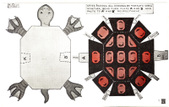
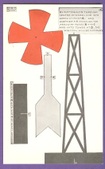
Another of the thoroughly annoying "cut 'em up" issues from ESCO. This one was intended to be made into three ballplayers on stands. Rare card; I've only seen a few.
|  119 119
|
 120 120
|  121 121
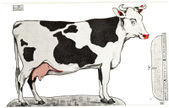
This and the next several are more from the cut-up series.
|  122 122
|  123 123
|  124 124
|  125 125
|  126 126
|
 127 127
|  128 128
|  129 129
|  130 130
|  131 131
|  132 132
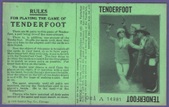
1929 Exhibit Tenderfoot Buzz Barton. This is an innovative, attractive, thoroughly maddening set to collect. There are 31 cards that look like this one and a header card with a picture of the "tenderfoot" [actually, an actor in a western; see next image for a film card using the same picture] and the rules. Basically, it was a matching game. 31 paired cards made by cutting apart tbe base cards and one oddball--the Tenderfoot--made by cutting down the header card. The one who gets stuck with the Tenderfoot lost. Needless to say, very few survive intact.
|  133 133
The original Tenderfoot movie image
|
 134 134
1929 Exhibit Tenderfoot. Another example.
|  135 135
|  136 136
|  137 137
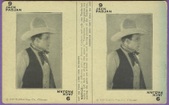
Tom Mix from a 1929 set devoted to him. Another innovative ESCO design for western cards.
|  138 138
Jack Holt from yet another ESCO innovative design, depicting famous Hollywood gunslingers as playing cards. There are also cards depicting a "hand" with multiple images.
|  139 139
Here is an example of the Western poker hand card. Cards are also known with actors in a "fan".
|  140 140
ESCO revived the playing card idea in the 1960s. Use of additional graphics was a way for ESCO to recycle older images. The Gary Cooper image shown here dates to roughly the High Noon period.
|
 141 141
1961 Wrigley Field Exhibit Babe Ruth. ESCO was headquartered in Chicago. I am surprised it took 40 years for them to think of a promo with the Cubs.
|  142 142
1961 Wrigley Field Cobb. The set consists of 24 alltime greats, sometimes found with postcard backs, sometimes with blank backs. They are pretty tough to find given that they were ballpark premiums.
|  143 143
1961 Wrigley Field Honus Wagner. By 1961 with the rise of TV and decline of amusement arcades, ESCO was in serious trouble. I suppose the baseball promo link was an effort to expand a dying business.
|  144 144
1961 Wrigley Field Gehrig.
|  145 145
1961 Wrigley Field Walter Johnson
|  146 146
Exhibit Salutations Ted Williams #9 shows. Beginning in 1939 ESCO issued a series of cards depicting ballplayers with nice "salutations" on the front (sincerely, best wishes, etc.; I suppose nowadays they's say stuff like "no comment" or "I didn't know it was a steroid"). This Williams is one of the short printed cards and is a set key.
|  147 147
Salutations DiMaggio. Nominally given a date of 1939-47, in reality some of the Salutations cards were issued for only a year or two, some were issued into the 50s or even 60s. Joe D's card was one that was issued into the early 1950s and is easier to find than most other cards.
|
 148 148
Jimmy Foxx played just long enough to merit inclusion in the set's early versions. Given the relative scarcity of the card, I suspect it ran for 3 or 4 years. One of my favorite poses of the man they called The Beast.
|  149 149
HOFer Charlie Gehringer is one of the toughest short prints, probably issued no more than a year or two. Given the spillover into the 50s and 60s, I hesitate to call the Salutations a separate set from the 1947-66 grouping. It makes more sense to treat them as series, as in the case of T206's different printings.
|  150 150
One of the two Hank Greenberg Salutations cards.
|  151 151
Here is the short print Greenberg
|  152 152
"King" Carl Hubbell has a nice Salutation card. It falls in the middle of the pack in terms of rarity, again probably issued for a few years.
|  153 153
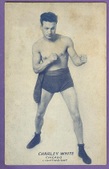
HOF shortstop Arky Vaughan is one of the shorter prints in the Salutations cards.
|  154 154
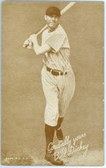
Print variations over the years created some scarcities over minute differences. This Bill Dickey and the next one have "MADE IN U.S.A." at different bottom corners.
|
 155 155
This Saluations Dickey has the inscription at the lower right.
|  156 156
|  157 157
|  158 158
|  159 159
|  160 160
1954 Canadian Exhibit Walter Alston. The 1950s Canada-only Exhibit issues use color and often depict players from the minor league teams in Canada. The Dodgers had a minor league team in Montreal that Alston managed before going to Brooklyn.
|  161 161
Major league cards were also issued in the early 1950s Canada, using artwork from the postwar sets. The Musial here shows one format similar to the minor league cards.
|
 162 162
Canadian Monte Irvin. Cards 1-32 can be found in green or red and have numbers in a diamond; 33-64 are blue or red and have free-floating numbers.
|  163 163
1948-52 Canadian "Exhibit" Maurice Richard. "Rocket" Richard, the 1st man to score 50 goals in a season, is the key to the set. There are 2 card of him, one with the stairs in the background, one without. I say "Exhibit" because ESCO did not issue these cards; they were copy cat arcade cards.
| 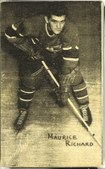 164 164
1948-52 Canadian Exhibit Maurice Richard, no stairs variation. I spoke with several Canadian hockey card dealers at the 2005 National who told me that this set is very scarce. I found only three cards for sale there from this set.
| 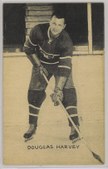 165 165
1948-52 Canadian Exhibit Doug Harvey. A HOF defenseman for the Habs and then the Rangers, Harvey was considered the greatest of all until Bobby Orr came along.
|  166 166
"Boum Boum" Geffrion. I guess that is how they spell it in Quebec?
|  167 167
|  168 168
|
 169 169
OK, I had to add this one. Julie Newmar, the ONLY Catwoman for me, in a late 50s Exhibit pin-up issue. I was able to secure her autograph on the card. What gams!
|  170 170
Late 1950s Marilyn Monroe, from a series of cheesecake Hollywood actresses. Schwingg!
|  171 171
Schwingg!
|  172 172
Betty Grable in the most famous pin-up shot of WWII. Schwingg!
|  173 173
1940s-1950s Groucho Marx, from a series of television and radio stars. Some of his best lines: I sent the club a wire stating, PLEASE ACCEPT MY RESIGNATION. I DON'T WANT TO BELONG TO ANY CLUB THAT WILL ACCEPT ME AS A MEMBER; Go, and never darken my towels again; I never forget a face, but in your case I'll be glad to make an exception; I've had a perfectly wonderful evening--but this wasn't it; A man's only as old as the woman he feels; Do you suppose I could buy back my introduction to you?; Here's to our wives and girlfriends...may they never meet!; Marriage is a wonderful institution...but who wants to live in an institution?; Politics is the art of looking for trouble, finding it, misdiagnosing it and then misapplying the wrong remedies.
| 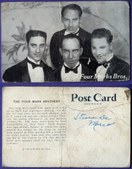 174 174
1926 Exhibit Four Marks [sic] Brothers. This is the only Marx Brothers exhibit card I have ever seen. It is from a rare set of theatrical cards. The card mentions their stage work but not their films because they had not yet made a film. The Cocoanuts was their new play on Broadway and would not be filmed until after the silent film era ended. Why ESCO did not make more Marx Brothers cards is beyond me; I would love to see cards of them in their big films.
|  175 175
1926 theatrical issue Willie Howard.
|
 176 176
1926 theatrical issue W.C. Fields.
|  177 177
1926 theatrical issue Eddie Cantor.
|  178 178
Lucy and Desi. They don't need last names. This is the most desirable of the Lucy Exhibit cards, though not the toughest Lucy card to find, because it is the only one of them together. I do not know of a solo Desi card.
|  179 179
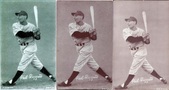
The earliest of Lucy's cards, from her ingenue days before she and Desi made history.
|  180 180
One of Lucy's portrait cards. She is likely the post-war star featured in the largest number of different Exhibit series. The following are some more of her cards.
|  181 181
More Lucy
|  182 182
|
 183 183
This one I believe dates to around the time of her pregnancy.
|  184 184
|  185 185
Sean Connery, about the time Dr. No was made. There are two Exhibit Connery cards.
|  186 186
Here is the other known Connery card. I'd say around the time of Thunderball.
|  187 187
The Bonanza crew, minus Pernell Roberts (Adam Cartwright), who left the show early on and is a short-printed card. From L to R: Dan Blocker (Hoss), Lorne Greene (Ben) and Michael Landon (Joe).
|  188 188
Here is the short printed Roberts. He played Adam Cartwright from 1959-1965.
|  189 189
A rare unopened pack of Exhibits from the 1960s. As part of its last gasp ESCO tried to sell cards in packs. They were not successful.
|
 190 190
Another example of the rare packs from the early 1960s, this one with Lee Marvin on the front.
| 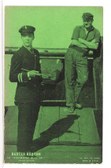 191 191
Buster Keaton in Steamboat Bill, Jr. (1928). Keaton and Chaplin were the two biggest comedic actors in the 20s. This film was parodied in "Steamboat Willie", a cartoon that featured a new character, Mickey Mouse.
|  192 192
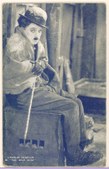
Charlie Chaplin in his most famous role, the tramp, in his most famous silent film, The Goldrush (1925).
|  193 193
As one of the biggest stars of the silent era, Chaplin was fodder for many Exhibit cards.
|  194 194
Here is a neat behind-the-scenes image of Chaplin at the directorial helm for one of his mid-1920s films.
|  195 195
Portraits of Chaplin without his makeup are tougher to find on Exhibits than are his images in character. Based on color and typeface, I'd say this one dates to the 1926-1928 period
|  196 196
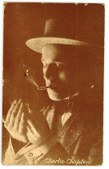
An early Chaplin card, ca 1920.
|
 197 197
The classic Little Tramp portrait of Chaplin, ca 1928
|  198 198
Another film comedic great, Harold Lloyd. His most famous role found him swinging from a ledge and the hands of a clock 9 stories above downtown Los Angeles.
|  199 199
Before he became the strong, silent archetypal hero, Gary Cooper starred in a number of silent westerns. This card is the earliest ESCO Cooper card I have found (1927).
|  200 200
The tubby sheriff in this scene is noneother than Oliver Hardy, pre Stan Laurel.
|  201 201
Another Hardy card
|  202 202
Another, very difficult to find, Hardy card.
|  203 203
This is the first (and only so far) Laurel and Hardy Exhibit card. it comes from their very popular 1933 film Busy Bodies.
|
 204 204
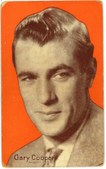
Gary Cooper from the ca. 1930 PC backed movie set.
|  205 205
Maurice Chevalier from the ca. 1930 PC backed set. When asked how it felt to turn 80, Chevalier said: "considering the alternative..."
|  206 206
Tom Mix from the ca. 1930 PC backed set. These cards are really hard to find. I acquired all but two from the same seller, who had picked up an old collection at an estate sale.
|  207 207
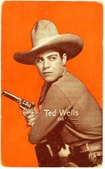
Ted Wells from the ca. 1930 PC backed set.
|  208 208
Jack Holt from the ca. 1930 PC backed set. His son Tim was a well known character actor whose best role was in "Treasure of the Sierra Madre" opposite Bogart and Walter Huston
|  209 209
Elmer Goodfellow Brendle had a four-decade career as a character actor in movies and television. The ex vaudevillain used a Swedish accent for comedic effect. I have to admit, I thought he was a Hispanic star given the name on the card.
|  210 210
Buck Jones from the ca. 1930 PC backed set.
|
 211 211
Here is the same Buck Jones image on a strip card that is about 1/4 the size of the PC backed card. W517 also has a rarer "mini" version that is closer in size to a standard strip card. Interesting how some of the PC backed baseball images show up as W517 and W517 minis and how some of the PC backed entertainers show up as strip minis. Now if only we had an intermediate sized card like W517 for the entertainment cards...
|  212 212
We do. This William Haines strip card is about 1/3 bigger than the preceding Buck Jones card.
|  213 213
A while ago I acquired about 20 of these cards in a smaller format. I assumed they were trimmed. Turns out, they were issued differently. The narrower cards were issued singly with tabs at the bottoms. This Lew Ayres card shows the tab version on the left and the strip version on the right. As you can see, the strip version is wider.
|  214 214
Victor McLaglen strip card.
|  215 215
Joe E. Brown strip card. Brown reputedly said "A friend in need is a pest".
|  216 216
A 4 on 1 PC backed entertainment card. Appears to be the same issuer as a set of strip cards as well as the PC backed baseball and boxing sets.
| 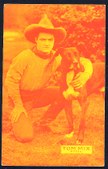 217 217
Tom Mix from the PC-backed issue. The back of the card is identical right down to the printing flaws with what is found on some of the PC back baseball cards as well as the Blue Boxers.
|
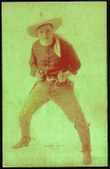 218 218
Another PC backed Mix, this time in green
|  219 219
Here is one of the strip cards from the same images as the 4 on 1 just shown. Tom Mix boxing. It is about 1/4 the size of the 4 on 1. The cards came in vertically-oriented strips of 10.
|  220 220
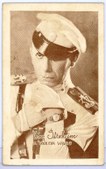
1922 Eric Von Stroheim. In 1921 and 1922 ESCO issued movie cards with the same format as their baseball cards from those years. While "von" was used to designate German aristocracy, in reality von Stroheim was an Austrian Jew.
|  221 221
1922 Gloria Swanson. Couldn't resist adding her in beside Von Stroheim given their "Sunset Boulevard" connection. "I'm ready for my close-up Mr. DeMille!" The top stars of the era made $10,000 a week before the income tax existed.
|  222 222
Rudolph Valentino. A mega star in early Hollywood, Valentino had a number of ESCO cards. The Hollywood PCL baseball team was named the Sheiks in honor of his most famous role. He died on August 23, 1926. This card shows him in his next to last role as Count Rodrigo Torriani in the 1925 film "Cobra" (not to be confused with the Sylvester Stallone film of the same name; oh, if only Sly had been silent in that one...).
|  223 223
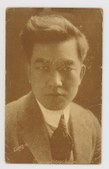
1920 Sessue Hayakawa. What a life this guy lived. He became the 1st Asian cinema star in the US with a scorching performance as the owner of a white sex slave in a lurid silent film (his branding her is the highlight), lost his career more or less and went overseas due to sound, and came back to be nominated for an Oscar for best supporting actor in 1957 as Col. Saito in Bridge On The River Kwai.
|  224 224
1920 Fatty Arbuckle. In addition to being a movie star, Fatty owned a piece of the Vernon team in the PCL. Probably issued ca. 1920; his career was destroyed in 1921 by a sex scandal.
|
 225 225
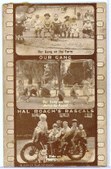
1929 Our Gang card. The Hal Roach Studios children (if you were born after WWII, you know them from TV as the Little Rascals) had a nice series of tri-image cards from 1920. One of the tougher cinema issues.
|  226 226
Horror ace Boris Karloff. His Exhibit cards are tough to find and sell for around $50 when they surface, which is rarely.
|  227 227
|  228 228
ESCO attempted to capitalize on the Mercury program's popularity with a series of cards of the astronauts, their equipment and some NASA conceptual drawings. Here is Alan Shepard, the first American to go up there.
|  229 229
Noted aviator and anti-Semite Charles Lindbergh was the subject of a card issue of his own after his solo flight across the Atlantic.
|  230 230
Exhibit cards are great vehicles for autographs by virtue of their large size. Here is Billy Conn, former lightheavyweight champion.
|  231 231
Willie Pep autographed this late 1940s issue. Unfortunately, since the last Exhibit set originated in the early 60s, there are relatively few living boxers on the cards available to chase for autographs. Muhammad Ali, Carmen Basilio, Jake LaMotta and Gene Fullmer are the only ones still alive who come readily to mind, but there were many who lived while Exhibits were made and who signed them, so they can be found on the secondary market.
|
 232 232
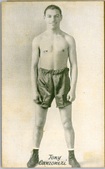
Talk about rare! Tony Canzoneri, who died in 1959, signed this Blue Boxers card.
|  233 233
Beau Jack was a title holder in the 1940s. He came up from the deep South the hard way, fighting Battle Royales where several young black fighters would be put into the ring together and the last one standing won. In later life he went back to shining shoes in Miami to make a living, where he was discovered and then became a fixture on the autograph circuit before he died.
|  234 234
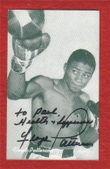
Floyd Patterson signed inscribed Exhibit card. One of the nicest ex-champs ever, Patterson was a very accommodating signer.
|  235 235
Another Patterson.
|  236 236
I got Hammerin' Hank at a show and saved the ticket.
|  237 237
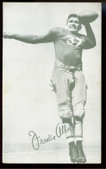
Luke Appling was one of my favorite autograph guests ever. A very gregarious man, when I handed him this card he told about what a misery those uniforms were. Seems they were made of black wool and would absorb and hold a ton of sweat, making for truly miserable double-headers.
|  238 238
I got this Lou Boudreau at a show in the early 1990s when he was the "door buster" free autograph.
|
 239 239
Table of Comparisons, Jack Dempsey and Gene Tunney. ESCO issued a small series of these cards comparing heavyweight rivals Dempsey, Tunney, and Wills. Not that hard to find but very desireable cards. One or the other of the vital stats is incorrect; Dempsey was born in 1895, Tunney in 1897. If I had to bet, I would guess that Tunney's age was incorrectly stated at the time the art was created; in 1925 he would have been 28 and Dempsey would have been 30.
|  240 240
Primo Carnera. In the late 20s and early 30s ESCO issued a series of cards depicting the main heavyweight contenders of the day in a variety of images. Oddball images like this one or the Schmeling with golf gear are prized. "Satchel Feet" was one of the worst fighters to become champion and was demolished by Max Baer in a title defense, being knocked down 11 times until finally KOd.
|  241 241
Carnera from the heavyweights series with the corner clipped, indicating a backside coupon was removed. He later wrestled professionally and owned a liquor store in Glendale, California. His mobbed-up career was source material for the 1956 film "The Harder They Fall".
|  242 242
Max Schmeling with golf bag. Schmeling recently passed away, the last of the heavyweight champions of the 1930s to die. A controversial personality because of his German nationality in the 1930s (while not a Nazi supporter, he found it convenient to let them use him for propaganda), Max was a robust man into his 90s. Consequently, Schmeling autographs are pretty easy to find.
|  243 243
Harry Wills was signed to fight Dempsey for the heavyweight title in 1924. The racist outcry over letting a black man have a shot at the crown led Jack Kearns (Dempsey's manager) to call off the fight. Dempsey lost his New York boxing license as a result. Wills' cards in the heavyweight series are the hardest to find. I suspect he was removed from the issue relatively quickly. The typeface used on the card is similar to that of the 1926 baseball issue.
|  244 244
An uncut sheet of Exhibit cards ca. 1960 or 1961 at the earliest (Rocky Colavito is shown with Detroit, where he went after the 1959 season in a trade for Harvey Kueen). Next to Rocky is Ted Williams' Salutations card that supposedly was printed from 1939-47. As I said earlier, it is misleading to consider the postwar ESCO issues as distinct sets; the Salutations can cross over into the later cards.
|  245 245
1921 Exhibit John L. Sullivan. The Great John L was the first great American world heavyweight champion. He would often enter a saloon and proclaim that he could lick any SOB in the place, and make good on the promise. A notorious partier in his youth, the old Sullivan became a crusader for temperance. Why ESCO chose to show him as an old, fat man is beyond me.
|
 246 246
1921 Exhibit Jim Corbett. Gentleman Jim was the first winner of a gloved championship, defeating John L. Sullivan for the title. The 1921 set is the only "historical" set ESCO issued of boxers. From its boxing cards it is possible to find every heavyweight champ from Sullivan to Dempsey.
|  247 247
1921 Bob Fitzsimmons. Ruby Robert defeated Corbett and held the middleweight and heavyweight championships at the same time.
|  248 248
1921 Exhibit Jim Jeffries. Jeffries defeated Fitszimmons and held the title until he retired in 1904. His July 4, 1910 comeback defeat at the hands of Jack Johnson touched off widespread race riots.
|  249 249
1921 Exhibit Jack Johnson. The first black heavyweight champion, his thrashing defeat of Jim Jeffries gave rise to the term "great white hope"
|  250 250
1921 Jess Willard. The mountainous Kansan who defeated Jack Johnson and was in turn demolished in three rounds by Jack Dempsey, who broke Willard's jaw, knocked out a bunch of his teeth and generally beat the hell out of the much bigger man.
|  251 251
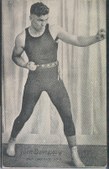
1921 Exhibit Jack Dempsey. The then-reigning heavyweight champ, this card may be predated by the film card shown above.
|  252 252
|
 253 253
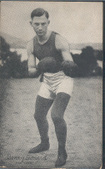
1921 Exhibit Benny Leonard. Considered one of the greatest lightweights of all time, he held the title for seven years. Leonard was a product of the Lower East Side of New York and changed his name from Leiner so that his mother would not find out he was fighting.
|  254 254
|  255 255
|  256 256
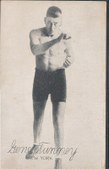
1922 Gene Tunney. The true "rookie" card of the lightheavyweight and future heavyweight champion.
|  257 257
1925 Exhibit Jack Dempsey, horizontal pose. There are four known poses in the 1925 Exhibit set for Dempsey.
|  258 258
1925 Exhibit Dempsey seated pose. The image is from a theatrical still (note the greasepaint make-up) and can be found in blank-backed format as part of a movie set as well as with the record back and 1925 copyright.
|  259 259
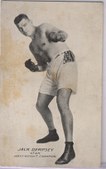
1925 PC backed Dempsey. The issuer of the PC backed baseball set issued a series of boxing cards in 1925 with 1924 records on their backs. The series was revised and reissued with recordless backs in 1926 through the late 20s in multiple colors. Collectively, the group is called the "Blue Boxers" after one of the most distinct card colors.
|
 260 260
2nd Blue Boxer type Dempsey. Two boxers have two cards in the set: Dempsey and Tunney. The 2nd cards reflect Tunney's late 1926 victory over Dempsey. As a consequence of the manner in which the Blue Boxers were issued, there are considerable short prints.
|  261 261
1925 PC back Dempsey without record back. This pose is found with the record back and with the PC only back. Given the new pose with the ex champ notation on the front, it appears that the Blue Boxers were issued in 1925 in the original record back format with 1924 record, reissued in 1926 with the PC backs, and modified thereafter with at least two new poses.
|  262 262
1925 PC record backed Benny Leonard. The toughest Exhibit Leonard card.
|  263 263
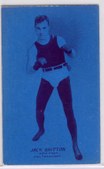
Blue Boxers Jack Britton. The next several images show some of the colors of Blue Boxers from the ca. 1926 and later printings of the set.
|  264 264
Orange stock Joe Burman Blue Boxer
|  265 265
Blue Boxers Jack Britton
|  266 266
Blue Boxers Carl Tremaine. As you can see, some colors worked better with some images than others.
|
 267 267
Red stock Johnny Dundee Blue Boxer
|  268 268
Blue Boxers Jess Willard
|  269 269
Blue Boxers Luis Firpo
|  270 270
Pink stock Dave Shade Blue Boxer
|  271 271
Grey stock with blue ink Eddie Fitzsimmon. This card and the next two depict the most difficult color combos to find. I suspect that they were printed first among the colored issue and quickly replaced
|  272 272
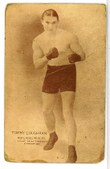
Blue Boxers Tommy Loughran sepia. One of the toughest colors to acquire.
|  273 273
Blue Boxers Leo Lomski light blue tone. Another very tough color.
|
 274 274
Yellow stock Lew Tendler Blue Boxer. I had considered trying a master set, but the numbers are potentially into the hundreds of cards. Here are several Lew Tendler cards.
|  275 275
Black and white Lew Tendler with record on back
|  276 276
Lew Tendler.
|  277 277
Blue Boxers Lew Tendler
|  278 278
Blue Boxers Archie Bell. Here is a nice run of the blue tinted cards.
|  279 279
Blue Boxers Tony Canzoneri
|  280 280
Blue Boxers Eugene Criqui
|
 281 281
Blue Boxers Jimmy Delaney
|  282 282
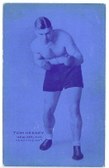
Blue Boxers Tom Heeney
|  283 283
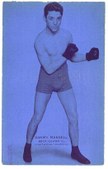
Blue Boxers Sammy Mandell
|  284 284
Blue Boxers Dave Rosenberg
|  285 285
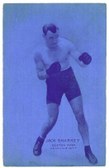
Blue Boxers Jack Sharkey
|  286 286
Blue Boxers Bud Taylor
|  287 287
Blue Boxers Paolino Uzcudun
|
 288 288
Blue Boxers Charlie White
|  289 289
1925 record backed Abe Attell Goldstein. The next few images depict some of the short prints in the set.
|  290 290
1925 Sailor Friedman
|  291 291
1925 Nate Goldman
|  292 292
1925 Rocky Kansas
|  293 293
1928 Exhibit Louis Kid Kaplan. The 1928 set is the largest of the sets, with over 140 known subjects. Nicknamed the Meriden Buzzsaw, Kaplan was a Russian-Jewish immigrant. He retired when he had trouble making weight, after turning down an offer to rig a fight for big money. As he moved up in weight class, he was denied a title shot out of fear of his ability.
|  294 294
|
 295 295
|  296 296
|  297 297
1928 Exhibit Ruby Goldstein. Goldstein, a Benny Leonard protege, was a tremendous fighter who had a glass chin, and was later a well known referee. He was officiating when Benny "Kid" Paret was beaten to death by Emile Griffith on national tv in a 1962 fight. Paret had called Griffith a homosexual [actually, he used an extremely denigrating Spanish slang term] because Griffith was a florist who hung out in gay bars. Ironically, and sadly, Griffith was very badly beaten in New York a few years ago while coming out of a gay bar. The story of the fight and its impact on the fighters and their families was the subject of a recent documentary film.
|  298 298
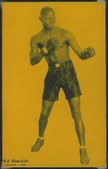
Kid Chocolate, real name Eligio Sardinas, was a top fighter out of Cuba. This card, from the 1928 set, is very popular and rather hard to find.
|  299 299
1948 Exhibit Champions Jack Dempsey. Along with Joe Louis, Dempsey is one of 2 boxers in this popular multi-sport set.
|  300 300
1948 Champions Bobby Riggs. Two decades before he became the poster-boy for male chauvanism, Bobby Riggs was a champion tennis player. He was also a heavy gambler and raconteur, which is how the whole Billie Jean King match came into being.
|  301 301
1940s-50s Jake LaMotta. The Salutations format was used by ESCO in a number of different personality sets. LaMotta's story is well known from the movie "Raging Bull" and he is a popular autograph guest.
|
 302 302
1950s Exhibit Rocky Marciano. The Rock is the only undefeated heavyweight champ, retiring in early 1956 with a perfect record. A friend of his, fighter Sammy Luftspring, claims that Rocky (a notorious cheapskate) retired in part because he was incensed over being cheated by their co-manager.
|  303 303
This Bill Terry card is from a large-format strip set called W517 and commonly dated as a 1931 issue. I put it here because this set uses many of the same images as are used in the PC-backed exhibit set, without the circular card number. This raises the intriguing possibility that the same company made the PC set, W517, the ca. 1930 entertainment cards shown above and at least two strip sets that appear to be directly derived from the entertainment cards.
|  304 304
Here is the original art for the Terry card. Photograph and ink on board. The small circular stain in the dirt appears to be where the #23 sticker appears in the finished card. It appears that the sticker fell off over time. Although this item was sold to me as a PC backed Exhibit image, it is clearly a W517. Sometimes the obvious smacks you in the face and you still miss it. The legend on the PC Back Exhibits and the W517 is handwritten by the same person.
|  305 305
ca. 1929 Fancy Script Bennie Bass. The Fancy Script issue is a small set named for its ornate legend. The cards are PC backed and dated based on the known subjects.
|  306 306
Fancy Script Bennie Bass color variation. Black and White is the most encountered color but there are some colored variations as well.
|  307 307
Fancy Script Primo Carnera. One of the earliest Carnera cards.
|  308 308
Fancy Script Max Schmeling. One of the earliest Schmeling cards, but not the earliest. Schmeling has a card in the 1928 Exhibit set and the 1927 York Caramel (E211) set.
|
 309 309
Fancy Script Al Singer, red tone. Dig those groovy trunks, man!
|  310 310
fancy Script Mickey Walker sepia tone. First one of these I've seen in a sepia tone. Came from a new to the hobby find of PC backed exhibits which included multiple sepia and light blue cards.
|  311 311
Dempsey v. Tunney II. In order to capitalize on the popularity of the Dempsey v. Tunney fights, ESCO issued a set devoted to the 2nd battle, the Long Count fight that took place in Chicago in 1927.
| 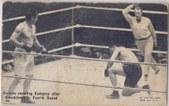 312 312
The Long Count resulted from a rule change that Dempsey caused. Under old rules a fighter could hover over a downed opponent and hammer him the moment he stood up. Dempsey was notorious for this. As a result, the rules were changed to require a fighter to go to neutral corner in the event of a knock down.
| 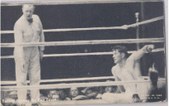 313 313
Dempsey downed Tunney and forgot the rule, resulting in the ref not starting the ten count until Dempsey went to the neutral corner.
|  314 314
Tunney received at least 14 seconds to recover from the knockdown.
|  315 315
He got back up and resumed fighting. It is unclear whether he was hurt enough by the knockdown to have needed the extra time, but it certainly helped him.
|
 316 316
Tunney, whose slashing, scientific style was tailored specifically to defeat Dempsey, resumed the fight and beat Dempsey for a second time to retain the title.
|  317 317
The Rat Pack had some nice Exhibit cards. Here is Sammy Davis Jr.
|  318 318
How did all these people get in my room? Dino's Exhibit card.
|  319 319
The Chairman of the Board had at least three Exhibit cards that I know of.
|  320 320
The great Louis Prima. When Sinatra and the rest of the boys finished at the Sands they would head for Prima's show. Easily the coolest show in Las Vegas history.
|  321 321
Keely Smith, Louis Prima's wife and lead singer.
|  322 322
Harry Belafonte. Day-O!
|
 323 323
The greatest voice in the history of Jazz, Ella Fitzgerald.
|  324 324
ESCO issued a number of series of cards devoted to pop stars in the 1960s in conjunction with Billboard, which provided the write-ups for the card backs. Here are the Animals.
|  325 325
The Beach Boys
|  326 326
The Fab Four.
|  327 327
The Prefab Four
|  328 328
The Rolling Stones in their mop-head stage.
|  329 329
Chuck Connors played baseball for the Brooklyn Dodgers, basketball for the Boston Celtics, but was best known as Lucas McCain, "The Rifleman". He was a big, rangy 6'7" and a very fun autograph guest at card shows.
|
 330 330
Connors as The Rifleman. This card is from a series of western cards made by Nu-Card in the early 1960s. They were sold in packs and are frequently mistaken for Exhibit cards because they are the same size and in a similar format.
|  331 331
Connors and Johnny Crawford, the boy who played his son on the Rifleman.
|  332 332
I could not believe this 1930s wrestling card when I saw it. While nationalities and home towns were frequent designations on card fronts, I have never seen a religious designation on a card front except on this card.
|  333 333
1930s Jim Londos. Wrestling as both legitimate sport and scripted spectacle was a popular subject of ESCO sport issues from their inception to the end. This card of legitimate wrestler Jim Londos comes from a very tough 1930s issue, rarely seen, that surfaced on ebay in July 2005 from an old family collection, along with some boxers from the same era.
|  334 334
1930s Bronko Nagurski. From a wrestling issue, he is best known as a HOF football player. Also had a couple of football cards in the 1930s and wrestling cards in the 1950s from Parkhurst.
|  335 335
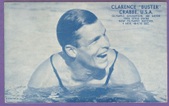
Larry "Buster" Crabbe won Olympic gold in the 1932 Los Angeles games and went on to star in various westerns and B serials, notably the Flash Gordon and Buck Rogers series.
|  336 336
Here is a tough pose of heavyweight Buddy Baer. I had not ever seen this pose before July 2005 when I picked it up at the National. Ironically, a week later one more surfaced on ebay from an old family collection being broken by heirs. I've seen it a handful of additional times.
|
 337 337
This Andy Martin is from a 1928 style subgroup of blue print cards with blank backs. I'd seen one or two before a nice group surfaced on Ebay. Some new additions to the checklist for 1928, some already known.
|  338 338
The first few years of baseball 4 on 1 issues were multi-colored. The next few cards are examples of the range of colors used.
|  339 339
Red with black print wasn't a really good choice.
|  340 340
I like the orange ones. Tough color to find.
|  341 341
This yellow card is printed on two-sided color stock. Very unusual for a baseball exhibit, which is why I bought it.
|  342 342
Bogart, from the 1940s. This is the scarcer of the two Bogart salutations exhibits.
|  343 343
Paul Henried. One enjoyable and challenging way to collect Exhibit entertainment cards is to try and assemble "teams" of casts of famous films. We have Bogie, Henreid and Rains next. Anyone want to guess what film?
|
 344 344
Rick: How can you close me up? On what grounds?
Captain Renault: I'm shocked, shocked to find that gambling is going on in here!
[a croupier hands Renault a pile of money]
Croupier: Your winnings, sir.
Captain Renault: [sotto voce] Oh, thank you very much.
[aloud]
Captain Renault: Everybody out at once!
|  345 345
|  346 346
1926-29 PC Back Lefty Grove. Considered to be one of Grove's rookie cards, though not his first card (he had a minor league card).
|  347 347
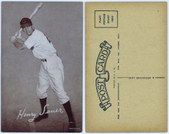
1950s Hank Sauer with Mutoscope back.
|  348 348
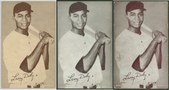
Three varieties of Larry Doby. No "An Exhibit Card"; "An Exhibit Card"; and scratched out "An Exhibit Card"
Look at the lower edge.
|  349 349
Salutations Tommy Holmes variations
|  350 350
This is not an Exhibit card. It is an arcade card from a rival issuer. There are several known cards of this format, all movie star cards from the era. They are very hard to find. A few have turned up in recent years in large, new to the hobby, groups of cards offered for sale. I will post a few more examples.
|
 351 351
Tom Tyler
|  352 352
Buzzy Barton (the kid) and two other hombres from the non-Exhibit issue.
|  353 353
Hoot Gibson from the Ruth-Snookums issue.
|  354 354
Bill Bojangles Robinson. Tough card to find.
|  355 355
Autographed 1977 Exhibit Hank Greenberg. The reconstituted company made an extensive series of reprints and new prints using the Baseball's Great Hall of Fame theme in 1977.
|  356 356
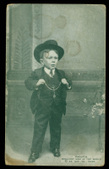
1925 Exhibit sideshow series card of Zip the pinhead. Very tough series with some truly disturbing sideshow acts in it.
|  357 357
|
 358 358
|  359 359
|  360 360
|  361 361
|  362 362
|  363 363
|  364 364
Real name Elly Annie Schneider, she was one of 4 tiny performers who billed themselves as the Earles and as the Dolls. She had roles in "Freaks" and "The Wizard of Oz" as a munchkin.
|
 365 365
|  366 366
|  367 367
|  368 368
|  369 369
|  370 370
1960s Cassius Clay green variety
|  371 371
|
 372 372
|  373 373
|  374 374
|  375 375
|  376 376
|  377 377
|  378 378
|
 379 379
|  380 380
|  381 381
|  382 382
|  383 383
|  384 384
|  385 385
|
 386 386
|  387 387
|  388 388
|  389 389
|  390 390
|  391 391
|  392 392
|
 393 393
|  394 394
1954 Canadian Exhibit Walter Alston. The 1953-1954 Canada-only Exhibit issues use color and depict players from the minor league AAA Montreal Dodgers farm team in Canada including HOFers Walter Alston and Tommy Lasorda.
|  395 395
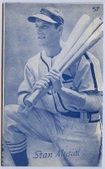
Major league cards were also issued in the 1953 Canada set, using artwork from the postwar sets. The Musial here shows one format similar to the minor league cards.
|  396 396
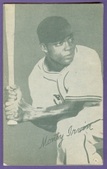
Cards 1-32 can be found in green or red and have numbers in a diamond; 33-64 are blue or red and have free-floating numbers.
|  397 397
|  398 398
|  399 399
|
 400 400
|  401 401
|  402 402
|  403 403
|  404 404
|  405 405
|  406 406
|
 407 407
|  408 408
|  409 409
|  410 410
|  411 411
|  412 412
|  413 413
|
 414 414
|  415 415
|  416 416
|  417 417
|  418 418
|  419 419
|  420 420
1927 Rixey with stamped back coupon
|
 421 421
|  422 422
|  423 423
|  424 424
|  425 425
|  426 426
|  427 427
|
 428 428
|  429 429
|  430 430
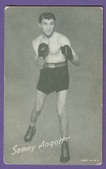
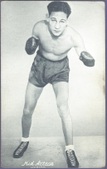
This is Tommy Yarosz, not Sammy Angott. The error was caught and corrected early in the print run, making this one of the rarest boxing exhibit cards.
|  431 431
|  432 432
Ted Sandwina's real name was Theodore Brumbach. He was the son of Katie Brumbach, a circus strongwoman who took the stage name Sandwina in honor of defeating strongman Eugene Sandow in a weightlifting contest in which she lifted a weight of 300 pounds over her head, which Sandow only managed to lift to his chest. Ted was strong but not skilled enough to become heavyweight champ.
|  433 433
Two cards of football great Red Grange in his Hollywood days
|  434 434
Another Grange. Tough as the others are this is the rarest of them all--a handfull of known examples.
|
 435 435
1925 Jeff Smith; 2013 IBHOF inductee
|  436 436
|  437 437
|  438 438
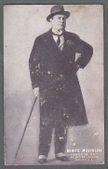
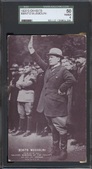
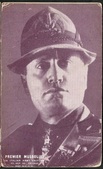
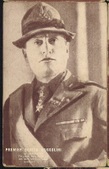
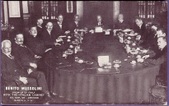
In retrospect, the company's decision to make Mussolini the subject of a 16-card set was not a good idea...
|  439 439
Needless to say, the cards are quite difficult to find today. I assume that the vast majority were destroyed during WWII.
|  440 440
|  441 441
|
 442 442
|  443 443
|  444 444
|  445 445
|  446 446
|  447 447
|  448 448
|
 449 449
|  450 450
|  451 451
|  452 452
|  453 453
|  454 454
A very tough 4 on 1 Exhibit card from the 1920s with the Our Gang Little Rascals and Rin Tin Tin. How perfect is that?
|  455 455
|
 456 456
|  457 457
|  458 458
|  459 459
|  460 460
|  461 461
|  462 462
|
 463 463
|  464 464
|  465 465
|  466 466
|  467 467
|  468 468
|  469 469
|
 470 470
|  471 471
|  472 472
|  473 473
|  474 474
|  475 475
|  476 476
|
 477 477
|  478 478
|  479 479
|  480 480
|  481 481
|  482 482
|  483 483
|
 484 484
|  485 485
|  486 486
|  487 487
|  488 488
|  489 489
|  490 490
|
 491 491
|  492 492
|  493 493
|  494 494
|  495 495
|  496 496
|  497 497
|
 498 498
|  499 499
|  500 500
|  501 501
|  502 502
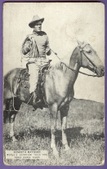
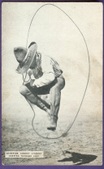
1925 Rodeo Yakima Canutt. A champion rodeo rider, Canutt is the "patron saint" of Hollywood stuntmen.
|  503 503
|  504 504
|
 505 505
|  506 506
|  507 507
|  508 508
|  509 509
|  510 510
|  511 511
|
 512 512
|  513 513
|  514 514
|  515 515
|  516 516
|  517 517
|  518 518
|
 519 519
|  520 520
|  521 521
|  522 522
|  523 523
|  524 524
|  525 525
|
 526 526
|  527 527
|  528 528
|  529 529
|  530 530
|  531 531
|  532 532
|
 533 533
|  534 534
|  535 535
|  536 536
|  537 537
|  538 538
|  539 539
|
 540 540
|  541 541
|  542 542
|  543 543
|  544 544
|  545 545
|  546 546
|
 547 547
|  548 548
|  549 549
|  550 550
|  551 551
|  552 552
|  553 553
|
 554 554
|  555 555
|  556 556
|  557 557
|  558 558
|  559 559
|  560 560
|
 561 561
|  562 562
|  563 563
|  564 564
|  565 565
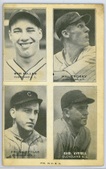
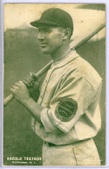
This is a fake.
|  566 566
|  567 567
|
