Hi ~ Love your site! I've noticed quite a few necklaces on ebay advertised as Miriam Haskell that don't look right to me. They have a "clamshell" bead tip (these are folded over the knot & squeezed tight) where the string of beads is attached to the clasp. It seems to me that MH would have used the older tips where the string was fed through & knotted, or knotted the end of the string to a bead & fed the string back through the other beads. Sometimes they are even used to fasten the beads to the front centerpiece. Is the use of these "clamshell" brass bead tips an indication that at least that part of the jewelry is not authentic? - Ruthie MCCORMACK | macks710@bellsouth.net, Thu, 7 Jun 2012 5:17PM
Love you website. I have a beautiful set I would love you to see the pictures of this belonged to a women that was born in the 1800's her daughters husband did double talk played with Jack Benny radio show, radio with Abbott and Costello, played at the Pantage, Keith and Balban & Kate vaudeville circnits. I would send you some pictures of this set if you could tell me your e-mail. I have yet to see a set that looks like this. God Bless! Kitty - kitty, Fri, 18 May 2012 4:07PM
Good morning! I have a pair of Haskell earings passed on to me from my godmother. the central pearl has lost is original galzed due to the fact that they were left in a drawer for a long time and its very humid where I live. How can I send you the pictures for you to look at them? I notice you posted the new location of Miriam Haskell boutique in NYC. Could they be repair? thank you in advance for any suggestions you may give me.
Hi Cathy, I sent you the pics but it was before your auto-reply. I responded to the auto-reply immediately though. Did you get the picture, and was it good enough? It was about the Bloomingdales Bracelet that was tagged with a paper tag but unsigned. I could resend if you would like to see it. the pics were from my webtv.net address if you need to look for it. Warm Regards, Dawn - dawn, Tue, 26 Aug 2008 2:19PM
I have a braclet and earrings that I think are Miriam Haskell and would like to know for sure. How do I have you look at them? - Sandy Lilla, Mon, 3 Mar 2008 1:06PM
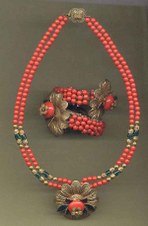
1 I bought this necklace and bracelet from a woman whose mother purchased it in Paris in the early 1930s. Coral glass beads are interspersed with green glass and gilt metal spacers and both pieces have large gilt metal flowers and pate de verre flattened coral beads. The bracelet is a wrap style--spring wire covered with silk thread. Unsigned Haskell.
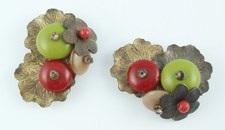
2 A matching dress clip to the necklace and bracelet.
3 Another style from the same line. This necklace is missing one strand of beads on each side of the clasp. Unsigned Haskell.
4 Gilt lily leaf dress clip with flattened glass beads and gilt findings. Unsigned Haskell.
5 Early necklace of taupe and rust-colored beads with a lovely clasp and center decoration made of gilt lily leaves and pate de verre beads in taupe, lime green and rust. One of my favorite necklaces to wear! Unsigned Haskell.
6 A matching paid of dress clips from the same line showing a more elaborate configuration. Unsigned Haskell.
7 Transition necklace of pate de verre and art glass beads in shades of amethyst and lavender. Signed hangtag, but unsigned flower hook. Probably from 1950-1951. Signed Haskell.
8 A variation on the prior necklace, using faceted glass stones instead of art glass beads. Most likely from the same line. Similar unsigned hook with oval hangtag leading me to believe that this is from 1950-1951. Signed Haskell.
9 Elaborate earrings from the same line. Signed Miriam Haskell on the French clip earring findings.
10 White glass bead lariat with motifs of curled glass leaves and half-dome shaped metal balls covered with seed beads. Clip backs are on pierced plastic, dating this to WWII era. Unsigned Haskell.
11 Chandelier earrings of Niki pearls and rose montees. Later adjustable ear-clips dating these to at least 1965. I believe these earrings (and the following collar) were designed by Robert Clark. Signed Haskell.
12 Elaborate pearl collar with round and oblong smooth Niki pearls set in silver-plated findings, with matching earrings. This is an "A" level set, attributed to Robert Clark. Signed Miriam Haskell on the clasp.
13 Collerette, c. late 1950s, of baroque pearls woven together and tipped with faceted, oval pale yellow crystal stones and pate de verre flowers and beads. See Cera pg. 131. Signed Haskell.
14 Matching spring wire pearl bracelet and earrings with low dome pearl button centers. Bracelet isn't signed, but probably had a hangtag; earrings have flat-back clips signed Miriam Haskell.
15 Necklace of large pressed glass leaves alternating with glass bananas, hung from celluloid chains and silk cords. 1930s, unsigned Haskell. See Cera pg. 71.
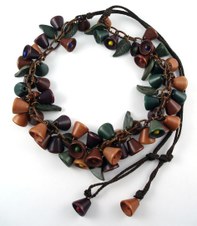
16 Necklace of wood bells with multi-colored glass beads strung on celluloid chain and silk cord. Unsigned Haskell.
17 Close-up of the bells and central glass beads.
18 Pin of coiled black silk cord and dangling bakelite balls strung on chains. Unsigned Haskell.
19 Dress clip of coiled navy blue silk cord with dangling blue glass beads. Unsigned Haskell.
20 Pin of multi-colored plastic roses on short chains with glass bead centers. Unsigned Haskell.
21 Back of the pin showing construction.
22 Long pin of tiny dyed wood beads with wood bows at the top. Unsigned Haskell.
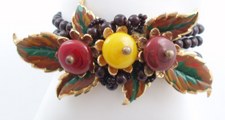
23 Three necklaces from an Autumn line with green glass beads and motifs of painted gilt metal leaves and flattened coral and bright yellow-colored glass beads. From bottom, A, B and C levels of complexity. Note the clasps; these are typical for unsigned Haskell. Motif backs are flat metal plates.
24 Bracelet strung on elastic from the same line in the brown glass bead version. Unsigned Haskell.
25 3-strand necklace of Niki pearls in light gray. Signed Haskell.
26 Two small dress clips of multi-colored glass beads. Probably are part of the line shown in Cera pg 70. Unsigned Haskell.
27 Necklace of gilt chains, bakelite beads and gilt circles sandwiching bakelite circles. Signed Haskell with original paper tag.
28 View of circles.
29 From the Buttons and Bows line, made in 1995, rose montees and pearls on bow-shaped gilt metal findings. Millie Petronzio design. Signed Miriam Haskell.
30 Two pairs of earrings from the line.
31 This is an interesting Haskell that I recently purchased on eBay. And the provenance is also fascinating! So, a bit of a tale, then several pictures.
The woman I bought this from wrote in her listing that her grandparents had met a rather disheveled woman named Miriam Haskell in Arizona or New Mexico in the late 1960s-early 1970s. Turns out they were hospitable mid-Westerners, so they invited Miriam to stay with them. They bought her shoes, got her glasses fixed, fed her, etc. After a couple of months, Miriam started to get haughty, so they decided to send her home to NYC. She had told them she had owned a famous jewelry company, but they thought she was just telling tales. She also invited them to come stay with her in NY.
So, they did. Miriam had a fabulous double apartment and they were wowed. In fact, one of the first things the grandmother did was rush out to a NY department store, where she discovered Haskell jewelry. Miriam was a very gracious, generous woman and l...
32 Central motif -- these gilt flowers are a typical Haskell finding
33 Note the gather where the chains are pulled together -- it is a small filigree bent into this shape. I have never seen this design before.
34 The back has lovely filigrees, but is unsigned. After WWII, when the jewelry industry was able to gain access to metal, Haskell changed its construction to use filigrees rather than the solid metal back plates.
The filigrees were purchased from suppliers in France and Rhode Island (notably the D.M. Watkins Company) and sent to Unida Plating, Providence RI. Unida used a process invented by James Brady for coating the metal parts. The parts went through 6 to 7 preparatory steps and then the special dipping process which created the Russian gold look. the dipping solution contained 24-karat gold, among other secret ingredients. The dipping was done by hand, and as more and more filigrees were dipped, the gold content in the solution got lower and lower, causing variations in coating depth and color. After dipping the filigrees were lacquered.
Sterling silver was used for parts in light (white) silver, rhodium-look silver, and Ru...
35 An unusual clasp embellished with the dove finding and rose montees. Again, the folded filigrees are used as the gather point. This is still a slide clasp, a Haskell necklace style until the early 1950s when Haskell started using the hook and tail design.