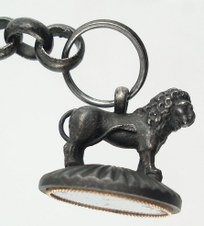
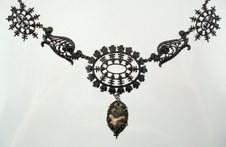
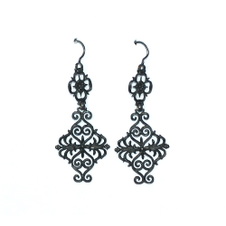
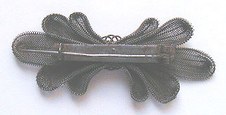
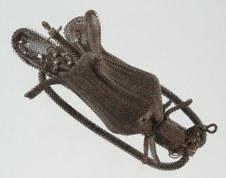
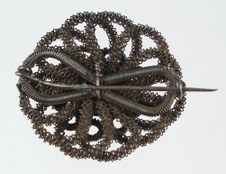
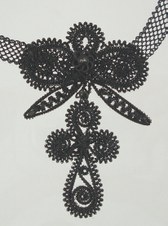
A collection of Berlin Iron and "Silesian" wirework jewelry.
Berlin Iron jewelry was popular throughout the late 18th and early 19th centuries. It was originally manufactured in Germany, but during the Napoleonic period (early 1800s), manufacturing moved to France. By 1813 or so, Germany was again creating this jewelry and by the 1830s it was available in London.
The intricate designs were fashioned from base metal finished in black lacquer; the resulting jewelry was called Berlin Iron, after the Prussian capital. During the Prussian War of Independence, 1813-15, women supported the war effort by exchanging their precious jewels and gold for delicate, ornate ironwork designs. Earlier examples were in the neo-classic style; later motifs were naturalistic, with a Gothic influence.
An excellent reference work on Berlin Iron is Cast Iron from Central Europe, 1800-1850 by Elisabeth Schmuttermeier, The Bard Center for Studies in the Decorative Arts, 1994.
Read more about Berlin Iron jewelry in Anne Clifford’s Cut Steel and Berlin Iron Jewellery and in Shirley Bury’s Jewellery 1789-1940 The International Era, Volume II.
Wirework jewelry's origins remain unknown, according to Christie Romero. It is traditionally known as "Silesian" wirework and originally thought to be manufactured in Silesia. Other possible manufacturing locations are France and England. Given the movement of Berlin Iron jewelry manufacture (Germany to France to London), it is possible Silesian wirework jewelry followed a similar path.
Date(s): March 2006. Album by Cathy Gordon. 1 - 95 of 95 Total. 44721 Visits.
I just drooled all over my iPad looking at your pages! Thank you so much for creating such wonderful pages for all of us to peruse. 💜💜💜💜💜💜 - Chris, Thu, 18 Jul 2019 7:42AM
Cathy, this page is getting a load of looks this week as this is a topic of discussion online. These pictures are thrilling -- love seeing them all assembled together like this -- it helps to train the eye to learn the look. Thank you x 1000! - Anne Morrissey, Fri, 13 Jul 2018 10:38AM
Cathy,
I don't know if you remember me from Jewelcollect, about 15 years ago. I sold you some haskells. I am pretty sure I sold #9 to the owner. I sold it from A Link to the Past website to a customer in California. - Betsy by Chicago, Sun, 29 Apr 2018 3:47PM
Hi, love this site! I have three pieces of silesian wirework on their original cards I bought years ago before anyone had ever heard of silesian wirework. Wish there was information on the card but it only has a Greek key design. Warm regards, Fran. - Fran Hartke, Wed, 14 Oct 2015 8:01AM
I have a ring that looks like silver. It has a black onyx and the only real word on the inside band I can make out says BERLIN. The rest is worn. I do not know much more about it. I can email photos if you like. - Ron Day, Wed, 14 May 2014 10:43AM
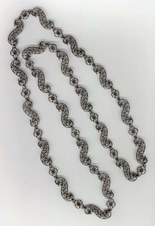
1 Berlin Iron chain necklace "Middle period" probably French post-1812
It is composed of alternating sea wave and flower links. The same sea wave link can be seen on color plate IV of Anne Clifford's book "Cut-Steel And Berlin Iron Jewellery". Her example has 12 sea wave links with a clasp. This chain is 41 inches long and in excellent condition. It's rare to get a chain of this length.
2 Berlin Iron Necklace w/ Cross Pendant Circa 1851 or 1861 (Gothic work was popular during the time of the Exhibitions)
A stunning 19th century Berlin Iron necklace with cross pendant, the necklace composed of circular links of sprung wire, suspending a Gothic revival style cross pendant. For a similar cross, see plates 40 (from the Rouen Museum) and 52 in Anne Clifford’s Cut Steel and Berlin Iron Jewellery; for similar sprung linking see the bracelet in plate 42. Berlin iron jewelry was popular throughout the 19th century and was manufactured in Germany, Austria and France. By the 1830s it was available in London. The intricate designs were fashioned from base metal finished in black lacquer; the resulting jewelry was called Berlin Iron, after the Prussian capital. During the Prussian War of Independence, 1813-15, women supported the war effort by exchanging their precious jewels and gold for delicate, ornate ironwork designs. Earlier examples were in the neo-classic style; la...
3 Closeup of the Gothic cross.
4 Berlin Iron bracelet with cameo clasp Early period, circa late 18th-early 19th century.
Bracelet of linked spring-wire circles with a single cameo plaque on polished steel decorating the clasp. The spring wire in this bracelet is the same construction as the chain in the prior necklace.
See Anne Clifford, Cut-Steel and Berlin Iron Jewelery Plate 42, page 80 for a similar example.
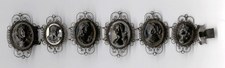
5 Berlin Iron Neo-Classic Cameo Bracelet Early Period, circa late 18th-early 19th century
Rare, stunning and early Berlin iron bracelet, comprising six neoclassical cameo links, circa the first few decades of the 19th century. Berlin iron jewelry is a rarity today. It is thought that it originated with Prussian armorers, who turned to jewelry when their shields and suit of armor were no longer needed. The first known factory dedicated to iron jewelry was opened in 1804 and the market peaked about ten years later, during the war with Napoleon, when wealthy citizens were urged to turn in their gold and gemstone jewelry to support the war effort. In return they were given pieces like this bracelet. These cameos were typical of jewelry made pre-Waterloo, when Napoleon’s empire still held sway over current fashion. This bracelet is superb. It features six different classical headset on a medallion of polished steel and surrounded with swirls of iron wire. The cameos are graduated, t...
6 Details of the cameos showing the polished steel plaques.
7 and more details.
8 More details.
9 Berlin Iron Post-1815
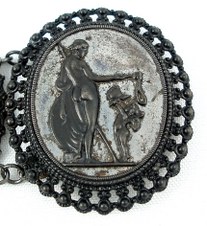
Bracelet with plaques in a floral design and a clasp with Cupid handing a helmet to Diana (on polished steel. See similar examples in Clifford's Cut Steel and Berlin Iron Jewelry, plates 42 and IV.
From her book, page 29: "The Empire style gave way to formalized foliate and lattice-work designs, which at first included much smaller steel and iron pseudo-cameos with fruit and flower motifs, or even classical subjects--such as Cupid and Psyche--treated romantically rather than heroically."
10 Close up of clasp, Cupid handing helmet to Diana (?). Some bits of rust on the polished steel back plate.
11 Two of the floral motif plaques.
12 Back of the plaques.
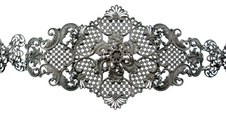
13 Berlin Iron bracelet Circa 1830s-1840s
A superb lacey cast iron bracelet, possibly by Siméon Pierre Devaranne, the son of a Berlin merchant, he established himself as a "craftsman in gold and silver" in 1814. He later described himself a manufactuer of gold, silver and fine cast-iron goods, Devaranne had his work cast at the Berlin or Gleiwitz foundry or in his own factory. His products were praised for their extraordinary technique and delicacy of the design.
14 Close-up of the central motif and side panels. Notice the amazing delicate vines and floral motifs. The bracelet is not heavy at all.
15 Back of the bracelet.
16 Bracelet clasp.
17 Berlin Iron bracelet Johann Conrad Geiss circa 1830
Elaborate cast iron bracelet, showing a combination of Neoclassical and neo-Gothic styles. There are Gothic architectural elements (tracery and foils) mixed with naturalistic representations of foliage. The clasp shows a dancing maiden set on polished steel and rimmed with gold wire.
Johann Conrad Geiss (1771-1846) was the most important influence on the production of iron jewelry. In 1806 he began to design his own jewelry and had the individual pieces produced in Gleiwitz and Berlin, then assembled into necklaces and bracelets. He was the first to set high quality iron jewelry elements in gold and silver and to frame cameos in gold wire. He became so successful the foundires could not keep up with his orders, so he estalished his own foundry in Berlin where he mainly cast jewelry elements he designed. (information from Cast Iron from Central Europe, 1800-1850, Elisabeth Schmuttermeir...
18 Close-up of the clasp.
19 Back of clasp showing (poorly) the Geiss signature.
20 Berlin Iron Watch Chain and Fobs c 1830
Rare watch chain with two fobs -- a lyre and a lion -- and a swivel hook.
21 Berlin Iron Lion Fob c. 1830
Lion fob mounted on a polished steel plaque with a 14 kt gold surround.
22 Berlin Iron Lyre Fob c. 1830
Berlin Iron lyre fob.
23 Berlin Iron bracelet Johann Conrad Geiss Circa 1830s-1840s
8-link cast iron bracelet of back-to-back grape leaves with an ornate rectangular clasp. the ironwork on the clasp is 2 1/4" by 1 1/2" and the central raised section is backed by a polished steel oval. Bracelet is 7 3/4" long.
While the bracelet is not signed, the leaves are a common design element used by Geiss.
24 Closeup of the clasp.
25 Interesting iron piece on the box clasp, another style shown on Geiss pieces.
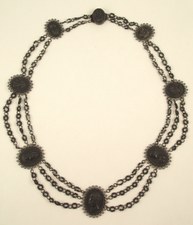
26 Berlin Iron Festoon Necklace with 8 Cameos Circa 1820s-1830s
The Neoclasical portraits on each medallion are silhouetted against a polished steel background. Each steel plaque is rimmed with a gold bezel. The clasp also has a cameo portrait.
The circles of iron-wire coils that serve as the necklace chain were a common feature in jewelry and purses.
27 Berlin Iron Ladies Dress Buckle Circa 1830s 3" by 1 1/4"
28 Berlin Iron bracelet Attributed to Johann Conrad Geiss C. 1820-1830
Filigree bracelet made up of 7 segments, with each having a trefoil placed above and below a square containing traceries. The rectangular clasp has a foliate design with a cameo on a ploished steel disk. See Bard catalog pg 294.
29 Berlin Iron cuff bracelet C. 1830
Unusual bracelet in a rigid cuff style. Center plaque is polished steel with a warrior cameo. Plaque has rust damage.
30 Side view of cuff. Clasp is a round ball that fits into holes on the other side of the bracelet.
31 Berlin Iron necklace Siméon Pierre Devaranne Circa 1830s-1840s
Unique Berlin Iron necklace by designer Siméon Pierre Devaranne, who with Johann Conrad Geiss took cast iron jewelry to a new level starting in the late 1820s.
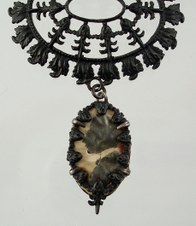
The necklace is made of delicate iron links, of which two are dolphins. The clasp is a Medusa head and the central drop has a woman's silhouette.
In Cast Iron from Central Europe, 1800-1850, by Elizabeth Schmuttermeier, several of the elements used in this necklace are pictured on page 109.
32 Central drop and dolphin links.
33 Look at this in full view. Silhouette of a woman facing to the left. There is damage to it, perhaps to the coating or perhaps to the underlying material. I am thinking the material may be mica.
34 The Medusa head clasp, slightly less than 1/2" across.
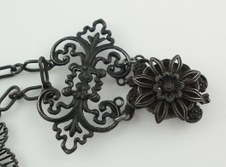
35 Berlin Iron choker Johan Conrad Geiss Circa 1830
This choker is a marriage and most likely started "life" as a bracelet. The two double-leaf panels appear to be an addition as they do not match the remainder of the panels. Marked Geiss Berlin.
36 Wonderful floral clasp.
37 Berlin Iron necklace Johan Conrad Geiss Circa 1830
A wonderful necklace of graduated leaf shapes with a clasped hands clasp. Marked Geiss.
38 Close-up of clasp.
39 Berlin Iron cross pendant and chain Circa 1820-1830
Cast iron cross with winged cherubs on each cross end and cherub faces down the center and on the arms. Delicate iron link chain.
40 Berlin Iron necklace Circa 1820
Dramatic Berlin Iron necklace composed of cast medallions and chain of iron-wire coils (made large enough to be visible from a distance and thus a key decorative part of the necklace).
The six iron cameos feature mythological subjects such as Apollo and the infant Bacchus as well as Roman notables. The lacy woven chain is triple-swagged in typical Neo-classical style.
The necklace is 46 cm [18.5 inches] long. The front cameo panel measures 1 and 1/8 inches by one inch and the lacy chain sections are one to one and 1/2 inches wide.
41 Another photo of the necklace.
42 Close-up of a cast medallion.
43 Close-up of a cast medallion.
44 Close-up of a cast medallion.
45 Berlin Iron cross pendant Circa 1820-1830 Possibly Johan Geiss
Gothic cross pendant with a central bust of Christ.
46 Back of cross
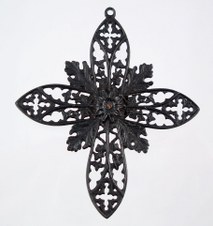
47 Berlin Iron cross pendant Circa 1820-1830 possibly French
Extremely delicate cast iron with acanthus leaves, pointed arches and a central medallion with a winged cherub.
48 Back of cross
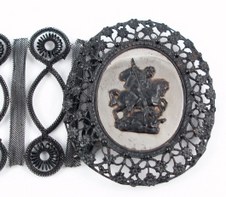
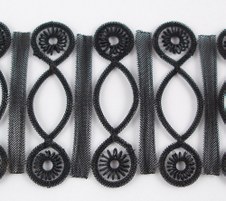
49 Berlin Iron and Silesian Wirework bracelet Circa 1820
A rare example of a combination of Berlin Iron and wirework. The bracelet "links" are alternating panels of woven wirework and coiled wire. The clasp is a large polished steel oval with a cast medallion of St. George and the Dragon surrounded by a foliate cast border.
See Clifford, page 84 plate 46 top bracelet for another example.
50 Close-up of clasp
51 Bracelet links
52 Berlin Iron Ring Dated 1914
Ring of gold and iron, inscribed: Gold gab ich fur eisen' [I gave gold for iron] and then initials WSK and the date 1914. Finger size 6 and 1/4, width of ring 1/4 inch.
53
54
55 Berlin Iron earrings Circa 1820-1830
56 Casting Tree Joseph Glanz Ironworks, Vienna 1831-49 Cast Iron 13x4 3/4" Technical Museum, Vienna Inv. No. 19.944
Cited from: Cast Iron From Central Europe, 1800-1850, pg 270. "The casting tree demonstrates elements of the technique used in casting jewelry. Models were attached to "veins," molten iron was poured into the main vein from which it spread throughout the individual elements. By means of this process extremely delicate and precise casts could be achieved. The temperature of the low-viscosity iron had to be carefully observed; too high a temperature would cause the delicate links to break after cooling.
On this casting tree, the individual elements, which were to be combined in different types of jewelry, are still attached to the casting veins. This rare example was acquired in 1849 by the Technological Collection." Reference: Marquardt 1983, p. 73, fig 55.
57 "Silesian" wirework necklace with a cross, circa 1820-1840. This necklace and the following pieces are attributed to manufacture in Silesia, but at this time, the facts around their origin are still conjecture.
58 Back of the necklace.
59 Silesian wirework circa early - mid 1800s
Elaborate "Silesian wirework" cross. Piece has some surface rust, but is otherwise in good condition.
60 "Silesian" wirework guard chain purchased with the prior necklace. Perhaps worn as a set?
61 "Silesian" wirework pin in the shaper of a bunch of grapes. This pin is amazing!. Origins of this are still unknown (see Warman page 30) though conjectured to come from Silesia. The woven wire mesh is machine-made and Christie Romero circa dates this pin to 1840. There is rust on the very bottom petals.
62 Back of the wirework pin.
63 Two identical "Silesian" wirework bracelets and a matching brooch. The bracelets have small reinforced slits in the band and there is a small metal "pin" that goes into the slit to form the clasp (sort of like a belt buckle). Circa 1820-1840.
64
65 Back of the brooch--notice the extremely long pin stem.
66 "Silesian" wirework coin purse. Measures 3 1/2" by 2/14" with a 7" chain. In incredible condition with one metal bead missing from the center of a flower.
Marked with a stamped, overlapping double V forming a W and the word Revete on the frame. Interior, rose-colored silk lining has come loose and it is backed with paper on which there are printed French words. I cannot read any of it and the paper is mostly glued back-to-back.
Sent to Christie Romero who studied it and her comments are: The "breveté" mark and the newsprint certainly suggest that it's French. But the mark under the "breveté" looks like part of a German mark for WMF, est. 1880 as mfrs of "silver, plate and other metalwork" (from Haslam's Marks & Monograms, the Decorative Arts, 1880-1960). One of their marks is W (configured like the W on your purse - looking like two overlapping Vs) above MF - which there isn't room for below the W on your purse. As we know, the Germa...
67 Details of the front showing wirework design and wire braid. The center paillette is often found on wirework pieces.
68 Back of "Silesian" wirework coin purse showing wire mesh in a diamond pattern.
69 Another "Silesian" wirework coin purse showing very similar manufacture though with no frame markings.
Purse shape is different but made with the same riveted construction. Chain purse handle is the same. This one's interior is intact and still attached, again with several compartments. No lining.
Front decoration is missing some leaves on the left, but the purse is in very good condition otherwise with only a tiny bit of rust on the back.
70 Back of the purse.
71 Early "Silesian" wirework purse. Beautifully designed with open sides, wire tassles and bobbles, and a fine mesh double chain handle.
72 Close up of decoration at center top.
73 Bobbles and handle.
74 Showing the amazing work on one of the bobbles.
75 "Silesian" Wirework floral brooch C. 1850
Small "Silesian" wirework brooch in the shape of a fuschia. Very unusual.
76 Another picture of the brooch.
77 And another... Note the stamens.
78 "Silesian" Wirework brooch C. 1850
Brooch formed of wire mesh loops with a faceted glass center framed by twisted coiled wire. See Romero, 2nd edition page 10 for the same brooch.
79 Back of brooch.
80 "Silesian" wirework bracelet 1820s
Balls of twisted wire -- i.e., the wire is twisted upon itself, then twisted again to make the balls (or beads).
81 Silesian wirework pin and earrings in original box c. 1820-1840
Rare set in pristine condition in the original box. There would have also been a bracelet fitted into the top section. The box lid is shaped to fit over the forms (and frankly reminds me of a coffin...).
82 Closer view of the set in the box.
83 Silesian wirework pin and earrings. There is no sign of rust or wear. In the pin, the tiny flowers have cut steel bead centers. The earrings are almost 3 inches long.
84 Silesian wirework necklace with tassles c. 1820-1840
A wonderful necklace of twisted wire links alternating with twisted wire balls ending with two tassles. This necklace came in the box with the previous pin and earrings but is not the same style.
85 Silesian Wirework bracelet Circa 1830-1840
86
87 Silesian wirework bracelet European, probably German Circa 1800
Rigid metal cuff covered with fine mesh wirework, decorated with pailettes and with a central dangle.
88
89 Silesian Wirework necklace with elaborate pendant Circa 1830-1840
90 Closeup of pendant
91 Gold and wirework earrings Victorian
I found this pair of earrings interesting as it is possible these are a "Silesian" wirework transition piece. There are indications wirework jewelry was made in England, and the mesh is exactly like other wirework pieces I own. Provenance -- from a Colorado estate, earrings purchased in England in the late 1800s.
92 Silesian wirework bow brooch Circa 1830s
93 Silesian wirework bow with its original handcrafted box.