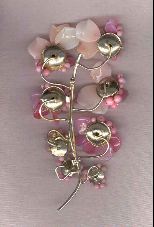
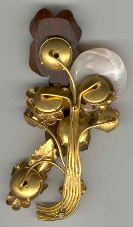
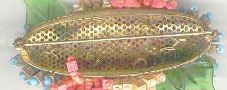
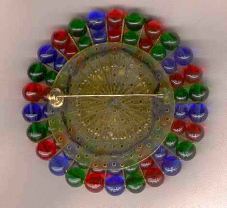
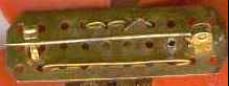
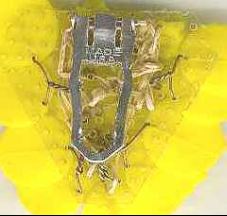
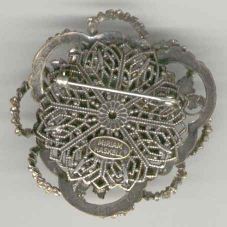
With Haskell clips and pins, some of the best indicators of her pieces are the backs. The same styles are used over and over again. Learn these and you won't even have to see the front! There are also a couple of examples of signed pins to give you a view of the variety of pin backs. There are many Haskell-like designers (Robert, DeMario, Eugene, Jonne, and Morton) as well as loads of pieces that imitated Haskell from Japan and Germany.
A rule of thumb: if a pin or clip is unsigned, and has a filigree back, it is UNLIKELY to be a Haskell.
Date(s): October 22, 2002. Album by Cathy Gordon. Photos by Cathy Gordon. 1 - 35 of 35 Total. 26041 Visits.
1 Early pin back, probably from the 1920s-1930s. Unsigned Haskell.
2 Early pin back, probably from the 1920s-1930s. Unsigned Haskell.
3 Early pin back, probably from the 1920s-1930s. Unsigned Haskell.
4 Early pin back, probably from the 1920s-1930s. Note that there is no clasp, just a notched "C" for the pin stem. Unsigned Haskell.
5 Early pin back, probably from the 1930s. Primitive pierced metal with sewn-on seed beads and a simple "C" clasp. Unsigned Haskell.
6 Early pin back, found throughout the 1930s, but this one is most likely from WWII, which is when these small beads were used. Unsigned Haskell.
7 Early pin back, probably from the early 1940s. Pierced metal is finer than prior pin and pin has a safety clasp. Note wired-on beads. Unsigned Haskell.
8 Early pin back, probably from the 1930s. During the 1930s, Haskell started to cover the pierced backing with flat metal covers. You will see these on necklace clasps, pin backs and other wired areas. Unsigned Haskell.
9 Another 1930s pin back with a metal cover over the wiring. Unsigned Haskell.
10 Typical fur clip configuration from the 1930s against a flat metal back. Unsigned Haskell.
11 Two pre-WWII fur clips showing clip and metal plate construction. Unsigned Haskell.
12 1930s dress clip style. These were on the backs of clips, but were also used on the ends of lariat necklaces.
13 Three turquoise art glass bead clips showing dress clip style on metal backing. Unsigned Haskell.
14 1930s dress clip with metal back. Often seen on lariats also. Unsigned Haskell.
15 1930s dress clip with metal back. This style of clip is the most common of all unsigned Haskell and is used on both clips and necklaces. Unsigned Haskell.
16 Hard to see....Pierced plastic back with pin and beads held on by thread. WWII era when metal was called in by the government. Unsigned Haskell.
17 Pierced plastic back with pin (simple "C" clasp) and beads held on by thread. Unsigned Haskell.
18 Flat, pierced pin style from WWII. It usually has a safety clasp, though I have seen "C" clasps. Unsigned Haskell.
19
20 WWII pin style--pierced metal with edges. Unsigned Haskell.
21 Example of pin style with edges. Unsigned Haskell.
22 Pierced plastic pin with sewn-on beads. Unsigned Haskell.
23 Most common clip style, showing the transition into the WWII style with the pierced plastic back. Unsigned Haskell.
24 WWII era clip on pierced plastic. This is a popular style of clip, often seen on larger pieces. Unsigned Haskell.
25
26 Uncommon WWII clip style. I've only found 4 of these. Unsigned Haskell.
27 WWII clip style typically used with smaller clips. Fairly common. Unsigned Haskell.
28 Uncommon WWII clip style (2 examples). I only have this single example. The front parts look correct, as well as the construction, but I don't have enough other examples for comparison to be totally sure in my attribution.
31 Another WWII clip used with smaller pieces. Unsigned Haskell.
32 Possible Haskell though not enough samples have been found.
33 Pin back showing filigree, signature plate and pin style. Note that the center of the filigree is solid. The next two pins show a different style. Probably from the 1950s. Signed Haskell.
34 Pin style showing filigree, signature plaque and pin. Filigree covers the wire-work. Probably from the 1950s-1960s. Signed Haskell.