 African Daisies 1 African Daisies 1
Introduced Species which escape from home gardens to invade native bushland.
|  African Daisies 2 African Daisies 2
Introduced Species which escape from home gardens to invade native bushland. They come in many colour combinations.
|  Asparagus Fern Asparagus Fern
Asparagus Fern or Ground Asparagus (Asparagus aethiopicus).
Originating in South Africa, Asparagus Fern is a multi-branched prostrate perennial shrub or scrambler forming a dense mat of tuberous roots. Branches grow to 60cm with a covering of small spines. Flowers are bell-shaped, white-pale pink clusters, flowering in late summer.
Fruit are red berries to 8mm wide containing 1 to a few black seeds about 4mm in diameter, occurring winter/early spring.
Seeds are spread by birds, water and dumping. Asparagus Fern can also reshoot from rhizome pieces left in the ground or dumped as garden waste. This weed is invasive and poses a significant threat to the bushland environment.
|  Barley Grass 1 Barley Grass 1
Barley Grass (Hordeum spp.)
Although providing valuable fodder for stock, Barley Grass is a major weed because it acts as an alternate host for a number of cereal diseases, causes stock health problems, is readily dispersed, and can develop resistance to herbicides.
|
 Barley Grass 2 Barley Grass 2
Seed head of Barley Grass (Hordeum spp.)
|  Blackberry Nightshade 1 Blackberry Nightshade 1
Solanum nigrum.
Origin: Native of Europe, Asia and northern Africa.
Dispersal: Spread by seed.
|  Blackberry Nightshade 2 Blackberry Nightshade 2
Solanum nigrum.
Widespread and very common in Australia. Found in many temperate and tropical regions around the world. One of Australia's worst weeds of intensive agriculture. Competes vigorously for space and nutrients especially in Solanaceae crops such as tomatoes. Known to be host to numerous nematodes, fungi and viruses that are indirectly a threat to associated crops.
|  Blackberry Nightshade 3 Blackberry Nightshade 3
Solanum nigrum.
Ripe fruit are black. Green fruit and leaves may at times contain toxic alkaloids.
|
 Blowfly Grass Blowfly Grass
Briza maxima:
Origin Mediterranean region.
Slender, erect and hairless annual (living only one growth cycle) grass. It has few leaf blades and stands erect.
The leaves are generally paler green in colour than other common grasses and have a noticeable twist. These features are useful for distinguishing Briza as a seedling before the seed heads form.
The seed head/fruit (inflorescence) consists of up to 10 spikelets (resembling blowflys) on very fine stems (pedicels). Spikelets are oval in shape and can be up to 10 - 20 mm in length. Spikelets consist of overlapping layers and a seed is held within each layer. Fruit may be pale green to cream/pale brown depending on maturity.
A node or knee-like structure is present on each stem of mature plants indicating that this is a grass.
|  Branched Broomrape (Orobanche) Branched Broomrape (Orobanche)
Orobanche ramosa:
Native of southern Europe, western Asia, Middle East and northern Africa.
Flowers: Pale blue, tubular and two-lipped with lower lip three-lobed and upper lip shallowly two-lobed. An erect spike of flowers appears in spring and summer.
Mature plants to about 20 cm tall with several branches from ground level. Stems with dense soft woolly hairs on the upper part. Leaves reduced to a few brown scales to 8 mm long. Capsule enclosed in persistent corolla. Seeds pepper-like, up to 40,000 per plant.
|  Brazilian Pepper Tree 1 Brazilian Pepper Tree 1
Schinus terebinthifolius.
Origin: Native of Argentina, southern Brazil and eastern Paraguay.
Dispersal: Spread by seed, mostly by birds and mammals, also by water.
|  Brazilian Pepper Tree 2 Brazilian Pepper Tree 2
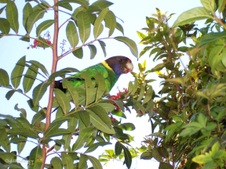
Schinus terebinthifolius.
Widely planted as an ornamental and now naturalised in subtropical areas in Australia. Common in south eastern Queensland, increasing in north eastern NSW and common along the Swan River estuary in WA. This species is particularly invasive in disturbed areas but will invade a number of natural environments. Plants may dominate ecosystems preventing growth of native species. A major weed in many sub-tropical countries between 150 and 300 North and South.
|
 Bridal creeper (Asparagus asparagoides) Bridal creeper (Asparagus asparagoides)
Bridal Creeper is a serious, highly invasive environmental weed, destroying large areas of the native vegetation in southern Australia. Native to Ethiopia, Swaziland and the Cape Province, Natal, Orange Free State and Transvaal regions of South Africa. This plant, currently naturalised in Australia, was introduced into the country as a garden plant during the 1870s. It proved popular in floral arrangements, in particular bridal bouquets, giving rise to its common name, and also as a plant for hanging baskets. Bridal creeper is a Weed of National Significance.
|  Bridal Creeper, an Introduced Species Bridal Creeper, an Introduced Species
Bridal creeper (Asparagus asparagoides), is a 'Declared Plant' in Western Australia.
|  Bridal Creeper, an Introduced Species Bridal Creeper, an Introduced Species
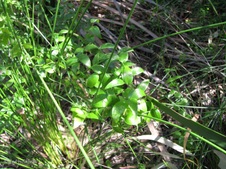
Bridal creeper (Asparagus asparagoides), introduced by early settlers and now escaped from domestic gardens.
|  Burr Medic 1 Burr Medic 1
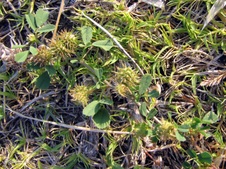
Burr Medic (Medicago polymorpha) is an annual weed, alien to Western Australia, that can often invade lawns. It is usually hairless with stems up to 60 cm long, and having clusters of two to seven flowers borne on short stems in winter and spring. The leaflets are oblong to heart shaped.
|
 Burr Medic 2 Burr Medic 2
Seed of Burr Medic (Medicago polymorpha).
The seed pods or burrs are disc-like, or cylindrical in shape, and consist of one to six coils that are densely spined. These burrs when mature and brown can often be painful to step on and attach easily to clothing like socks and shoes and also to pet hair, where the seeds are then spread to other areas.
|  Caltrop 1 Caltrop 1
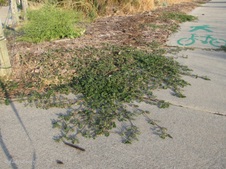
Tribulus terrestris:
Origin: Native at least of the Mediterranean, now cosmopolitan. One Australian species is probably included under this name.
Flowers/Seedhead: Solitary in the leaf axils, 5-petalled. Flowers summer and autumn in southern Australia.
|  Caltrop 2 Caltrop 2
Prostrate annual with stems to 2 m long. Leaves with 4–8 pairs of oblong leaflets, each leaflet to 12 mm long, the upper surface dark green and often with hairy margins, the lower surface paler and hairy. Fruit 11–20 mm wide (including spines), comprising a cluster of 5 segments each with 2 larger divergent spines above and 2 smaller downward projecting spines below. Each segment with 1–5 seeds.
|  Caltrop 3 Caltrop 3
Distinguishing features: Distinguished by petals 2–10 mm long; style shorter than to slightly longer than length of stigma and fruit with 2 larger and 2 smaller spines per fruit segment.
Dispersal: Spines of fruit segments ensure rapid dissemination of seeds.
|
 Caltrop 4 Caltrop 4
A troublesome weed of wasteland, pastoral land, cropping, vineyards and recreation areas. Sharp spines on dry fruit hamper stock handling, are a nuisance in recreation areas and fruit may contaminate drying grapes. Photosensitisation, staggers and nitrate poisoning are also caused by stock grazing Caltrop. Young sheep are especially sensitive.
|  Caltrop 5 Caltrop 5
A native insect and mite damage plants and overseas biological control has been used to reduce problems associated with this species.
| 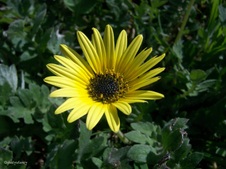 Capeweed 1 Capeweed 1
Capeweed (Arctotheca calendula).
Origin: Native of South Africa and Lesotho.
Flowers/Seedhead: Many small flowers (florets) in solitary heads, 2–6 cm across at the end of stalks 8–25 cm long. Flowers mostly spring and early summer.
|  Capeweed 2 Capeweed 2
Flower and Foliage.
Description: Annual rosette-forming herb with taproot; individual plants to 80 cm wide and 30 cm high. Leaves with upper surface hairless to hairy; basal leaves 5–25 cm long, 2–6 cm wide, on a stalk to 6 cm long; upper leaves, if present, stem-clasping.
Dispersal: Spread by movement of seed, by wind, water or movement in mud.
|
 Capeweed 3 Capeweed 3
Germinates autumn and winter, dying in summer. Widespread and common in temperate areas, and sometimes dominant in pasture. A weed of cultivation, pastures, lawns and disturbed areas. Plants are readily eaten by stock, but woolly seeds may cause impaction. Grazing is thought to taint milk and where Capeweed is the dominant feed nitrate poisoning of stock is possible.
|  Caustic Weed 1 Caustic Weed 1
Caustic weed (Chamaesyce drummondii) is a prostrate multibranched annual weed that infests both gardens and lawn areas. The leaves are circular to oblong shaped and often have a purplish blotch in the centre.
| 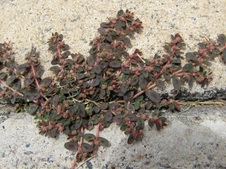 Caustic Weed 2 Caustic Weed 2
Caustic weed (Chamaesyce drummondii). The flowers are inconspicuous and small and are often tinged pink. Flowers appear in summer to autumn.
|  Common Sowthistle 1 Common Sowthistle 1
Sonchus oleraceus:
Native of Europe, Asia & northern Africa.
|
 Common Sowthistle 2 Common Sowthistle 2
Annual herb to 1.2–2 m high. Stems hollow. Leaves variable; basal leaves 5–25 cm long, lanceolate, base not stem clasping; stem leaves 6–35 cm long, lanceolate, usually lobed and with pointed stem clasping basal lobes. Flowerhead made up of heads in flat-topped panicles. Seeds brown.
|  Common Sowthistle 3 Common Sowthistle 3
Spread by movement of seed, by wind, water or movement in mud.
|  Common Sowthistle 4 Common Sowthistle 4
Widespread and common. A serious crop weed in some areas. Does not persist in pasture as it is readily grazed.
|  Common Sowthistle 5 Common Sowthistle 5
This thistle is widely naturalised around the world. Moderately salt tolerant.
|
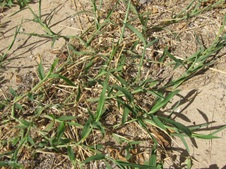 Crabgrass 1 Crabgrass 1
Crabgrass (Eleusine indica).
Crabgrass grows flat along the ground with wide leaves on very tough and wiry stems, the leaves of young plants will be rolled over in half, opening as the leaf matures.
|  Crabgrass 2 Crabgrass 2
Crabgrass (Eleusine indica).
Masses of seeds are produced on several finger-like branches on top of the numerous stems produced by each Crabgrass plant.
|  Crabgrass 3 Crabgrass 3
Seed head of Crabgrass (Eleusine indica). Crabgrass is very difficult to eradicate with selective herbicides as the weed is very similar in nature to many desirable grass varieties we use as lawns.
|  Creeping Oxalis Creeping Oxalis
Creeping oxalis (Oxalis
corniculata) is a common lawn weed. It is highly branched with a lightly fleshy taproot, producing
slender stems that creep horizontally, rooting at intervals and with leaves along the stem. Small yellow flowers in clusters of one to six arise on stalks from the leaf axils. Creeping oxalis flowers in spring and summer.
|
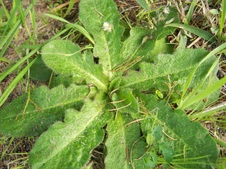 Dandelion 1 Dandelion 1
Dandelion (Taraxacum officinale)is an increasingly common weed in lawns in Western Australia.
|  Dandelion 2 Dandelion 2
Dandelion (Taraxacum officinale) with yellow flower.
|  Dandelion 1 Dandelion 1
Dandelion (Taraxacum officinale) is an increasingly common weed in lawns in Western Australia.
|  Dandelion 2 Dandelion 2
Dandelion (Taraxacum officinale)
is a perennial, with a strong taproot and a rosette of toothed leaves. The stems are hollow, with only ever one flower head per stem.
|
