 Emu at the Pinnacles Emu at the Pinnacles
On entering the Pinnacles we surprised an Emu which was strolling between the Pinnacle formations. The Emu (centre) blends in with surrounding colours.
|  The Emu walks towards the Bush The Emu walks towards the Bush
Nambung National Park.
|  Rear view of the Emu Rear view of the Emu
Nambung National Park.
|  Emu glances back at Camera Emu glances back at Camera
Nambung National Park.
|
 Emu strides away Emu strides away
Nambung National Park.
|  Galah perched on a Pinnacle Galah perched on a Pinnacle
Nambung National Park.
|  Pinnacles come in many shapes and sizes Pinnacles come in many shapes and sizes
In the Pinnacles Desert, in the heart of Nambung National Park, thousands of huge limestone pillars rise out of a stark landscape of yellow sand.
|  Galah keeping watch over Pinnacles Galah keeping watch over Pinnacles
In places the Pinnacles reach up to three and a half metres tall.
|
 Pinnacles formations large and small Pinnacles formations large and small
Some are jagged, sharp-edged columns, rising to a point; while others resemble tombstones.
|  The Pinnacles of Nambung National Park The Pinnacles of Nambung National Park
Three old systems of sand dunes run parallel to the WA coast, marking ancient shorelines.
|  The Pinnacles The Pinnacles
The oldest of these, known as the Spearwood dune system, is characterised by yellow or brownish sands.
|  The Pinnacles The Pinnacles
In winter, rain, which is slightly acidic, dissolves small amounts of calcium carbonate as it percolates down through the sand.
|
 Texture of the Pinnacles Texture of the Pinnacles
As the dune dries out during summer, this is precipitated as a cement around grains of sand in the lower levels of the dunes, binding them together and eventually producing a hard limestone rock.
|  Textures of the Pinnacles Textures of the Pinnacles
At the same time, vegetation that became established on the surface, aided this process.
|  The Pinnacles The Pinnacles
Plant roots stabilised the surface and encouraged a more acidic layer of soil and humus (containing decayed plant and animal matter) to develop over the remaining quartz sand.
|  The Pinnacles The Pinnacles
The acidic soil accelerated the leaching process, and a hard layer of calcrete formed over the softer limestone below.
|
 The Pinnacles The Pinnacles
Cracks which formed in the calcrete layer were exploited by plant roots.
|  The Pinnacles The Pinnacles
When water seeped down along these channels, the softer limestone beneath was slowly leached away and the channels gradually filled with quartz sand.
|  The Pinnacles in Morning Sun The Pinnacles in Morning Sun
This subsurface erosion continued until only the most resilient columns remained.
|  The Pinnacles in Morning Sun The Pinnacles in Morning Sun
The Pinnacles, then, are the eroded remnants of the formerly thick bed of limestone.
|
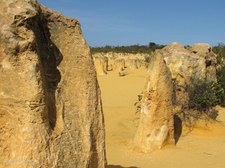 The Pinnacles in Morning Sun The Pinnacles in Morning Sun
As bush fires denuded the higher areas, south-westerly winds carried away the loose quartz sands and left these limestone pillars standing up to three and a half metres high.
|  Sedge growing at base of Pinnacle Sedge growing at base of Pinnacle
Although the formation of the Pinnacles would have taken many thousands of years, they were probably only exposed in quite recent times.
|  Lit by the Morning Sun Lit by the Morning Sun
Aboriginal artefacts at least 6,000 years old have been found in the Pinnacles Desert despite no recent evidence of Aboriginal occupation.
| 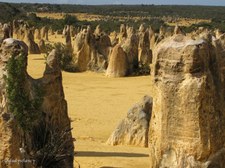 Seemingly endless Pinnacles Seemingly endless Pinnacles
This tends to suggest that the Pinnacles were exposed about 6,000 years ago and then covered up by shifting sands, before being exposed again in the last few hundred years.
|
 Shaped by the Winds Shaped by the Winds
This process can be seen in action today - with the predominantly southerly winds uncovering pinnacles in the northern part of the Pinnacles Desert but covering those in the south.
|  A Pinnacle is Born A Pinnacle is Born
The shifting sands uncover the top of a Pinnacle previously buried in the sand.
|  Limestone Formation Limestone Formation
Over time, the limestone spires will no doubt be covered again by other sand drifts and the cycle repeated, creating weird and wonderful shapes over and over again.
|  The Pinnacles Desert The Pinnacles Desert
Nambung National Park.
|
 Sands of Time Sands of Time
|  Sculptured by Nature Sculptured by Nature
|  Pinnacles large and small Pinnacles large and small
|  Nature's creation Nature's creation
|
 Standing in the Desert Standing in the Desert
|  Pinnacles to the Horizon Pinnacles to the Horizon
|  The Pinnacles Desert The Pinnacles Desert
|  Life in the Desert Life in the Desert
|
 Distant Views over the Pinnacles Distant Views over the Pinnacles
|  Distant Views over the Pinnacles Distant Views over the Pinnacles
|  Distant Views over the Pinnacles Distant Views over the Pinnacles
|  Indian Ocean in the Distance Indian Ocean in the Distance
Nambung National Park.
|
