 Dunes carpeted with Wildflowers Dunes carpeted with Wildflowers
The Pinnacles Desert is surrounded by Dunes which are carpeted with Wildflowers during Spring
|  Rose Banjine (Pimelea rosea) Rose Banjine (Pimelea rosea)
|  Rose Banjine (Pimelea rosea) close-up Rose Banjine (Pimelea rosea) close-up
|  Common Clematis (Clematis pubescens) Common Clematis (Clematis pubescens)
|
 Thick-leaved Fanflower (Scaevola crassifolia) Thick-leaved Fanflower (Scaevola crassifolia)
|  Silky Hemigenia (Hemigenia incana) Silky Hemigenia (Hemigenia incana)
| 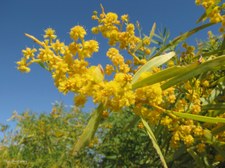 Wattle (Acacia species) Wattle (Acacia species)
| 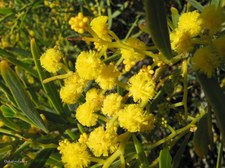 Wattle (Acacia species) Wattle (Acacia species)
|
 Mike is a dedicated Tour Guide Mike is a dedicated Tour Guide
'Turquoise Coast Enviro Tours'
www.thepinnacles.com.au
| 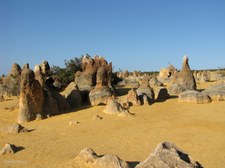 Entering the Pinnacles Desert Entering the Pinnacles Desert
Nambung National Park, Western Australia.
Located on the Swan Coastal Plain, 260 kms north of Perth.
|  Pinnacles formations Pinnacles formations
The formation of the Pinnacles would have taken many thousands of years.
|  Vegetation beside Pinnacle Vegetation beside Pinnacle
In winter, rain, which is slightly acidic, dissolves small amounts of calcium carbonate as it percolates down through the sand.
|
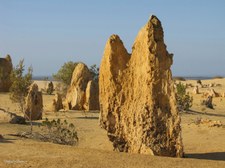 The Pinnacles Desert The Pinnacles Desert
As the dune dries out during summer, this is precipitated as a cement around grains of sand in the lower levels of the dunes, binding them together and eventually producing a hard limestone rock.
|  The Pinnacles Desert The Pinnacles Desert
At the same time, vegetation that became established on the surface, aided this process. Plant roots stabilised the surface, and encouraged a more acidic layer of soil and humus (containing decayed plant and animal matter) to develop over the remaining quartz sand.
|  In Shadow of encroaching Sand Dune In Shadow of encroaching Sand Dune
The acidic soil accelerated the leaching process, and a hard layer of calcrete formed over the softer limestone below.
| 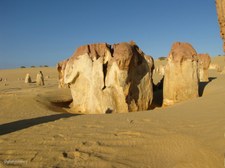 'Chocolate-coated' Pinnacles 'Chocolate-coated' Pinnacles
Cracks which formed in the calcrete layer were exploited by plant roots.
|
 The Pinnacles Desert The Pinnacles Desert
When water seeped down along these channels, the softer limestone beneath was slowly leached away and the channels gradually filled with quartz sand.
|  The Pinnacles Desert The Pinnacles Desert
This subsurface erosion continued until only the most resilient columns remained.
|  Emu Footprint in the Sand Emu Footprint in the Sand
The Pinnacles, are the eroded remnants of the formerly thick bed of limestone.
|  The Pinnacles Desert The Pinnacles Desert
As bush fires denuded the higher areas, south-westerly winds carried away the loose quartz sands and left these limestone pillars standing up to three and a half metres high.
|
 The Pinnacles Desert The Pinnacles Desert
Although the formation of the Pinnacles would have taken many thousands of years, they were probably only exposed in quite recent times.
|  Yellow Sands of the Pinnacles Yellow Sands of the Pinnacles
Aboriginal artefacts at least 6,000 years old have been found in the Pinnacles Desert despite no recent evidence of Aboriginal occupation.
|  Pinnacles Landscape Pinnacles Landscape
This tends to suggest that the Pinnacles were exposed about 6,000 years ago and then covered up by shifting sands, before being exposed again in the last few hundred years.
|  White Sand Dunes in the Distance White Sand Dunes in the Distance
This process can be seen in action today - with the predominantly southerly winds uncovering pinnacles in the northern part of the Pinnacles Desert but covering those in the south.
|
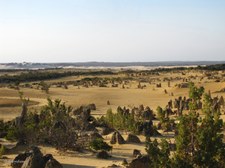 The Pinnacles The Pinnacles
Over time, the limestone spires will no doubt be covered again by other sand drifts and the cycle repeated, creating weird and wonderful shapes over and over again.
|  The Pinnacles The Pinnacles
The first known European recording of the Nambung area dates back to 1658, when the North and South Hummocks first appeared on Dutch maps.
|  The Pinnacles The Pinnacles
The Hummocks were also mentioned in navigator Philip Parker King's journal in about 1820.
|  The Pinnacles The Pinnacles
Nambung is an Aboriginal word that means crooked or winding and it was from this river that the park was named.
|
 The Pinnacles The Pinnacles
The Pinnacles Desert remained relatively unknown until the late 1960s, when the Department of Lands and Surveys agreed to add the area to the already existing national park, which had been established in 1956.
|  The Pinnacles The Pinnacles
Today the park is visited by approximately 250,000 visitors, from all over the world, each year.
|  The Pinnacles The Pinnacles
Information courtesy:--
http://www.dec.wa.gov.au/hotproperty/property/national-parks/nambung-national-park-pinnacles.html
|  The Pinnacles The Pinnacles
Nambung National Park, Western Australia
|
 Parrotbush (Dryandra sessilis) Parrotbush (Dryandra sessilis)
|  Opening flower of Parrotbush (Dryandra sessilis) Opening flower of Parrotbush (Dryandra sessilis)
|  The Pinnacles The Pinnacles
Nambung National Park, Western Australia
| 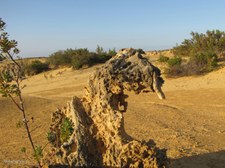 The Pinnacles The Pinnacles
Nambung National Park, Western Australia
|
 Galahs perched on a Pinnacle Galahs perched on a Pinnacle
Galahs(Cacatua roseicapilla)are common in Nambung National Park.
| 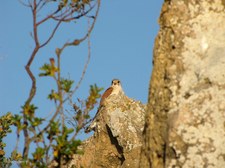 Nankeen Kestrel (Falco cenchroides) Nankeen Kestrel (Falco cenchroides)
This bird of prey is also known as Australian Kestrel.
|  Nankeen Kestrel (Falco cenchroides) Nankeen Kestrel (Falco cenchroides)
|  The Pinnacles The Pinnacles
Nambung National Park, Western Australia
|
