 Tasmania #09 Collage Tasmania #09 Collage
| 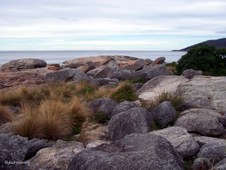 Bicheno Granite Outcrop Bicheno Granite Outcrop
The seaside coastal town of Bicheno has interesting coastal walks which include some superb rocky outcrops and spectacular blowholes.
| 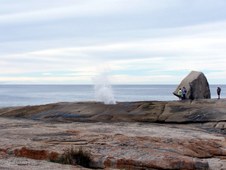 Bicheno Rocking Rock Bicheno Rocking Rock
Bicheno's famous Rocking Rock (a huge 80 tonne piece of granite balanced so that it rocks with the movement of the tide) and the very impressive local blowhole.
|  Red Lichen on Rocks Red Lichen on Rocks
The rocks at Bicheno have a distinctive red colour as a result of deposits of red lichen.
|
 Bicheno Blowhole Bicheno Blowhole
Blowhole at Bicheno on the east coast of Tasmania.
|  Australian Merchant Navy Memorial Australian Merchant Navy Memorial
Bicheno, Tasmania.
|  Waubs Beach Waubs Beach
Bichino began around 1803 as Waubs Boat Harbour when Whalers and Sealers used the safe harbour. Today Bicheno is a major Fishing Centre and Holiday Resort.
|  Baby Tasmanian Devil Baby Tasmanian Devil
A cute baby Tasmanian Devil (Sarcophilus harrisii) at East Coast Nature World.
|
 Baby Tasmanian Devil Baby Tasmanian Devil
This baby thought that one photo was enough!
| 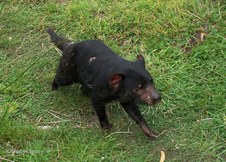 Tasmanian Devil Tasmanian Devil
A battle-scarred Tasmanian Devil at East Coast Nature World. The Tasmanian devil cannot be mistaken for any other marsupial. Its spine-chilling screeches, black colour, and reputed bad-temper, led the early European settlers to call it The Devil. Although only the size of a small dog, it can sound and look incredibly fierce.
|  Tasmanian Devil Tasmanian Devil
The world's largest surviving carnivorous marsupial, the Tasmanian Devil has a thick-set, squat build, with a relatively large, broad head and short, thick tail. The fur is mostly or wholly black, but white markings often occur on the rump and chest. Body size also varies greatly, depending on the diet and habitat. Adult males are usually larger than adult females. Large males weigh up to 12 kg, and stand about 30 cm high at the shoulder.
| 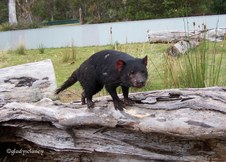 Tasmanian Devil Tasmanian Devil
Devils are widespread in Tasmania from the coast to the mountains. They live in coastal heath, open dry sclerophyll forest, and mixed sclerophyll-rainforest -- in fact, almost anywhere they can hide and find shelter by day, and find food at night.
|
 Tasmanian Devil Tasmanian Devil
The Tasmanian Devil is mainly a scavenger and feeds on whatever is available. Powerful jaws and teeth enable it to completely devour its prey, bones, fur and all. Wallabies, and various small mammals and birds, are eaten, either as carrion or prey. Reptiles, amphibians, insects and even sea squirts have been found in the stomachs of wild devils. Carcasses of sheep and cattle provide food in farming areas. Devils maintain bush and farm hygiene by cleaning up carcasses. Devils are famous for their rowdy communal feeding at carcasses, the noise and displays being used to establish dominance amongst the pack.
|  Tiger Snake Tiger Snake
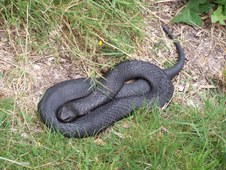
Tiger Snake (Notechis scutatus) at East Coast Natureworld. Tasmania has three species of Snake, the Tiger Snake is the most common and hard to distinguish from the Lowlands Copperhead, and the third species is the Whip Snake.
|  Tiger Snake Tiger Snake
Tasmanian Tiger Snake has recently been shown to be the the same species as that which occurs on the south-eastern Australian mainland, (Notechis scutatus). The markings are extremely variable and should not be used in isolation to identify snakes. Colours range from jet black, through yellow/orange with grey bands to sandy grey with no bands. There are unconfirmed reports of red-bellied Tiger snakes in north-east Tasmania. Typical forms are of a black snake with either no bands or faint yellow to cream bands. Dark olive snakes with yellow bands are fairly common.
|  Tiger Snake Tiger Snake
Generally the belly is pale yellow, white or grey, the enlarged ventral scales often edged with black. The head is broad and blunt. It can be difficult to distinguish the Tiger Snake from the Copperhead since sizes, habitat preferences and behaviour overlap somewhat. Tiger Snakes have 13 - 19 rows of scales around the middle of the body, the usual number being 17. On the mainland of Tasmania Tiger snakes reach a length of 1 to 1.8 m. Male tiger snakes reach a greater size than females and have larger heads.
|
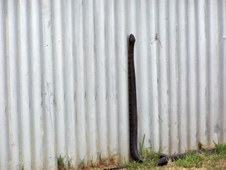 Climbing Wall of Snake-Pit Climbing Wall of Snake-Pit
Tiger snakes feed mainly on mammals and birds under 300 g in weight. Tiger snakes habitually raid birds nests and have been found climbing trees to a height of 8 m. A good indicator of the presence of a Tiger snake is the alarm calls of small birds such as honeyeaters and thornbills. They also eat other vertebrates including lizards, smaller snakes, frogs and occasionally fish. Juvenile tiger snakes will use constriction to subdue struggling skinks, a principal food of smaller snakes. Adult snakes are also known to use constriction on larger prey as well. Tiger snakes are important predators of introduced rodent pests and readily enter the burrows of mice, rats and even rabbits in search of their quarry.
|  Underside of Snake Underside of Snake
The underside of the Snake as seen through the clear panel in Snake-Pit Wall at East Coast Natureworld.
|  Snake Head Snake Head
The highly toxic venom of Tiger Snakes is produced in large amounts. The venom is mainly neurotoxic, affecting the central nervous system, but also causes muscle damage and affects blood clotting. The breakdown of muscle tissue can lead to kidney failure.
|  Forester Kangaroo Forester Kangaroo
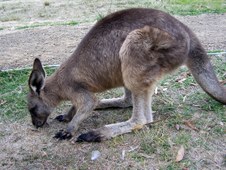
Forester Kangaroo (Macropus giganteus) is the largest marsupial in Tasmania and the second largest in the world -- males can reach over 60 kg and, when literally on tippy toes, stand 2 m tall! Colour varies from light brownish grey to grey. They have relatively large ears and differ from the other two species in having hair between the nostrils and upper lip. They often make clucking sounds between themselves and give a guttural cough when alarmed. The Forester kangaroo is restricted to northeastern Tasmania and small areas in central Tasmania. The species is common on mainland Australia, where it is commonly known as the grey kangaroo.
|
 Emus at Rest Emus at Rest
Two Emus resting at East Coast Natureworld. The Emu is Australia's largest bird and although flightless, the powerful legs can give them speeds up to 50 kph.
|  Young Emu Young Emu
This young Emu with mud on his head was eyeing off my camera.
|  Young Emu Young Emu
East Coast Natureworld operates as an animal rescue centre. Injured and orphaned animals, birds and reptiles are rehabilitated for return to the wild. If this is not possible then a safe and happy home is provided for the rest of their lives in as natural a setting as possible.
|  Emu Portrait Emu Portrait
At East Coast Natureworld, expert veterinary input, full-time animal behaviourist and dedicated carers ensure that the welfare of the animals is never compromised.
|
 Laughing Kookaburra Laughing Kookaburra
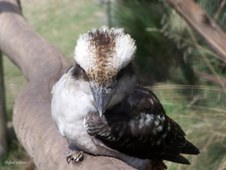
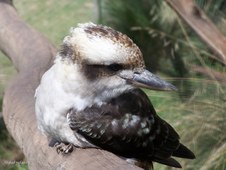
The Laughing Kookaburra (Dacelo novaeguineae) has been introduced to Tasmania from mainland Australia.
|  Laughing Kookaburra Laughing Kookaburra
Laughing Kookaburra at East Coast Natureworld, Tasmania.
|  Laughing Kookaburra Laughing Kookaburra
East Coast Natureworld operates as an animal rescue centre. Injured and orphaned animals, birds and reptiles are rehabilitated for return to the wild. If this is not possible then a safe and happy home is provided for the rest of their lives in as natural a setting as possible.
|  Laughing Kookaburra Laughing Kookaburra
Injured wildlife receive veterinary input and rehabilitation by dedicated carers at East Coast Natureworld.
|
 Female Masked Owl Female Masked Owl
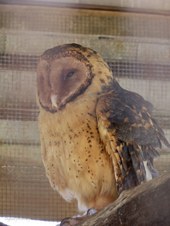
Masked Owl (Tyto novaehollandiae) The female masked owl is larger than the male, measuring about 47 cm in length, where as the males are about 37 cm in length. They are a robust owl with a crouched posture. The eyes are black eyes inside a round, dark-bordered face mask which is a dark chestnut colour. The back is dark brown with fawn patches and white flecks, while the undersides are buff coloured with dark spots.
|  Female Masked Owl Female Masked Owl
If cornered or threatened, masked owls sway from side to side spread their wings and hiss and snap their beaks.
|  Female Masked Owl Female Masked Owl
They live in forests and woodlands. During the day the owls roost in hollows in trees or rock crevices. They are distributed around coastal Australia within a few hundred kilometres of the sea. In Tasmania where there are no other large owls, masked owls are the biggest and darkest of all. With no owl competitors, they occupy a wider variety of habitat and occur in greater numbers than anywhere in Australia.
|  Female Masked Owl Female Masked Owl
The breeding season varies according to food supplies. They prefer the big hollows of trees to nest, usually at a considerable height. They lay two or three pearly-white, oval-shaped eggs. The female stays in the nest initially with the male ferrying food to her and the chicks. It is three months before the young learn to fly.
|
 Male Masked Owl Male Masked Owl
The masked owl eats small mammals, reptiles and occasionally birds. Due to its larger size, the Tasmanian race feeds regularly on rabbits.
|  Male Masked Owl Male Masked Owl
Male Masked Owl (Tyto novaehollandiae) at East Coast Natureworld.
|  Male Masked Owl Male Masked Owl
Male Masked Owl (Tyto novaehollandiae) at East Coast Natureworld.
|  Little Corella Little Corella
Little Corella (Cacatua sanguinea).. Little Corellas are mostly white, with a fleshy blue eye-ring and a pale rose-pink patch between the eye and bill. In flight, a bright sulphur-yellow wash can be seen on the underwing and under tail. The sexes are similar in plumage, and young birds look like the adults. The adults measure 35cm - 39cm; young birds are slightly smaller.
|
 Pond Scene Pond Scene
Autumn tones in this pond scene at East Coast Natureworld.
|  Black Swan Black Swan
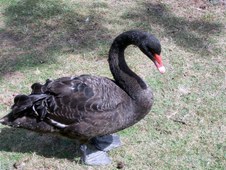
Black Swan (Cygnus atratus) is a protected species in Australia.
|  Mulga Parrot Pair Mulga Parrot Pair
A pair of Mulga Parrots (Psephotus varius) with a nesting box.
|  Wattlebird Wattlebird
In the aviary at East Coast Natureworld.
|
