 Approaching Lake Clifton Approaching Lake Clifton
Situated within Yalgorup National Park, Lake Clifton is very salty, long and narrow and abounds with a variety of bird life.
|  Lake Clifton in Yalgorup National Park Lake Clifton in Yalgorup National Park
The lake provides a temporary home to hundreds of migrating birds, many of which travel great distances to breed.
|  Blue Waters of Lake Clifton Blue Waters of Lake Clifton
Lake Clifton supports a thrombolite reef over 6km long and up to 120m wide, possibly the largest living thrombolite reef in the southern hemisphere.
|  Boardwalk Boardwalk
A board walk leads out over the lake for easy viewing of the thrombolites.
|
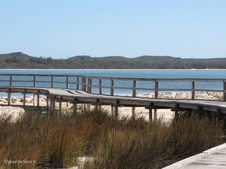 Boardwalk over Thrombolites Boardwalk over Thrombolites
On 28 January 2010, the thrombolites in Lake Clifton were declared endangered under the Environment Protection and Biodiversity Act.
|  Thrombolites at Lake Clifton Thrombolites at Lake Clifton
Thrombolites, 'living rocks', are the most common form of microbialites, which are rock-like structures built by micro-organisms.
|  Thrombolites along the eastern bank of Lake Clifton Thrombolites along the eastern bank of Lake Clifton
One of the few places in the world where the thrombolites grow is at Lake Clifton in Western Australia's Yalgorup National Park which is located 32 kilometres south of Mandurah.
|  Thrombolites viewed from the Boardwalk Thrombolites viewed from the Boardwalk
The lake is also one of only two sites known where microbialites occur in water less salty than sea water.
|
 Looking down on the Thrombolites Looking down on the Thrombolites
The lake contains the largest lake-bound microbialite reef in the southern hemisphere which is over 6kms long and widens in parts to 120m.
|  Thrombolites large and small Thrombolites large and small
The thrombolite structures reach heights of up to 1.3m.
|  More Thrombolites More Thrombolites
Stromatolites and thrombolites are created by algae and represent the earliest record of life on earth.
|  Thrombolites below the Boardwalk Thrombolites below the Boardwalk
Thrombolites are formed when the micro-organisms photosynthesise.
|
 Visitors at the end of the Boardwalk Visitors at the end of the Boardwalk
During this processs they are able to precipitate calcium carbonate from the waters of the lime-enriched lake to form the rock-like structures.
| 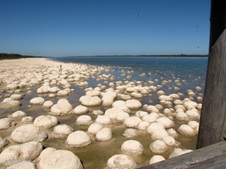 Eastern Bank of Lake Clifton Eastern Bank of Lake Clifton
Luckily Lake Clifton has an abundance of fresh ground water which is high in calcium carbonate providing the perfect environment.
|  Lake Clifton's Thrombolites Lake Clifton's Thrombolites
Thrombolites have an internally clotted texture and are formed by blue-green bacteria trapping sediment particles.
|  The Boardwalk The Boardwalk
Thrombolites and stromatolites were the only known form of life on Earth some 350 to 650 million years ago.
|
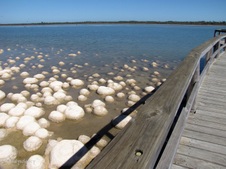 Edge of the Boardwalk Edge of the Boardwalk
Microbes found in both thrombolite and stromatolite formations are believed to be responsible for oxygen production which allowed life to exist on the planet.
|  Thrombolite Reflections Thrombolite Reflections
Thrombolites are the most common form of microbialites and are formed by a variety of micro-organisms. They grow at an average of 1mm a year.
|  Molly enjoying a day out in the sunshine Molly enjoying a day out in the sunshine
|  Inland view from Boardwalk Inland view from Boardwalk
The water has receeded leaving these Thrombolites high and dry.
|
 Shallows of Lake Clifton Shallows of Lake Clifton
|  Boardwalk over Thrombolites Boardwalk over Thrombolites
|  Yalogorup National Park Yalogorup National Park
The name Yalgorup is a composite of the Aboriginal words ‘yalgor’ (swamp or lake) and ‘up’ (a place).
|  View across Lake Clifton View across Lake Clifton
|
 The Bend in the Boardwalk The Bend in the Boardwalk
|  Another view of the Thrombolites Another view of the Thrombolites
|  Rushes beside the Boardwalk Rushes beside the Boardwalk
|  Black Swan on Lake Clifton Black Swan on Lake Clifton
Indigenous birds that come to Yalgorup every year to feed and breed include:- Black Swans, Australian Shelducks, Banded Stilts, Red-capped plovers, Crakes, Australian Crakes, Australian Reed-Warblers, Pacific Black Ducks and Hooded Plovers.
|
 Lake Clifton through the Trees Lake Clifton through the Trees
The Ramsar wetlands of the Yalgorup Lakes System are also the breeding, moulting and feeding grounds for thousands of endemic and migratory birds each year.
|  Walking back to the Car Park Walking back to the Car Park
Yalgorup is a 12,888 hectare national park situated between Mandurah and Bunbury - a narrow coastal strip of land that includes Lake Clifton and Lake Preston and seven other minor lakes.
|  Looking back along track to Thrombolites Looking back along track to Thrombolites
Thrombolites are 100 m from the Car Park.
|  Natural Vegetation of Yalgorup National Park Natural Vegetation of Yalgorup National Park
Flora includes coastal heaths, tuart woodlands, paperbark swamps, mixed eucalypt woodlands and sedge swamps.
|
 Leaving the Car Park Leaving the Car Park
Fauna within the park includes Grey Kangaroo, Brush Wallaby, emus, Whistling Kite, Horny Grebe, Black Swan, Rock Parrot, Sacred Kingfisher, Red Kneed Dotterel, Red Capped Dotterel and Hooded Dotterel.
|  Island Point Reserve Island Point Reserve
A short drive to a lovely picnic spot at Island Point Reserve on the Peel Estuary.
|  Peel-Yalgorup System, Wetlands of International Importance Peel-Yalgorup System, Wetlands of International Importance
The Convention on Wetlands of International Importance, called the Ramsar Convention, is an intergovernmental treaty that provides the framework for national action and international cooperation for the conservation and wise use of wetlands and their resources.
| 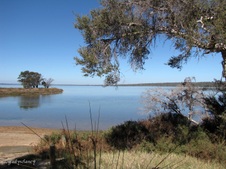 Tranquil Scene on Harvey Estuary Tranquil Scene on Harvey Estuary
Peel-Harvey has traditionally been seen as one estuary. However, the Water and Rivers Commission of WA has now classified it as two separate estuaries (Peel Inlet and Harvey Estuary) so that each one is linked to the River Basin from which it drains.
|
 Track around the Point Track around the Point
|  Small Islands in Harvey Estuary Small Islands in Harvey Estuary
|  Black Swans on the Estuary Black Swans on the Estuary
|  Zoomed to Black Swans and House on the Hill Zoomed to Black Swans and House on the Hill
|
