 Welcome to Guilderton Welcome to Guilderton
Located where the Moore River meets the Indian Ocean about 94 kms north of Perth.
|  Guilderton on the Moore River Estuary Guilderton on the Moore River Estuary
The town of Guilderton was gazetted on 30 November 1951. Originally known as 'Gabbadah' an Aboriginal term meaning "mouthful of water", the area has been used for recreation since the earliest days of white settlement in the Gingin district.
|  Looking towards the mouth of the Moore River Looking towards the mouth of the Moore River
One of the most pristine, yet fragile estuarine environments in the south west of Western Australia.
|  Northerly bank of the Moore River Northerly bank of the Moore River
|
 Clean White Sands of Sandbar Clean White Sands of Sandbar
|  Launching the Cruise Boat Launching the Cruise Boat
|  Cruise Boat almost afloat Cruise Boat almost afloat
|  Boarding the Cruise Boat Boarding the Cruise Boat
|
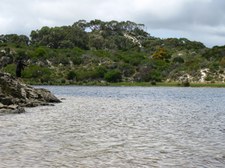 South Bank of the Moore River South Bank of the Moore River
View from Cruise Boat.
|  Heading towards the Sandbar Heading towards the Sandbar
|  Sandbar at mouth of Moore River Sandbar at mouth of Moore River
| 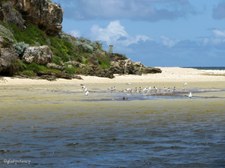 Waterbirds enjoying the Shallows Waterbirds enjoying the Shallows
|
 Caves in the Limestone Cliffs on North Bank Caves in the Limestone Cliffs on North Bank
|  Seagulls and Terns in Shallows Seagulls and Terns in Shallows
|  Boardwalk around base of Cliffs Boardwalk around base of Cliffs
|  Limestone Cliffs Limestone Cliffs
|
 The Indian Ocean beyond the Sandbar The Indian Ocean beyond the Sandbar
The ocean swell builds up the sandbar damming the river mouth in Spring and Summer.
|  The Sandbar The Sandbar
|  Hilltop Lookout on North Bank Hilltop Lookout on North Bank
|  The Town of Guilderton The Town of Guilderton
The strong affection which the population of the area felt for the Gabbadah district was reflected in the very enlightened and 'site-sensitive' design of the settlement with large areas of native vegetation preserved within the townsite.
|
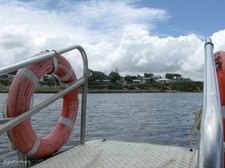 Heading Upstream Heading Upstream
| 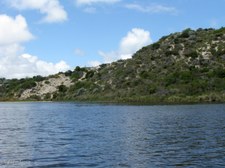 Calm Waters of the Moore River Calm Waters of the Moore River
|  Sand Dunes on the Southern Side Sand Dunes on the Southern Side
| 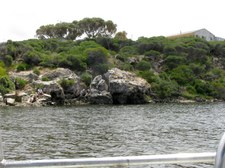 Northern Side of Moore River Northern Side of Moore River
|
 A Splash of Colour A Splash of Colour
The bright Orange of the West Australian Christmas Tree (Nuytsia floribunda)makes a splash of colour on the hill side.
| 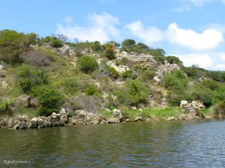 Natural Vegetation on Sand and Limestone Natural Vegetation on Sand and Limestone
|  Little Pied Cormorants in Tree Little Pied Cormorants in Tree
(Phalacrocorax melanoleucos)
|  Little Pied Cormorants on Rock Little Pied Cormorants on Rock
(Phalacrocorax melanoleucos)
|
 Trio of Little Pied Cormorants Trio of Little Pied Cormorants
(Phalacrocorax melanoleucos)
|  Birds in the Trees ahead Birds in the Trees ahead
There have been positive sightings of over 110 species of birds in the Moore River area.
|  Australian Pelicans and Little Pied Cormorants Australian Pelicans and Little Pied Cormorants
|  Birds enjoying the Sunshine Birds enjoying the Sunshine
|
 Australian Pelicans Australian Pelicans
(Pelecanus conspicillatus)
|  Birds enjoying the Sunshine Birds enjoying the Sunshine
|  Row of Little Black Cormorants on Left Row of Little Black Cormorants on Left
(Phalacrocorax sulcirostris)
|  Little Black Cormorants Little Black Cormorants
(Phalacrocorax sulcirostris)
|
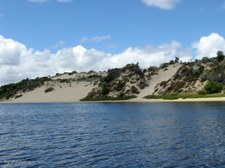 Quindalup Dunes Quindalup Dunes
The Quindalup Dunes on the south of the river were too infertile for either pasture or crops, so it is fortunate that their rich bio-diversity has been spared from being cleared for agriculture.
|  Enjoying the Tranquility of the Quindalup Dunes Enjoying the Tranquility of the Quindalup Dunes
|  Re-vegetation on the North Bank Re-vegetation on the North Bank
All development has taken place on the north side of the estuary and this area has been re-vegetated to provide habitat for native birds and wildlife.
|  River Bank Vegetation River Bank Vegetation
Vegetation is of vital importance because it holds the sand together with its roots and reduces wind speed, and therefore erosion, with its branches.
|
