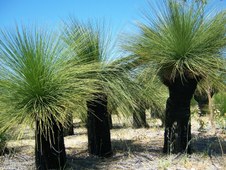
 Grasstrees (Xanthorrhoea preissii) Grasstrees (Xanthorrhoea preissii)
Grasstrees (Xanthorrhoea preissii)are native to Western Australia where they are mainly found on the sandy coastal plain.
|  Mature Grasstree Mature Grasstree
These remarkable plants have a lifespan of 600 years but are very slow-growing. The trunk takes a decade to form initially as it is composed of a mass of old leaf bases held together by a natural resin. It is then a further 20 years or more before the mass of thin, linear leaves rises above it. From then on, it grows only about 1-2cm (0.4-0.8in) in height per year.
|  Xanthorrhoea preissii Xanthorrhoea preissii
From then on, it grows only about 1-2cm (0.4-0.8in) in height per year. Plants have been observed which have taken 27 years to grow 30 centimetres (one foot).
|  Grasstrees with Flower Spikes Grasstrees with Flower Spikes
The Grasstree can grow to a height of over 4 metres and often has branches. It’s growth rate is only about 1 metre every 100 years.
|
 Base of Flower Spike Base of Flower Spike
The Flower Spike emerges from the crown of dense leaves.
|  Creamy White Flowers opening on Flower Spike Creamy White Flowers opening on Flower Spike
|  Flower Spike of Creamy White Flowers Flower Spike of Creamy White Flowers
|  Long Flower Spike Long Flower Spike
The Flower Spike grows quickly at a rate of 2 – 3 cm per day reaching to a height of over 3 metres. Mature plants will result in flowering every 2 – 3 years.
|
 Close-up of Flower Spike Close-up of Flower Spike
Flowers are densely packed on the long Flower Spike.
|  Grasstree Flowers Grasstree Flowers
The flowering spear of the plant attracts honey eating birds, bees, ants, and butterflies. Flowers are usually seen from June to December.
|  Grasstree seed capsules and Seeds Grasstree seed capsules and Seeds
After the flowers, come the seeds! Cultivation presents great challenges, with the seed taking up to a year to germinate and the young grow at a rate of only a centimetre or so a year.
|  Young Grasstrees Young Grasstrees
These will take many years to reach maturity.
|
 Young Grass Tree Young Grass Tree
|  Grasstrees of varying ages Grasstrees of varying ages
|  Grasstree Twins Grasstree Twins
|  Grasstrees in a Reserve Grasstrees in a Reserve
|
 Grasstrees at Cooloongup Grasstrees at Cooloongup
|  Grasstree in Suburbia Grasstree in Suburbia
|  Grasstrees and Native Vegetation Grasstrees and Native Vegetation
Cooloongup.
|  Grasstree with many heads Grasstree with many heads
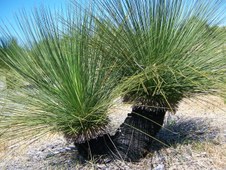
Beautiful old examples are often survivors of bushfires and develop into architectural masterpieces. Bushfires can cause their blackened trunk (1 to 2 metres) to branch into two or even more heads. These consist of thick, rough corky bark, surrounded by a whorl of long, wiry leaves with unique flowers.
|
 Healthy Grasstrees Healthy Grasstrees
Cooloongup.
|  Gnarled branch of a Grasstree Gnarled branch of a Grasstree
|  Broken Trunk reveals inner core Broken Trunk reveals inner core
|  Cross section of Grasstree Trunk Cross section of Grasstree Trunk
|
 A fallen Grasstree A fallen Grasstree
This one would be hundreds of years old.
|  Fungi growing nearby Fungi growing nearby
|  Grasstrees (Xanthorrhoea preissii) Grasstrees (Xanthorrhoea preissii)
The Aboriginal name for the Grasstree is 'Balga'.
|  Flower Spikes usually straight, but sometimes deformed Flower Spikes usually straight, but sometimes deformed
Grasstrees often flower as a direct response to a very recent bushfire. This ability to be one of the first flowers to appear after a bushfire ensures a food source for many insects and birds, in an otherwise alien, blackened moonscape environment.
|
 Aboriginal Tools from Grasstrees Aboriginal Tools from Grasstrees
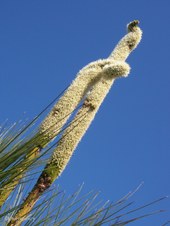
The light straight flower stalk served as a butt-piece for spears. A tip section of tea tree would then be attached to the end of the spear and hardened in the fire before being used for hunting.
|  Flower Spikes Flower Spikes
Aboriginals used pieces of very dry flower spike for making fire with a drilling stick.
|  Resin from Grasstrees Resin from Grasstrees
The leaves produce a hard waterproof resin, which could be collected from the base of the trunk. This resin melts when warmed, but sets hard when cold.
|  Resin from Grasstrees Resin from Grasstrees
The Resin had a number of uses for Aboriginals including; Forming glue by mixing it with charcoal, beeswax or fine sand and dust. Gluing the cement stone heads to wooden handles and spears to shafts and tips. Waterproofing bark canoes and water carrying vessels.
|
 Resin from Grasstrees Resin from Grasstrees
The versatility of this resin in the every day lives of the aborigines, made it a valuable trading item and was traded amongst tribes for other important collectables.
|  Mature Grasstree with many heads Mature Grasstree with many heads
Grasstrees were a 'staple' plant for the aborigines, providing food, drink, fibre and materials for making implements and weapons.
|  Aboriginal Food Sources Aboriginal Food Sources
As a food source, the white, tender sections of leaf bases, the growing points of stem and succulent roots were all eaten regularly. The removal of the growing point was rare as it destroyed the plant altogether. The seeds were collected and ground into a flour to provide dough for cooking a type of damper, within the ashes of a wattle wood fire.
|  Aboriginal Food Sources Aboriginal Food Sources
They frequently dug out edible grubs found at the base of the trunk. The grub's presence could be detected by the observing the dead leaves in the centre of the grass tree crown.
|
 Aboriginal Food Sources Aboriginal Food Sources
Small sweet pockets of honey could also be extracted from the carpenter bee's cellular nests, which were often bored in the soft pith of the flower stalk.
|  Aboriginal Food Sources Aboriginal Food Sources
To wash this down, the nectar from the flower could be extracted by soaking it in water filled bark troughs, to produce a thick sweet drink.
|  Aboriginal Food Sources Aboriginal Food Sources
A citric flavoured alcoholic brew could be made from fermenting the nectar over 3 to 5 days. An extra tang was added to the brew by crushing a few 'formic' ants into the beverage.
|  Grasstrees in the Park Grasstrees in the Park
Grass Trees make excellent native plants in commercial and domestic environments. Once re-established, they make outstanding features.
|
