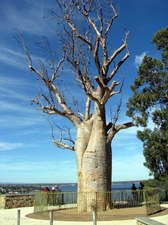
The Boab Tree (Adansonia gregorii) is easily recognised by the swollen base of its trunk which gives the tree a bottle-like appearance. Endemic to Australia, this Boab occurs in the Kimberley region of Western Australia and east into the Northern Terriitory. It is the only boabab to occur in Australia. The Australian Aboriginal Legend of the Boab Tree:-- "When The Tree God created the Boab Tree it was to be the most beautiful of all trees in the universe, with the most beautiful flowers and bearing the juiciest fruit. But as the tree grew to maturity its flowers were mediocre and its fruit had a bad odour and tasted vile. The Tree God became so angry that he yanked the Boab out of the ground and slammed it back in the earth upside down and that is why today, when you see a Boab tree, it looks as if its roots are growing up in the air."
Showing 1-18 of 1810999 visitsAlbum by gladysclancyPhotos by Gladys
Story of Gija Jumulu (Boab Tree)After travelling an amazing 3,200 km from Telegraph Creek, northern Western Australia, the Gija Jumulu was planted on 20 July 2008. This was the longest land journey of a tree of this size in history. The construction of a new bridge on the Great Northern Highway required the tree to be moved. The Gija people of the East Kimberley gifted the Jumulu to the people of Western Australia.
The Giant Boab Tree in its new location at Kings ParkThis giant Boab Tree, estimated to be 750 years old, weighs 36 tonnes and stretched 14 metres high and 8 metres wide (branch span). The trunk measures 2.5 metres in diameter.
Bare Branches with Seed PodsAfter a farewell ceremony by the Gija people, the journey south began on Monday 14 July 2008.
Upper Branches and Seed PodsThe tree arrived at its new home in the heart of Kings Park on Saturday 19 July 2008.
Boab Branches against the SkyOnce the tree has settled in, Kings Park staff will collect its seeds and grow about 200 Boab seedlings to return to the Kimberley.
Boab upper TrunkBoabs (Adansonia gregorii) are deciduous trees that are highly valued by Indigenous people for their edible fruits, medicinal uses and water-holding properties.
Upper Trunk against Blue SkyIndigenous Australians obtained water from hollows in the tree, and used the white powder that fills the seed pods as a food.
Upper Boab TrunkDecorative paintings or carvings were sometimes made on the other surface of the fruits. The leaves were used medicinally by Indigenous people.
Gija Jumulu in Kings ParkThe giant Boab was officially planted on Sunday 20 July 2008 at the Two Rivers Lookout, Kings Park. A crowd of over 3,000 people gathered to watch the event.
Smaller Boab Trees at Kings ParkThe Giant Boab compliments the 14 other smaller Boabs that have been previously transplanted in Kings Park.
Smaller Boab Trees at Kings ParkThe Giant Boab compliments the 14 other smaller Boabs that have been previously transplanted in Kings Park.
Smaller Boab Trees at Kings ParkThe Giant Boab compliments the 14 other smaller Boabs that have been previously transplanted in Kings Park.
Six Months LaterA delight to see the new green leaves appearing on Gija Jumulu when I visited Kings Park on 04 March 2009.
New Life on this Magnificent Tree
Zoomed to the New Green Leaves
Healthy Growth on the Giant BoabGija Jumulu appears happy in its new home overlooking the Swan River.
Giant Boab in March 2011After being transported over 3,200 kms from the Kimberley in 2008, this Giant Boab has new leaf growth and appears happy in its new surroundings.
Boab Tree (Adansonia gregorii)24 August 2012. This huge Boab survived the long journey of over 3,200 kms from the Kimberley to its new location in Kings Park. Currently there is plastic around the base to prevent it getting too wet during winter. The Botanists say the tree is healthy and doing well.