 Entrance Gates Entrance Gates
Queens Park, Perth, Western Australia.
|  Notice on the Gate Notice on the Gate
Hope I find the Cygnets!
|  Reflections in the Pond Reflections in the Pond
These ponds were formerly clay pits where clay was mined for brick making.
|  Palm Tree Reflection Palm Tree Reflection
|
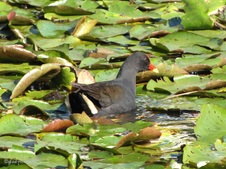 Dusky Moorhen in the Waterlilies Dusky Moorhen in the Waterlilies
| 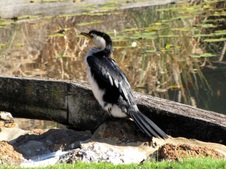 Pied Cormorant drying in the Sun Pied Cormorant drying in the Sun
| 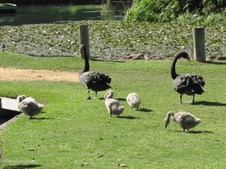 The Black Swan Family The Black Swan Family
Cygnus atratus.
|  Four Cygnets follow the parent Four Cygnets follow the parent
|
 Two Cygnets go swimming Two Cygnets go swimming
|  Fluffy Cygnet at edge of pond Fluffy Cygnet at edge of pond
| 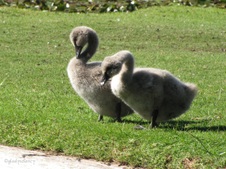 Two Cygnets on the Lawn Two Cygnets on the Lawn
|  Watchful eye of the parent Watchful eye of the parent
Black Swan (Cygnus atratus)is the Western Australian bird emblem.
|
 Going for a stroll Going for a stroll
Black Swans are herbivores and eat mostly water plants.
| 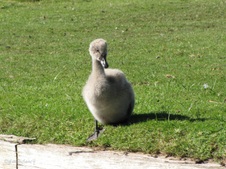 Cygnet about to go swimming Cygnet about to go swimming
Baby swans, or cygnets, are grey.
|  In the water In the water
|  Peter Pan Statue in Queens Gardens Peter Pan Statue in Queens Gardens
In 1927 the Peter Pan statue was presented to the children of Western Australia by the members and friends of the Rotary Club of Perth.
|
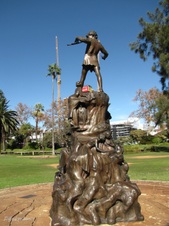 Rear of Peter Pan Statue Rear of Peter Pan Statue
The statue is a replica of Sir George Frampton's famous Peter Pan statue which is located in London's Kensington Gardens in England and is one of only seven made from the original mould.
| 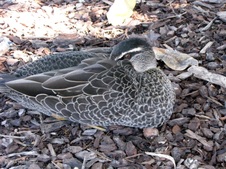 The watchful eye of Pacific Black Duck The watchful eye of Pacific Black Duck
Anas superciliosa.
|  Here come the Swans Here come the Swans
| 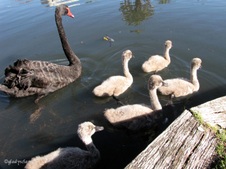 Swan with five Cygnets Swan with five Cygnets
|
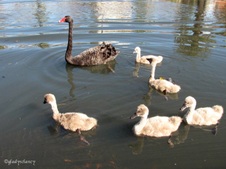 Circling around Circling around
|  The whole Family! The whole Family!
One cygnet found something interesting in the water.
|  Cygnet looked under the water! Cygnet looked under the water!
| 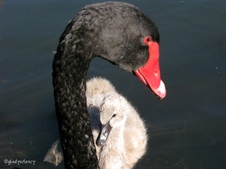 That's my Baby! That's my Baby!
|
 A feather floats by! A feather floats by!
| 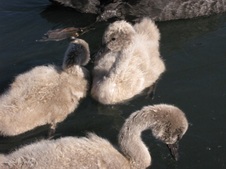 Three siblings Three siblings
|  Practising swimming strokes Practising swimming strokes
|  A closer view A closer view
|
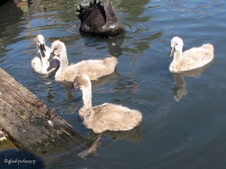 Four siblings Four siblings
|  One looks under the water again One looks under the water again
|  Black Swan comes to say 'Hello' Black Swan comes to say 'Hello'
Cygnus atratus. Swans are the largest of the waterfowls. They have long, slender necks which are longer than their bodies. They are black except for white wing quills. The bill is broad and bright red.
| 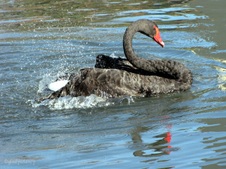 The other Swan takes a bath The other Swan takes a bath
|
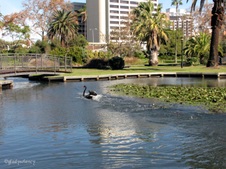 In protective mode In protective mode
The swan suddenly skimmed across the water to chase an Eurasian Coot that ventured too close to the cygnets.
|  All is peaceful again All is peaceful again
|  Cygnet swimming away Cygnet swimming away
|  Cute bundle of fluff Cute bundle of fluff
|
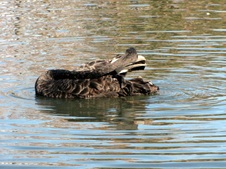 Taking a bath and preening wing Taking a bath and preening wing
|  More preening while circling around More preening while circling around
|  Having a good splash! Having a good splash!
|  Swan Family in the Pond Swan Family in the Pond
Black Swans mate for life and reunite every year to breed. Both parents take care of raising the cygnets, which stay with their parents for some time.
|
