 The Stirling Range through the Windscreen The Stirling Range through the Windscreen
The Stirling Range National Park was included in the National Heritage List on 15 December 2006.
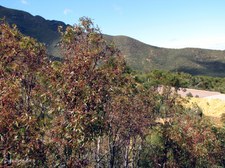
|  View from Bluff Knoll Carpark View from Bluff Knoll Carpark
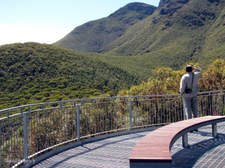
Formed over millions of years by weathering and erosion, the Stirling Range in south-west Western Australia is regarded as an area of great biogeographic and evolutionary interest and displays one of the richest floras in the world. The Stirling Range is a popular destination for its mountain views, wildflowers, bird and animal life.
|  Bluff Knoll zoomed from Carpark Bluff Knoll zoomed from Carpark
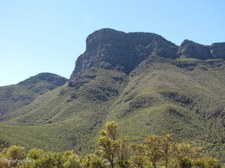
The Nyoongar people of the area referred to Bluff Knoll as Bular Mial (many eyes) or Bala Mial (his eyes), as they believed the rocks on the bluff were shaped like the eyes of an ancestral master spirit that are visible on the mountain.
|  Viewing Platform at Bluff Knoll Viewing Platform at Bluff Knoll
The range stretches for 65 kilometres from east to west and the tallest peak Bluff Knoll stands at 1059 metres above sea level.
|
 Stirling Range Panorama Stirling Range Panorama
Stitched from the following five images.
|  Panorama 1 Panorama 1
|  Panorama 2 Panorama 2
|  Panorama 3 Panorama 3
|
 Panorama 4 Panorama 4
|  Panorama 5 Panorama 5
|  The Stirling Range has many Peaks The Stirling Range has many Peaks
|  Bluff Knoll Carpark Bluff Knoll Carpark
|
 Road Maintenance Crew Painting the White Lines Road Maintenance Crew Painting the White Lines
|  The Stirling Range The Stirling Range
Aboriginal Heritage -- The Mineng and Goreng people are believed to have originally lived in and around the mountains. Many Creation stories reflect the mystery and danger of the jagged peaks of the Stirling Range, particularly Bluff Knoll.
|  The distinctive Bluff Knoll Peak The distinctive Bluff Knoll Peak
Located in the Stirling Range National Park, Bluff Knoll is the highest and one of the most spectacular peaks in the south of Western Australia.
|  Other Peaks beside Bluff Knoll Other Peaks beside Bluff Knoll
|
 Hills and Valleys Hills and Valleys
|  Views to Admire from Eastern Lookout Views to Admire from Eastern Lookout
|  A Range of Biodiversity A Range of Biodiversity
Outline of the Stirling Range with images of some of its flora and fauna. This image forms a mural in the shelter facing Bluff Knoll.
|  Mural in Information Shelter Mural in Information Shelter
Information shelters in the park provide information about the plant and animal life in the area and guide you to sites of interest.
|
 Mural -- section 1 Mural -- section 1
|  Mural -- section 2 Mural -- section 2
|  Mural -- section 3 Mural -- section 3
|  Mural -- section 4 Mural -- section 4
|
 Walking Trail Walking Trail
Listed as one of Australia's 25 best hikes, Bluff Knoll provides an admirable and rewarding challenge for bushwalkers, rock climbers and abseilers of all levels.
|  Trail to Bluff Knoll from Eastern Lookout Trail to Bluff Knoll from Eastern Lookout
Bluff Knoll is one of the few places in the state to actually experience occasional snow fall.
|  Entering the Bluff Knoll trail Entering the Bluff Knoll trail
This Top Trail commences from the car park, along a well formed and maintained path. The weather can often surprise you: no matter how hot you feel in the car park before beginning the climb, take a sweater with you. The weather can change quickly on the summit.
|  Stirling Range Vegetation Stirling Range Vegetation
|
 Kingia australis Kingia australis
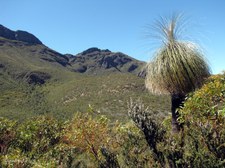
A perennial tree-like monocot which grows 1–8 m high.
|  Flowerheads of Kingia australis Flowerheads of Kingia australis
The Kingia australia has drum-stick like flowerheads which distinguish it from the Grasstree which has long spear-like flowerheads.
|  Agonis species Agonis species
|  Fountain Triggerplant (Stylidium) Fountain Triggerplant (Stylidium)
|
 Mountain View Mountain View
|  Northern end of the Stirling Range Northern end of the Stirling Range
|  Walking Trail to Bluff Knoll Walking Trail to Bluff Knoll
|  Stirling Range Scenery Stirling Range Scenery
|
 Kingia australis standing tall Kingia australis standing tall
|  Southern Cross Southern Cross
Xanthosia rotundifolia
|  These energetic Hikers hoped to reach the top These energetic Hikers hoped to reach the top
Time for me to return.
|  Bluff Knoll from Walking Trail Bluff Knoll from Walking Trail
|
