 Stuart Crystal slide Stuart Crystal slide
Circa 1690s
Two cherubs (putti) facing each other, adorned with red sashes and small green and red wings. Each cherub holds aloft in one hand the heraldic symbol of ardent affection — the flaming heart — offering one to the other as they rest upon a bannered motto “Mine for Yours”. Both the saying and the putti are rendered in enamel metal. There are gilt cyphers A and M, all resting on finely woven hair. There is a gilt edging under the crystal and a sawtoth edge on the outside. Crystal has rub in center.
| 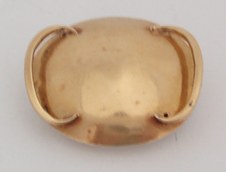 Back of the slide. Back of the slide.
|  Stuart Crystal slide Stuart Crystal slide
Circa 1690s
Aristocratic gentleman painted on vellum, gold over silver, chip on crystal
|  Back of slide. Back of slide.
|
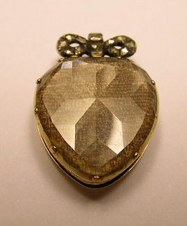 Stuart Crystal Portrait Pendant Stuart Crystal Portrait Pendant
circa 1690s
Stuart crystals were first popularized in 1649, when Charles I, the martyred King of England, was executed under Cromwellian rule. Royalists wishing to show their sympathy for the fallen monarch would wear small slides set with the King's portrait underneath a faceted crystal, or a swatch of hair with the King's initials beneath worked in fine gold wire.
These earliest of "memento mori" jewels created a fashion among the aristocracy for memorial crystals of their own. These crystals were usually fashioned as slides to be strung through a ribbon, but were also made as pendants and earrings. Most Stuart crystals which survive today are of the slide variety.
This 300+ year old heart shaped Stuart Crystal Portrait Pendant has everything.
The front of the gold heart shaped pendant is topped by a rose diamond bow, which is set in silver, and covered by a multi-faceted rock crystal that reflects light b...
|  Back of pendant, "Mon Coeurs Toujours Fidelle" (My Heart is Always Faithful) Back of pendant, "Mon Coeurs Toujours Fidelle" (My Heart is Always Faithful)
|  The back of the heart is convex and engraved "Mon Coeur Toujours Fidelle"- roughly translated - "My Heart Always Faithful". The back of the heart is convex and engraved "Mon Coeur Toujours Fidelle"- roughly translated - "My Heart Always Faithful".
|  The best part is when you lift the heart shaped back and see the hand painted portrait miniature under convex crystal. It appears to be a young man, 25 to 30, wearing a wig and dressed in finery. The best part is when you lift the heart shaped back and see the hand painted portrait miniature under convex crystal. It appears to be a young man, 25 to 30, wearing a wig and dressed in finery.
|
 Another picture of the portrait. Another picture of the portrait.
|  Amuletic Stuart Crystal -- Lord's Prayer Amuletic Stuart Crystal -- Lord's Prayer
English
Dated 1692
Stuart Crystal slide, dated 1692, with a ground of royal blue enamel, gold wire and plaited hair, overlaid with a miniature version of the Lord's Prayer, written by hand on a tiny disc of paper less than one centimeter in diameter, all set beneath a cabochon rock crystal.
This slide measures 3/4" x 3/4". There is some loss to the blue enamel and there is a 19th brooch fitting to the back with the original slide fittings removed.
| 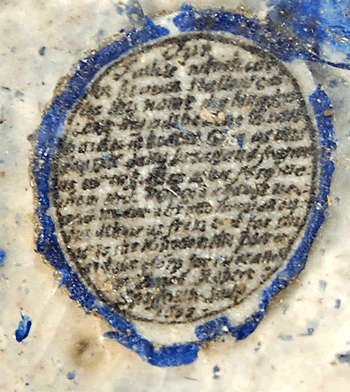 Detail of the Lord's Prayer Detail of the Lord's Prayer
Designed to demonstrate the astonishing skill of the calligrapher, the writing is barely decipherable without the aid of magnification.
Miniature writing samples of this type showed the characteristic 17th century interest in scientific experiment and technical virtuosity. Masters in the art trained for seven years to develop their calligraphy skills in miniature. Such pieces held more than curiosity value, as religious inscriptions were often held to protect the owner against misfortune.
A similar example, in a ring, is in Case 20, Religion and Ritual, in the Enlightenment Gallery of the British Museum. Evidently considered a remarkable piece early in its history, it was acquired by Sir Hans Sloane, whose collections became the foundation of the British Museum in 1753. It is the only example of this work in the museum.
[Text written by Michele Rowan, rowanandrowan.com]
|  Stuart Crystal clasp Stuart Crystal clasp
1708
Extraordinary Stuart Crystal clasp attached to a ribbon (not original) and used as a bracelet.
The amazing scene depicts a cherub (or putti) on a bench with an anvil. He rests his elbow on a skull. The word "Hope" is underneath as well as the initials JC in gold wire thread. The background is tightly woven hair.
|
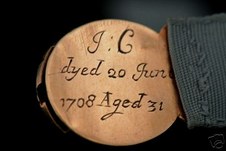 Back of the clasp. Marked: Back of the clasp. Marked:
JC dyed 20 June 1708 Aged 31
|  Picture of bracelet showing size. Picture of bracelet showing size.
|  Stuart Crystal slide -- Queen Mary of England Stuart Crystal slide -- Queen Mary of England
Circa 1690s
Large gold slide of Queen Mary of England set with her cypher and with a gold crown held by cherubs. The crystal is surrounded by Scottish pearls.
|  Another picture of the Queen Mary crystal. Another picture of the Queen Mary crystal.
|
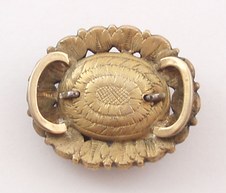 Back of the Queen Mary slide -- the Tudor rose in gold. Back of the Queen Mary slide -- the Tudor rose in gold.
|  Stuart Crystal -- Memento Mori of a Skeleton Stuart Crystal -- Memento Mori of a Skeleton
Circa 1688?
Large Stuart Crystal brooch set on the diagonal. A full skeleton is painted in enamel on tightly woven hair. It holds an hourglass and a bone. The gold wire cypher appears to be the initials B W and below them it appears to say Oct (or At?) 88. The crystal is surrounded by Scottish pearls set in gold.
| 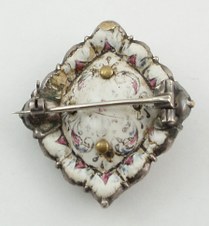 Unusual back to the skeleton crystal, painted in white enamel with pink and black paisleys, perhaps some initials, though considerably damaged. This is a style created by Gilles Légaré, a French jeweler and enameler in the 17th century. Pin stem is a later addition. Unusual back to the skeleton crystal, painted in white enamel with pink and black paisleys, perhaps some initials, though considerably damaged. This is a style created by Gilles Légaré, a French jeweler and enameler in the 17th century. Pin stem is a later addition.
| 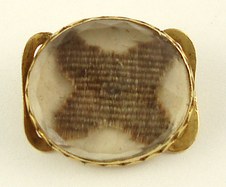 Stuart Crystal slide. Stuart Crystal slide.
Marked 90 (1690)
Woven hair with gold sawtooth bezel under faceted rock crystal.
|
 Back of slide marked "ob June 9 90" Back of slide marked "ob June 9 90"
|  Stuart Crystal Memento Mori skull Stuart Crystal Memento Mori skull
Circa 1680
English Memento Mori ( Remember you too will die) memorial jewelry slide. High carat gold containing woven hair on pink silk, an enamel skull and bones, gold wire border and cypher 'A C' set beneath faceted rock crystal.
|  Back of skull slide Back of skull slide
|  Side view of two Stuart Crystal slides showing faceted crystals and sawtooth bezels. Side view of two Stuart Crystal slides showing faceted crystals and sawtooth bezels.
|
 Stuart Crystal Amatory Slide Stuart Crystal Amatory Slide
Circa 1680s
Rose cut faceted rock crystal enclosing a compartment with a basket-weave panel of hair. High carat gold with saw-tooth bezel.
The tableau is of Venus, with long golden hair wearing a green wreathed crown and clothed in red and blue, pursuing a golden haired cupid with wings tipped in red and green. The cupid holds a red enamel heart that he has just stolen from Venus.
The border enamel is green foliage with red hearts.
The red enamel title read Le Vaincrau - the Vanquished.
|  Stuart Crystal Amatory Slide Stuart Crystal Amatory Slide
Circa 1680s
|  Stuart Crystal Ring Stuart Crystal Ring
Circa 1680
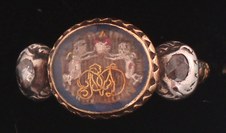
Exceptional Stuart crystal ring, circa 1680, with rose-cut diamond shoulders and reverse enameling in duck-egg blue. Beneath the central rose-cut crystal two angels hold aloft a heart, with gold wire cipher initials and a weave of hair on a blue ground. The heart symbolism denotes it as a love token rather than memorial. The three stone design was popular in decorative rings of the 17th century but is most unusual combined with a Stuart crystal center. The ring is size J [ 5 US] and in excellent condition.
|  |
 |  |  |  Stuart Crystal Betrothal Slide Stuart Crystal Betrothal Slide
Circa 1680
Stuart crystal slide, a compartment of faceted rock crystal containing a ground of woven hair, overlaid with two brightly colored cherubs holding aloft a garland of flowers and gold cipher initials EG. The slide is gold with scalloped edges and the typical 17th century saw-toothed setting. The devices on these pretty ornaments symbolized various events in people's lives - in this case the cherubs and garland of flowers denote a betrothal or wedding. The slide measures 2.5 cm by 2 cm [ one inch by 3/4 of an inch]. It is in pristine and amazingly bright condition for its age.
|
 |  I have never seen this subject on a Stuart crystal slide before, cannot find the same in any reference books and consider it to be extremely rare. A plump slide, circa 1680, with vivid blue enamel ground, depicts Cupid, having shot his arrow through a lover's heart, above a leaping stag -a visual pun, as Cupid has shot a heart above a hart [male stag]. Below the scene is the motto 'Varreste Love' a corruption of the Latin verb voliere, meaning 'to be worthy', hence the motto is 'worthy of love'. The scene is set under a facteded rock crystal to a border of foiled table-cut garnets and river pearls. The reverse is as exquisite as the obverse, enamelled in a pink, black and white botanical design much favoured in the 17th century. A later gold brooch fitting has been added to the original slide fittings. The whole measures 3 cm by 3 cm [1 and 1/4 inches by 1 and 1/4 inches]. There is slight discolouration on the enamel motto but the piece is in amazingly good ... I have never seen this subject on a Stuart crystal slide before, cannot find the same in any reference books and consider it to be extremely rare. A plump slide, circa 1680, with vivid blue enamel ground, depicts Cupid, having shot his arrow through a lover's heart, above a leaping stag -a visual pun, as Cupid has shot a heart above a hart [male stag]. Below the scene is the motto 'Varreste Love' a corruption of the Latin verb voliere, meaning 'to be worthy', hence the motto is 'worthy of love'. The scene is set under a facteded rock crystal to a border of foiled table-cut garnets and river pearls. The reverse is as exquisite as the obverse, enamelled in a pink, black and white botanical design much favoured in the 17th century. A later gold brooch fitting has been added to the original slide fittings. The whole measures 3 cm by 3 cm [1 and 1/4 inches by 1 and 1/4 inches]. There is slight discolouration on the enamel motto but the piece is in amazingly good ...
|  |  |
 Back of the crystal showing enamel work in the style of Gilles Légaré. Back of the crystal showing enamel work in the style of Gilles Légaré.
|  | 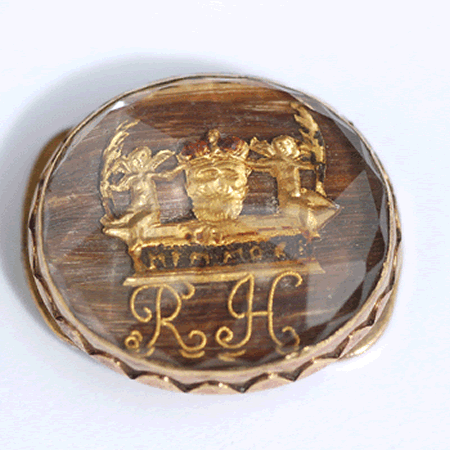 Stuart Crystal Memento Mori Slide Stuart Crystal Memento Mori Slide
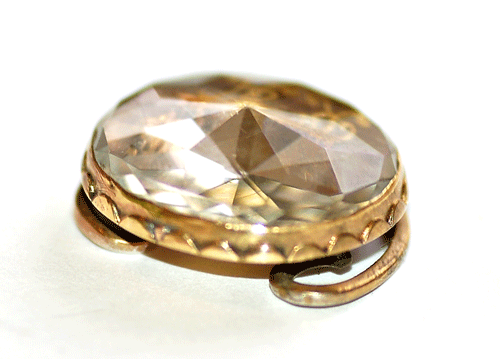
Stuart crystal slide, circa 1680, a rock crystal compartment containing a lozenge of gummed hair overlaid by a device of two cherubs holding aloft a red enamelled crowned skull,which rests on a coffin. The coffin is inscribed 'mem mori' for Memento Mori. Gold wire intials below. The slide is gold, with reverse fittings terminating in scrolls. Immaculate condition.
|  |
