THE ROBIN DEUTSCH COLLECTION
Jewelry by Knoll & Pregizer. Pforzheim, Germany. 1887-1975
Knoll and Pregizer Jewelry History. KP Germany Sterling 925 935 Victorian-Edwardian-Belle Epoque-Art Deco Jewelry and Watches through Post WWII.
This website was started June 2009 and is the first and only authentic website on Knoll & Pregizer Jewelry.
COPYRIGHT©ROBIN DEUTSCH 2009-2026. ALL RIGHTS RESERVED.
The use of any information or images from this website is PROHIBITED without my prior written consent.If you choose to use the information I have provided in a public setting, book,article, webpage (whether in a sales venue or not), etc., please use the following credit:
"INFORMATION REGARDING KNOLL & PREGIZER IS COURTESY OF ROBIN DEUTSCH".
I have been collecting this exquisite jewelry for over 20 years now , unfortunately compared to the size of some of my other collections this one is much smaller as it is usually hard to find. Each acquisition of a piece of Knoll & Pregizer has been a joy to acquire. "In my collector's eye, they are the Cartier of German costume jewelers." This is just a small portion to give you an idea of the quality of jewelry made by this amazing company, as I have many incredible pieces that are not on this site. Sometimes the KP punch is so small that you might not even know you have a piece. I have had pieces for a couple of years before I found the mark. Sometimes I will buy a piece of it missing stones knowing I might never be able to repair it just to have it in my collection, however over the years as my collection grew and evolved, I did indeed have several of my most special treasures repaired and restored. Each piece is handcrafted from sterling silver, using the finest paste and imitation glass stones mimicking platinum,diamonds, rubies, sapphires and emeralds, also copies of fabulous "tutti frutti/fruit salad" stones. Sometimes they will use semi-precious stone colors such as amethyst and onyx. The pieces are constructed exactly as a piece of fine jewelry would be, and I am sure the same jewelers working on real jewelry also made these exquisite imitations. My saddest loss was not being able to buy a Cartier copy of an Art Deco Egyptian Revival scarab brooch they made but I will never forget that piece. You never forget the ones that get away...and sadly several have. (I am so thrilled to report that in 2012, I am now the happy owner of this breathtaking and extremely rare and unique piece. Sometimes it can take years to obtain the jewel of your dreams. See my treasure below!)
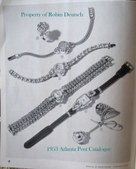
For years it remained one of those jewelry mystery marks that remained unsolved to us American collectors. I had noticed the company name listed in the Theodor Fahrner Jewelry Book of registered German companies not as KP, but as Knoll & Preziger (misspelled) and that piqued my interest.(Just the name was listed, there was absolutely no information on the company itself). I have been a passionate collector of some of the most marvelous German art deco sterling and paste jewelry with a mystery mark of KP in a shield with the letters intersecting for years trying to discover who this mark belonged to with no avail. I tried researching the name every way possible and all I would get on occasion would be watch auctions but nothing that showed the trademark. One day as I was researching I could not believe what I found. An eBay auction from a seller in Uruguay of all places who was selling a 1953 Atlanta Post catalogue containing German jewelry and accessory companies. The seller listed the names of the companies in the auction and photos of many pages. There it was. A photo of jewelry with the KP Trademark and the company name. Buying this catalogue was one of the most important purchases I’ve ever made.(After I received it, I saw that all of the ads from the companies were in German, but the descriptions in the back of all of the items were in Spanish. The writing on the cover translated to "Journal of International Trade. Spanish Edition". Many Germans had emigrated to South America and there was a large market for their products).
In all my years of research this was probably one of my happiest and proudest moments. To be able to connect and confirm all of the information together. I am also proud to be the person who has been able to give Knoll & Pregizer the respect and admiration for posterity that it deserves, since before the publication of this website virtually nothing about this company was known. This 1953 catalogue page shown below confirms without a doubt the attribution of jewelry marked KP Sterling Germany (or KP 925 or KP 935) to Knoll & Pregizer of Pforzheim, Germany. What is fascinating is in their long history they made Victorian/Art Nouveau, the garland style jewelry popular in English Edwardian and French Belle Époque and the MOST extraordinary (and my favorite) breathtaking Art Deco jewelry. Because of the 1953 catalogue page you can see the change in their style of jewelry after WWII. Amazingly, I have discovered several patents dated from 1906 thru 1975 registered in Germany, France, the United States, and the UK.
The jewelry was ALWAYS made in Germany except for the movements to their timepieces which were Swiss. The patents approved and registered for other countries were to protect their designs/inventions that were exported as well as their trademark. Many of their later watches Post WWII were made in 14K/18K gold with diamonds and the earlier ones in sterling silver with pastes or marcasites. I've seen Swiss movements marked Deauville, Knoll & Pregizer, Goldsiegel/KP, FIG, LOTOS, A. Nicolet Watch Co., FHF, and others that mean nothing to me (this is besides the two Glycines now seen) Some are 15 Jewels, some 17 jewels. Except for one piece having Nicolet on the dial and A. Nicolet on the movement (for Armand Nicolet Co) with "Knoll & Pregizer, Sterling West Germany" INSIDE the case, or movements specifically made for them marked KP/Goldsiegel (A brand of theirs) or just KP, they made the cases and had someone make the movements for them (although the 1962 trademark registration covers movements). There is a separate trademark registration for them here in the US just for their watch business aside from the jewelry, and I have found German patents for watch crystals (such as used on the KP/Goldsiegal watch I own) in 1939 as well as 1952, and the last one in 1975 for "Watch cases with band connection for flexible bracelets" and that's in addition to other patents for jewelry mechanisms going back as far as 1906. The patents were registered in the US as early as 1912, and also to England and France, as KP was always a big exporter to those countries as well as the US and Canada...even Australia and South America. They were a full-fledged jewelry manufacturer in every sense of the word, and advertising their watches in trade magazines including a 1973 Swiss watch magazine (that states the company was over 100 years old, so that predates the 1887 registration of their KP trademark by 14 years). There are people now trying to sell art deco sterling paste watches only marked 935 on the back as Knoll & Pregizer.
The ONLY GUARANTEED AUTHENTIC WATCHES ARE MARKED KP ON THE BACK!!! I own an ASPREY art deco paste watch from 1938 and the only identification that it is Knoll & Pregizer is the KP TRADEMARK on the BACK. ******I cannot stress to you enough that ever since my website was launched in 2009 and KP has become collectible, how many people are trying to sell unsigned jewelry as Knoll & Pregizer. The ONLY GUARANTEE you are getting AUTHENTIC Knoll & Pregizer is by their REGISTERED TRADEMARK!!!******
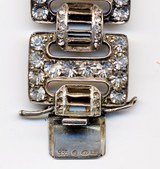
I now know they also made jewelry in 14K/585 gold, 18K/750 gold and 9ct gold (for export to England). This site is always a work in progress and I am updating my information as I make new discoveries. No matter what the piece or when it was made, the markings are the same. The K and P are ALWAYS intersecting at the bottom as shown in the advertising and images below. The letters are ALWAYS in CAPITALS. Sometimes the shield/flower might be lightly struck but the letters will ALWAYS intersect. I have already noticed some eBay sellers trying to attribute pieces marked KP in a rectangle or K.P.(notice the periods) Sterling as Knoll & Pregizer. Or low end base metal plated jewelry with a cheap hangtag of KP in script (They don't mark with script letters and they DON'T USE HANGTAGS). *****I cannot emphasize this to you enough. The mark MUST match their registered trademark.There are some other jewelers out there that have the initials KP which are stamped on the jewelry. Be vigilant and wary because misattributions abound. It was a requirement that registered German manufacturers of precious metal items had to be stamped with the fineness mark for metal and their registered trademark as they were responsible for assaying their own jewelry, and Knoll & Pregizer made a lot of jewelry for export***** I have several exquisite pieces destined for the French market as they are marked with the swan in an oval for small silver articles imported into France. The different grades of silver fineness used were to fulfill the minimum silver requirements for export to certain countries, but the majority destined for the European market were made in 935 silver which would cover export to every country except Poland whose minimum was 940. Pieces marked Sterling or Sterling Germany were destined for the Canadian and/or US market. On certain pieces they will be marked Sterling Germany and the European silver fineness in order to be sold everywhere. Throughout my collecting and research in addition to Europe, the US and Canada, I have found pieces sold as far as Australia, South America and South Africa. England, France, Canada seems to have been their largest trading partners manufacturing jewelry for retailers such as Asprey, Fortum & Mason, Ciro (watches) and Birks in Canada
One of the reasons that Knoll & Pregizer probably fell into obscurity is because, as far as I can tell, except for trade journals and catalogues, they did absolutely no advertising in the way Theodor Fahrner did. They were not known as a "brand", except for their watches. (Someone once sent me a picture of their gorgeous LOTOS paste watch in a marked LOTOS velvet case). Their jewelry seems to have been made as private label orders for the carriage trade and sold in the finest upscale jewelry and department stores in Paris, London, New York (they had a US rep and their trademark and patents were registered here) and other major cities across the globe. Pforzheim firms (not just Knoll & Pregizer) made some of the best paste jewelry I've ever seen. I have a magnificent KP art deco necklace that I purchased in its original unsigned jewelry store box, satin lined inside and leather on the outside with gold tooling. It came from a Massachusetts estate and by the markings on the jewel I can tell it was made for the European market. This dazzling piece was probably bought on holiday in Europe in the 1920s or 1930s at a fine jewelry store...a time of unparalleled glamor and luxury (despite the Depression and the coming of WWII). It looks exactly like carved jade and diamonds and was cared for as such, by the beautiful,almost pristine condition it is in 90 years later. I believe that the best of KP jewelry was sold not just to women who couldn't have the real thing, but to many women who COULD, and considered it "travel jewelry"...copies of their real pieces that they could wear that would fool the eye, but not to be afraid to wear for fear of losing or being robbed of their real jewels. However, fine paste jewelry itself was always desirable on its own...not just as a copy of real jewels for the "have nots". Many women of discriminating taste and style wore paste jewels lavishly, and no one would be the wiser that they were not wearing Cartier or Van Cleef & Arpels. Stores such as Asprey in London sold and advertised paste jewelry, and I have a 1930s advertisement of theirs showing a page of jewels with a paste watch looking very much like my Knoll & Pregizer deco watch below, along with double clip brooches, ear clips, pendant earrings, rings and bracelets that would be undetectable to the eye. Jewelry stores like that would have sold the pieces in their own fitted cases, not identifying the jewelry as an outside manufacturer. In the US, there were companies making sterling paste jewelry such as Diamonbar by Wachenheimer Bros. in Providence, RI, and New York firms such as Fishel Nessler and Ciner. Other companies were making exquisite reproductions of fine jewelry in rhodium plated metal with the finest paste stones such as Trifari, Mazer, and DuJay as noted in 1934 and 1936 Saks Fifth Avenue ads I have where the copy would say "reproduced from a fine jeweler's piece".
Like many incredible jewelers of the past, all good things must come to an end. By what I have seen of the gold pieces I believe these were made while the company was winding down in the 1960s-1970s. Nothing is as grand or as extraordinary as their heyday up until the late 30s and the start of World War II. I do have several pieces marked West Germany that are post WWII and lovely, but I still think the pre-war pieces were the best. As with every manufacturer, they made different qualities of jewelry for different markets and price points. As I've continued to collect I've found the same models made with less fine manufacturing techniques for lower end production. Unfortunately, as the company was nearing its end in the 1970s, they made some of the most atrocious pieces I have ever seen. To see them go from the magnificence of their early days to some of the ugliest, modernist monstrosities, was very sad indeed.
Marks:
KP Sterling Germany
KP Sterling (usually with a retailer or mystery mark)
KP Sterling Birks in SCRIPT or CAPS (For Birks in Canada)I need to add a caveat for these Birks pieces. ONLY if it is marked Birks WITH the KP trademark was it made by Knoll & Pregizer. Many other companies made jewelry for Birks. If it does not have the KP mark then it is NOT KP.
KP 800 (This is the lowest amount of silver, also referred to as "Coin Silver" or Continental Silver used in Europe)
KP 830
KP 925
KP 935
KP Sterling West Germany Post WWII
KP 925 or 0.925 (in a rectangle) West Germany Post WWII
KP 585 or 0.585 (in a rectangle) (14K) West Germany Post WWII
KP 750 or 0.750(18K) West Germany Post WWII
KP 9ct for export to England
KP Metal/Rhodiant- I believe this jewelry to be c.1960 or later and made for the lower end market. Rhodiant is some type of rhodium-like plating although my research turns up very little about it. I have only seen 3 pieces marked as such--a paste lapel watch and a necklace and earring set with no other silver fineness mark...which regardless of how it tests I believe to be nothing more than plated metal. I know from trademark applications to the US in 1962 for their jewelry and watches, they covered precious metals (gold/silver) and "their alloys". Every piece I have from pre-WWII and for many pieces after are all precious metals except for my 1950s earrings where the inside of the clip mechanism on the earring is marked "metal" and the outside "sterling", obviously to cut costs.
*****Knoll & Pregizer KP REPRODUCTION ALERT*****
I have added a pair of earrings to the album that have been making the rounds on eBay as recently as September 2011. (Now in 2012 I have seen at least 15 pairs of these sold this year alone--still showing up in 2018)). I bought my pair shown below about 10 years ago on eBay knowing full well they were reproductions and not authentic deco paste, but I never took any notice of the KP mark. My first pair of art deco paste reproduction earrings were, in fact, purchased in person, by me, at the Chelsea Antiques Fair in London 16 years ago while on vacation. At the time I knew little about paste jewelry and nothing of reproductions and believed them to be completely authentic, until I saw my English "antique" earrings start to turn up by the boatload a few years later on eBay sold by a host of different sellers. Very expensive but important lesson learned. Authentic period earrings were not made in huge multiples in different colors. The same earrings could not possibly be sold by a multitude of sellers at the same time and be original. This has nothing to do specifically with KP, just reproductions in general, so from my experience I know this has been going on for at least that amount of time, probably longer. A friend alerted me to a pair recently on eBay and I said "I have those" and pulled my exact pair out. Sure enough, there it was. The KP trademark. Apparently these reproductions were made from an authentic pair of KP earrings that were used to make the mold. I know they are different earrings made at different times because they have different surmounts from mine. The ones I saw are brand new, and mine have the patina of age, so this means they have been making this earring for at least 10 years. Usually KP put their trademarks on the screwback fitting (HINT: Authentic early KP earrings were mostly made as screwbacks, not pierced,because that was not the style at the time. Many KP earrings will forever remain unidentified because of conversion to pierced earrings/posts and the removal of the KP trademark on the fitting) and not the jewel itself, but I do have an authentic pair of KP earrings where they are marked on the back of the earring like these. The earring I am showing is the only reproduction piece I have seen thus far. I am fairly certain that at that time years ago when the original earring was copied, the mark meant nothing to whomever manufactured them, they just liked the style. I have not seen mention of the KP mark in the auctions yet, but it is only a matter of time before someone tries to sell these as authentic. See my description below to know what to look for.
Founded in 1887 by Theodor Eberhard Friedrich Knoll and Friedrich Pregizer. Friedrich Pregizer left the company in 1907 and was replaced by Carl Knoll. Registered in 1887 (Theodor Fahrner by Schmundt-Weber-Becker book page 68) misspelled. Along with jewelry, they made watches signed Goldsiegel(Gold Seal) registered in 1938, KAPE registered in 1935 and 1938 and also signed LOTOS (registration date c.1940). I have a very early and elegant art deco paste watch that has no name on it except SWISS on the front of the face and the KP mark on the back along with a registration number. I've recently discovered a watch they made marked NICOLET for the Armand Nicolet Co. from Switzerland post WWII. Other marks on their watch faces include LOTOS, KAPE, KP, Corundo, Knoll & Pregizer,or the names of retailers or companies where KP manufactured the watch cases for them. Sometimes, but not always, the movements themselves will be marked KP. They probably had a Swiss company manufacture those movements for them. One of my most interesting purchases was of a wonderful 14K Man's Military Watch. In 1971 Knoll & Pregizer won the prestigious Golden Rose of Baden-Baden award for excellence for their watch model named "Evening Star". This award was considered the "Oscar" to German watch manufacturers. (found in the publication "Baden-Württemberg" in Google Books). I have found many patents of theirs in my research including the earliest ear clip finding patented in Germany in 1906 and later registered here in the US in 1912. In contrast, the first American company to patent an ear clip was Ballou in 1934 so they were way ahead of their time.
KNOLL & PREGIZER, of 16, Goethestrasse, Pforzheim, Germany 455 Zugang 1992-53 Nr. 372 Post WWII Archive Records that show they were registered as a business from 1948-1973 (many of the business registration records for German jewelers were destroyed during the war hence the date of 1948 for KP) however I have found a patent for a watch crystal as late as 1975. This, along with the 1887 date of registration as a company from the Theodor Fahrner book, patent info, and other trade publications confirms that Knoll & Pregizer were in business from 1887 thru AT LEAST 1975. Although they were open during WWII, from private research that I own, I know that in 1942 they were "overflowing with orders for men's and women's golden wristwatches and at the moment we see no way to deliver them". During WWII,on November 9, 1944, the large office building where Knoll & Pregizer was located in Goethestrasse sustained tremendous damage when hit by a heavy bomb. "Bombing Germany: The Final Phase" by Tony Redding published in 2015. On February 23 1945 the city of Pforzheim suffered its largest and most devastating air attack by the RAF with nearly 2/3 of the city and a third of the population destroyed. Because the town was the jewelry and watch center of Germany, the Allies thought they were producing precision instruments for the German war effort. Pforzheim records date Knoll & Pregizer (and many other companies) from 1948 onward because many of the previous records were lost. Anything regarding their jewelry, watches or factory during WWII is sketchy as I don't believe they were allowed to export anything out of Germany past 1939.Please see some U.S. Trademark information for Knoll & Pregizer that I found recently in the United States that was registered in 1962/1963 by Walter Knoll who ran the company during those years for costume and precious jewelry as well as watches. You can see these documents at at the end of the album. The trademark expired in 1987, but since I have not found any information about the company since 1975, I am "assuming" they were given a 25 year US trademark. Will update if I find any further information.
The company was run from 1969 until 1972 by Lutz Stavenhagen, who married Christine, the stepdaughter of the former managing director of Knoll & Pregizer jewelry and watch factories, in 1965. Mr. Stavenhagen, was a German politician (Minister of State at the Chancellery and Member of Parliament) from 1972 until his death in 1992. His wife Christine died in 2015.
I found a listing from the 1970s of Der Deutsch-Amerikaner von heute:Deutsch-Amerikanisches Adressbuch fur due-by Stefan Deubel Page 383: US Rep: Grosse Jewels 303 Fifth Avenue NY, NY. Knoll & Pregizer, Pforzheim Watches & Jewelry Pforzheim, Germany had hundreds of jewelry manufacturers on par with Providence, RI here in the US. I have many pieces of jewelry just marked Sterling Germany, but **UNLESS THE PIECE IS MARKED KP, ONE CAN'T CONFIRM IT WAS MADE BY KNOLL & PREGIZER**. THIS IS IMPORTANT TO NOTE AS THEY WERE DILIGENT ABOUT MARKING THEIR JEWELRY AS REQUIRED BY GERMAN LAW.
Per his great-great grandson Thomas Wolfgang Maguire on 8-12-09 the family tree is: Theodor Eberhard Friedrich Knoll ( 1851-1928) (Great-Great-Grandfather) ---- Theodor Knoll(Great-Grandfather) (1881-1961)----- Margarete Nestlen nee Knoll (1914-1984) ---- Margrit W. Maguire nee Nestlen (1943) --- Thomas Wolfgang Maguire (1981) His mother Margrit is the granddaughter of Theodor Knoll.
VERY EXCITING NEWS PER GREAT-GRANDSON THOMAS WOLFGANG MAGUIRE ON 9-10-09: "The History of Knoll & Pregizer according to the Archives in Pforzheim and translated from German." (This is exactly as it was translated, I have not made any grammatical corrections) "The Knoll Family originates from Schwäbisch Gmünd, there they had a small shop inside their home to make Jewelry for the Areas Jewelry Stores. After Theodor Eberhard Friedrich Knoll learned to be Goldsmith in the Home Business of His Father and learned at a Technical School did he go to The Military. After he left the Military in 1877 did he take up a position as a Apprentice in a Fine Pforzheim Business, after two years he made himself independent and founded a small business in Pforzheim. In 1882 did he take into the company The Merchant and Traveling Imitation Jeweler Friedrich Pregizer. The Company now was run under the Name of Knoll & Pregizer. The offer was extended to the production of Imitation products using Fine Pour Technique. In the future the company was able to begin thanks to a little competitive pressure to increase their sales steady and even train their own apprentices. There was establishing or further branches and others in Nagold. In 1907 Pregizer resigned from the business. After the two eldest sons, Carl and Theodor of merchants had completed training in Pforzheim stores, They picked up their father as an employee and left them after 1914, the sole managing director. From the effects of World War I. The production activity (could be maintained only in very restriction. The Nagold branches had to be closed.) Recovering the company after the war, again due to high demand, was relatively quickly. Carl Knoll, the eldest son and later on the city council had received since 1906 with the departure of Frederick Pregizer transferred the commercial management of the business. He married about 1908 Margarete nee Nestlen with which he had three children, Ilse (born 10.12.1908), Marianne and Walter (both born on 27.5.1911) had. The latter subsequently took over the lead. Erich Keller, son of Ilse Knoll first marriage, was transferred in 1957 by the participation in the business. Both Life Stories which are steepened the above information is taken to give a great insight into the families and Company history, especially from the Pforzheim Foundation 1879 to 1958. In addition, the city archives has in its files Commercial Papers (Knoll & Pregizer, jewelry and watches factory, manufacture of watches and jewelry, Walter Knoll; Friedenstr 62; Goethe Strasse 16."
All of the pieces and pictures are from my collection except where noted. Many thanks to my dear friend and colleague Dr. Kristin Rheinwald in Germany who so patiently helped me translate and navigate these German archives. She has been invaluable to me and a wonderful friend. I would also like to thank the very gracious keeper of the Knoll Family History, Thomas Wolfgang Maguire, great-great grandson and great-grandson of both TEF Knoll & T. Knoll for being so generous sharing his time and family history and wonderful photographs. -----------------------------------------------------------------------------------------------------------------------------------------------------------------------------------------------
©ROBIN DEUTSCH 2009-2023. No information or images may be used without prior consent.
Please feel free to contact me at knollandpregizer@gmail.com While I am happy to answer any questions you may have regarding Knoll & Pregizer jewelry, I DO NOT OFFER APPRAISALS.
I am a member of:
The American Society of Jewelry Historians (ASJH)
Association for the Study of Jewelry and Related Arts (ASJRA)
Gem-X
Costume Jewelry Collectors Int'l
Private Collector and Jewelry Historian
My article on Knoll & Pregizer was published in Vintage Fashion & Costume Jewelry Magazine Vol. 19, No. 3, 2009
Lender to the exhibit "Finer Things" at Stan Hywet Hall & Gardens. Akron, Ohio. April-October 2012
For more pieces from my other collections visit: https://pinterest.com/knollpregizer/
Several pieces of "The Robin Deutsch Collection" are featured in the 2014 book "Warman's Costume Jewelry" by Pamela Wiggins.
I have written exclusive content for CJCI:
https://www.costumejewelrycollectors.com/2015/06/16/who-was-reinad-creator-or-copier-by-robin-deutsch-for-cjci/
https://www.costumejewelrycollectors.com/2014/06/09/foiling-style-pirates-exclusives-patents-copyrights-robin-deutsch-cjci/
https://www.costumejewelrycollectors.com/2014/01/02/makes-piece-copy-worthy-robin-deutsch-cjci/
https://www.costumejewelrycollectors.com/2013/10/17/advent-costume-jewelry-early-period-copies/
https://www.costumejewelrycollectors.com/2013/10/07/the-piece-of-your-dreams-or-is-it-by-robin-deutsch/
Fabulous new article with ground breaking research on Otis, Inc. co-authored by me, Robin Deutsch, with my friend and fellow jewelry historian Barbara Schwartz of Trufaux Jewels in Toronto, Canada:
https://www.trufauxjewels.com/otis-sterling-bracelets/
May 2018: The latest article and collaboration between my colleague and jewelry historian Barbara Schwartz and myself, Robin Deutsch on the connection between the German company Schrieber & Hiller and Esha Randel. This is new information that has never been published before.
https://www.trufauxjewels.com/jewelry-mystery-drgm-1138525-esha-randel/