 [Sold: necklace and small bracelet] Early Haskell parure, probably from the early 1940s. Necklace, 2 bracelets on elastic and a dress clip, all made with turquoise glass beads, some wired into balls, roses montees, and rhinestone-studded leaves and flowers. The bracelet on the right is from Miriam Haskell's private stash and is a much more elaborate version made for evening wear than the one on the left. Unsigned Haskell. [Sold: necklace and small bracelet] Early Haskell parure, probably from the early 1940s. Necklace, 2 bracelets on elastic and a dress clip, all made with turquoise glass beads, some wired into balls, roses montees, and rhinestone-studded leaves and flowers. The bracelet on the right is from Miriam Haskell's private stash and is a much more elaborate version made for evening wear than the one on the left. Unsigned Haskell.
|  [Sold] Close-up view of front of the necklace. The turquoise balls are held on by a single thread of seed beads. It is amazing to me that this has survived. [Sold] Close-up view of front of the necklace. The turquoise balls are held on by a single thread of seed beads. It is amazing to me that this has survived.
|  Back of the necklace, showing the primitive, wire foundation and loop clasp. Note the seed bead attachments and the roses montees inset into the balls. This necklace must have been very uncomfortable to wear! Back of the necklace, showing the primitive, wire foundation and loop clasp. Note the seed bead attachments and the roses montees inset into the balls. This necklace must have been very uncomfortable to wear!
|  [Sold-necklace and bracelet] Another early choker, bracelet and clip with balls made of pink art glass beads, accented by pink glass leaves. The bracelet is a typical early style strung on elastic (usually needing restringing). Unsigned Haskell. [Sold-necklace and bracelet] Another early choker, bracelet and clip with balls made of pink art glass beads, accented by pink glass leaves. The bracelet is a typical early style strung on elastic (usually needing restringing). Unsigned Haskell.
|
 close-up of the necklace. The construction is quite interesting. The balls are made of two metal half circles on which the beads are wired and then they are mounted on a thin metal chain strung through the middle of the two halves. You can see an example of this construction by looking at the ball that is the 2nd down from the clasp on the left (11 o'clock). close-up of the necklace. The construction is quite interesting. The balls are made of two metal half circles on which the beads are wired and then they are mounted on a thin metal chain strung through the middle of the two halves. You can see an example of this construction by looking at the ball that is the 2nd down from the clasp on the left (11 o'clock).
|  Another very early bracelet, c. 1930s, of celluloid flowers, glass leaves and small yellow glass beads. It is missing several flowers and leaves and has some chips, but the colors are remarkably brilliant. All components are sewn onto silk cord. Unsigned Haskell. Another very early bracelet, c. 1930s, of celluloid flowers, glass leaves and small yellow glass beads. It is missing several flowers and leaves and has some chips, but the colors are remarkably brilliant. All components are sewn onto silk cord. Unsigned Haskell.
|  Back of bracelet showing construction (and dirt from wear!). Back of bracelet showing construction (and dirt from wear!).
| 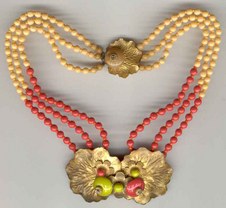 [NFS] Early necklace of taupe and rust-colored beads with a lovely clasp and center decoration made of gilt lily leaves and pate de verre beads in taupe, lime green and rust. One of my favorite necklaces to wear! Unsigned Haskell. [NFS] Early necklace of taupe and rust-colored beads with a lovely clasp and center decoration made of gilt lily leaves and pate de verre beads in taupe, lime green and rust. One of my favorite necklaces to wear! Unsigned Haskell.
|
 [Sold] Matching bracelet strung on elastic. Unsigned Haskell. [Sold] Matching bracelet strung on elastic. Unsigned Haskell.
| 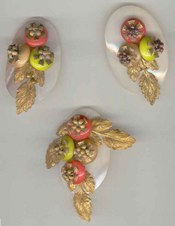 Two dress clips and a pin of pate de verre and wood beads, gilt metal leaves mounted on mother-of-pearl. Pin is from the late 1930s-early 1940s and the dress clips are WWII era. Unsigned Haskell. Two dress clips and a pin of pate de verre and wood beads, gilt metal leaves mounted on mother-of-pearl. Pin is from the late 1930s-early 1940s and the dress clips are WWII era. Unsigned Haskell.
| 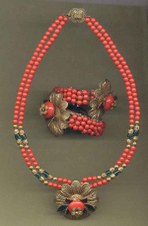 [Sold-wrap bracelet, On Hold necklace] I bought this necklace and bracelet from a woman whose mother purchased it in Paris in the early 1930s. Coral glass beads are interspersed with green glass and gilt metal spacers and both pieces have large gilt metal flowers and pate de verre flattened coral beads. The bracelet is a wrap style--spring wire covered with silk thread. Unsigned Haskell. [Sold-wrap bracelet, On Hold necklace] I bought this necklace and bracelet from a woman whose mother purchased it in Paris in the early 1930s. Coral glass beads are interspersed with green glass and gilt metal spacers and both pieces have large gilt metal flowers and pate de verre flattened coral beads. The bracelet is a wrap style--spring wire covered with silk thread. Unsigned Haskell.
|  [Sold] Close-up of the necklace, showing the central element (which includes enameled green leaves) as well as the elaborate gilt metal slide clasp. The central element on the necklace has a dress clip on the back, allowing it to be asymetrically clipped to the wearer's neckline. [Sold] Close-up of the necklace, showing the central element (which includes enameled green leaves) as well as the elaborate gilt metal slide clasp. The central element on the necklace has a dress clip on the back, allowing it to be asymetrically clipped to the wearer's neckline.
|
 [Sold] A matching dress clip to the necklace and bracelet. [Sold] A matching dress clip to the necklace and bracelet.
|  [Sold-all] A lariat and wrap bracelet from the 1930s showing a different treatment and colors, but similar elements to the previous coral set. The lariat clips to your collar or can be used as a sweater clip. Both pieces have been redone as they were falling apart. The wrap bracelet was missing the floral element on the right and this replacement is as close as we could get to the original findings. Unsigned Haskell. [Sold-all] A lariat and wrap bracelet from the 1930s showing a different treatment and colors, but similar elements to the previous coral set. The lariat clips to your collar or can be used as a sweater clip. Both pieces have been redone as they were falling apart. The wrap bracelet was missing the floral element on the right and this replacement is as close as we could get to the original findings. Unsigned Haskell.
|  Back of the lariat showing a typical 1930s dress clip style. The clips are mounted on a smooth metal plate that covers the wiring. Back of the lariat showing a typical 1930s dress clip style. The clips are mounted on a smooth metal plate that covers the wiring.
|  Probable early Haskell necklace of green, red, blue glass beads and two sizes of glass leaves. The leaves are an exact match for other Haskells that I own, as are the beads. My hesitation comes from the clasp which is not typical Haskell as it has the "thumb-thingy." See Cera pg 71 for similar long leaves. Probable early Haskell necklace of green, red, blue glass beads and two sizes of glass leaves. The leaves are an exact match for other Haskells that I own, as are the beads. My hesitation comes from the clasp which is not typical Haskell as it has the "thumb-thingy." See Cera pg 71 for similar long leaves.
|
 [Sold] White pate de verre bead choker strung on intertwined chain with long hanging pressed glass leaves. Unsigned Haskell. [Sold] White pate de verre bead choker strung on intertwined chain with long hanging pressed glass leaves. Unsigned Haskell.
|  [Sold all] Gray baroque pearl necklace and pin. The necklace has two elaborate elements of layered pressed glass flowers in rose, pale pink, aqua and amethyst colors, each with a central roses montees, then layers of glass leaves looking like mother-of-pearl. Tucked into both elements are pearls and complimentary colored rhinestones, rare as Haskell didn't use too many colored rhinestones in her early pieces. The necklace has a silver filigree slide clasp which is quite small for the weight that it carries! The pin uses similar elements. Unsigned Haskell. [Sold all] Gray baroque pearl necklace and pin. The necklace has two elaborate elements of layered pressed glass flowers in rose, pale pink, aqua and amethyst colors, each with a central roses montees, then layers of glass leaves looking like mother-of-pearl. Tucked into both elements are pearls and complimentary colored rhinestones, rare as Haskell didn't use too many colored rhinestones in her early pieces. The necklace has a silver filigree slide clasp which is quite small for the weight that it carries! The pin uses similar elements. Unsigned Haskell.
|  Back of necklace elements showing metal plates that cover the wiring. The pin has a similar metal plate. These were used in the 1930s until WWII. Back of necklace elements showing metal plates that cover the wiring. The pin has a similar metal plate. These were used in the 1930s until WWII.
| 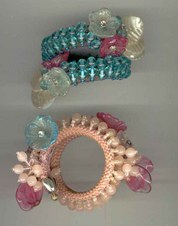 [Sold-all] Two wrap bracelets in pristine condition using similar elements as the prior necklace/pin, but with an emphasis on different colors. Unsigned Haskell. [Sold-all] Two wrap bracelets in pristine condition using similar elements as the prior necklace/pin, but with an emphasis on different colors. Unsigned Haskell.
|
 [Sold] Fabulous festoon necklace from the 1940s with layers of small white beads in increasing sizes (probably Gripoix) and glass leaves. Necklace shows typical Haskell spring-ring clasp (without "thumb-thingy"). Unsigned Haskell. [Sold] Fabulous festoon necklace from the 1940s with layers of small white beads in increasing sizes (probably Gripoix) and glass leaves. Necklace shows typical Haskell spring-ring clasp (without "thumb-thingy"). Unsigned Haskell.
|  [on hold] A glorious lariat and earrings, c. early 1940s, in rose pink glass beads and creamy pearls, ending in floral masterpieces--rose pink glass, glass imitating mother-of-pearl as leaves and flowers and elaborate gilt metal floral findings. The lariat has clearly been restrung with new gold bead spacers. Unsigned Haskell. [on hold] A glorious lariat and earrings, c. early 1940s, in rose pink glass beads and creamy pearls, ending in floral masterpieces--rose pink glass, glass imitating mother-of-pearl as leaves and flowers and elaborate gilt metal floral findings. The lariat has clearly been restrung with new gold bead spacers. Unsigned Haskell.
|  Back of lariat showing clip ends mounted on pierced wire mesh. These are the most frequently seen Haskell clips. Note the spacer bead configuration--seems like a complicated job to lay those out correctly! Back of lariat showing clip ends mounted on pierced wire mesh. These are the most frequently seen Haskell clips. Note the spacer bead configuration--seems like a complicated job to lay those out correctly!
|  Silver-tone chain and leaves lariat, c. late 1930s. Unusual Haskell beacuse of its simplicity. Unsigned Haskell. Silver-tone chain and leaves lariat, c. late 1930s. Unusual Haskell beacuse of its simplicity. Unsigned Haskell.
|
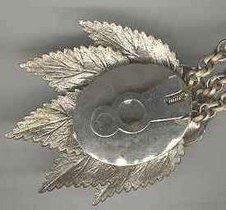 Back of lariat ends, showing another Haskell clip style (also used on dress clips). Note the metal plate covering the wiring as well as the style of chain, both used in many early Haskell pieces. This clip style is rare, but confirmed as Haskell. Back of lariat ends, showing another Haskell clip style (also used on dress clips). Note the metal plate covering the wiring as well as the style of chain, both used in many early Haskell pieces. This clip style is rare, but confirmed as Haskell.
|  4 strand lariat of topaz-colored glass beads ending in gilt metal leaves decorated with flattened topaz glass beads, pearls, interesting cloudy glass beads and floral filigree findings topped with rhinestone balls. These lariats are often quite long--this one measures 26". Unsigned Haskell. 4 strand lariat of topaz-colored glass beads ending in gilt metal leaves decorated with flattened topaz glass beads, pearls, interesting cloudy glass beads and floral filigree findings topped with rhinestone balls. These lariats are often quite long--this one measures 26". Unsigned Haskell.
|  Back of lariat showing another typical clip-end style. Back of lariat showing another typical clip-end style.
| 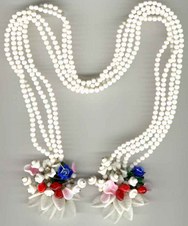 Lariat, c. WWII era, of white glass beads ending in lovely floral corsages of pink, red, white, blue flowers and leaves. Unsigned Haskell. Lariat, c. WWII era, of white glass beads ending in lovely floral corsages of pink, red, white, blue flowers and leaves. Unsigned Haskell.
|
 Back of lariat showing WWII-style clip ends--pierced plastic and lighter weight clips. Back of lariat showing WWII-style clip ends--pierced plastic and lighter weight clips.
|  Lariat of green and white art glass beads ending in leaf-shaped beaded clips topped with gilt metal flowers. Unsigned Haskell. Lariat of green and white art glass beads ending in leaf-shaped beaded clips topped with gilt metal flowers. Unsigned Haskell.
|  [Sold] Lariat, c. 1930s, of pink glass beads imitating quartz and clip ends of pressed glass hot pink leaves, pale pink glass beads with a central glass "raspberry" bead. I found this at the Cow Palace and it strongly resembled another necklace I owned from Sheila P. I triumphantly showed it to Sheila and Glenn, but it was SO pristine (and the clip backs weren't familiar) that we all decided that it was a fake. I put it away in a box to be sold, then dragged it out earlier this year. After 2 years of collecting, I now realized that it is a real Haskell. Knowledge is cumulative! Unsigned Haskell. [Sold] Lariat, c. 1930s, of pink glass beads imitating quartz and clip ends of pressed glass hot pink leaves, pale pink glass beads with a central glass "raspberry" bead. I found this at the Cow Palace and it strongly resembled another necklace I owned from Sheila P. I triumphantly showed it to Sheila and Glenn, but it was SO pristine (and the clip backs weren't familiar) that we all decided that it was a fake. I put it away in a box to be sold, then dragged it out earlier this year. After 2 years of collecting, I now realized that it is a real Haskell. Knowledge is cumulative! Unsigned Haskell.
|  Close up of leaves and beads. Anyone know how to describe the irridescent bead in the middle? Close up of leaves and beads. Anyone know how to describe the irridescent bead in the middle?
|
 Back of lariat. Back of lariat.
|  Close-up of clip. Close-up of clip.
|  [Sold-bracelet, pin, necklace] Fabulous necklace, bracelet and pin c. 2nd half of 1930s. The necklace and bracelet are of pressed glass beads imitating quartz with deep and lighter-toned hot pink glass beads. The floral elements are pressed glss leaves (just like the lariat) with flowers made of concentric circles of faceted glass beads. Note the clasps on both the necklace and bracelet. The bracelet clasp is a slide that connects from top to bottom--unusual. The pin has similar leaves and floral elements but also pearls and a millefiori bead nestled in the back. See Cera pg 88 for a similar necklace. Unsigned Haskell. [Sold-bracelet, pin, necklace] Fabulous necklace, bracelet and pin c. 2nd half of 1930s. The necklace and bracelet are of pressed glass beads imitating quartz with deep and lighter-toned hot pink glass beads. The floral elements are pressed glss leaves (just like the lariat) with flowers made of concentric circles of faceted glass beads. Note the clasps on both the necklace and bracelet. The bracelet clasp is a slide that connects from top to bottom--unusual. The pin has similar leaves and floral elements but also pearls and a millefiori bead nestled in the back. See Cera pg 88 for a similar necklace. Unsigned Haskell.
| 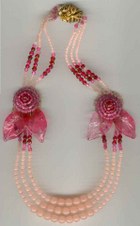 [Sold] Close-up of the necklace. [Sold] Close-up of the necklace.
|
 Back of the necklace element. The drilled holes are interesting and I have encountered them several times on other pieces. I don't know what they are for....Ideas?? Back of the necklace element. The drilled holes are interesting and I have encountered them several times on other pieces. I don't know what they are for....Ideas??
| 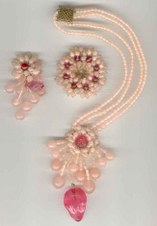 From the same pressed glass imitation quartz family, a necklace and two clips. Necklace is probably late 1930s and the clips are WWII era. Note the raspberry bead in the necklace, similar to the one on the pink lariat. Unsigned Haskell. From the same pressed glass imitation quartz family, a necklace and two clips. Necklace is probably late 1930s and the clips are WWII era. Note the raspberry bead in the necklace, similar to the one on the pink lariat. Unsigned Haskell.
|  Closeup of the necklace showing typical style of Frank Hess. Note the elaborate silver metal clasp and the pressed glass hot pink leaf. It is missing one dangle on the left. Closeup of the necklace showing typical style of Frank Hess. Note the elaborate silver metal clasp and the pressed glass hot pink leaf. It is missing one dangle on the left.
|  [Sold] Haskell designed a line of dimensional flower-shaped pieces in 1938 and this lovely necklace is a terrific example. More of the pressed glass quartz-like beads, an elaborate beaded slide clasp mounded with pink and bright yellow beads. The center floral element consists of small glass tubes wrapped over a pierced metal 3-D form. Lovely (intact!) pressed glass leaves set off the flower. Unsigned Haskell. [Sold] Haskell designed a line of dimensional flower-shaped pieces in 1938 and this lovely necklace is a terrific example. More of the pressed glass quartz-like beads, an elaborate beaded slide clasp mounded with pink and bright yellow beads. The center floral element consists of small glass tubes wrapped over a pierced metal 3-D form. Lovely (intact!) pressed glass leaves set off the flower. Unsigned Haskell.
|
