 Haskell horseshoe plaque. This is the earliest signature plaque, used primarily in 1948-1950 but are still in Haskell's inventory today. Haskell soldered the design plaques onto the filigree backs long before they were used on a piece of jewelry, using whichever one (horseshoe or oval) that fit best on the backing. Then, when jewelry was made, a piece with the applied plaque was used based on fit. Apparently the horseshoe was discontinued because it bent too easily when being soldered onto the backs. Haskell horseshoe plaque. This is the earliest signature plaque, used primarily in 1948-1950 but are still in Haskell's inventory today. Haskell soldered the design plaques onto the filigree backs long before they were used on a piece of jewelry, using whichever one (horseshoe or oval) that fit best on the backing. Then, when jewelry was made, a piece with the applied plaque was used based on fit. Apparently the horseshoe was discontinued because it bent too easily when being soldered onto the backs.
|  Haskell oval hang-tag with stamping carrying through to back side. Use started in approximately 1950-1951. Easily detached and reused on jewelry that is not Haskell, so identification of a piece should also rely on other factors such as beads, findings, etc. Later oval hangtags were flat on the backs, an indication that the jewelry was made starting in 1979 (or so) to present. Haskell oval hang-tag with stamping carrying through to back side. Use started in approximately 1950-1951. Easily detached and reused on jewelry that is not Haskell, so identification of a piece should also rely on other factors such as beads, findings, etc. Later oval hangtags were flat on the backs, an indication that the jewelry was made starting in 1979 (or so) to present.
|  Two dove clasp ornaments. The top shows an incorrect dove (or one that was being considered as a finding, but not used) and the bottom shows the commonly used dove configuration. According to Millie Petronzio, the lower dove was used into the 1970s. You will also find it used as decoration on pins. Two dove clasp ornaments. The top shows an incorrect dove (or one that was being considered as a finding, but not used) and the bottom shows the commonly used dove configuration. According to Millie Petronzio, the lower dove was used into the 1970s. You will also find it used as decoration on pins.
Haskell most commonly used the flower as a clasp ornament, but you will find the dove and also a turtle.
| 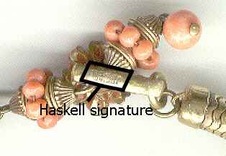 Hook (not) showing the Haskell signature. Imagine that you could see Haskell in block letters in the area indicated by the black square. Anyway, this is the location to look for the signature on the hook. Hook (not) showing the Haskell signature. Imagine that you could see Haskell in block letters in the area indicated by the black square. Anyway, this is the location to look for the signature on the hook.
|
 Haskell oval plaque first used in 1950-1951. This is soldered to the filigree back. The oval mark is still used today by Haskell Jewels. When used as a hangtag, the contemporary tags are flat on the back while the pre-1979 tags show the Haskell imprint in reverse on the back side. Haskell oval plaque first used in 1950-1951. This is soldered to the filigree back. The oval mark is still used today by Haskell Jewels. When used as a hangtag, the contemporary tags are flat on the back while the pre-1979 tags show the Haskell imprint in reverse on the back side.
|  Back of a set showing a variety of Haskell identification. The back of the hook is also signed. Back of a set showing a variety of Haskell identification. The back of the hook is also signed.
|  Raised, stamped label, found on necklace and bracelet clasps starting from the early 1950s. In rare instances, the signature is indented. Raised, stamped label, found on necklace and bracelet clasps starting from the early 1950s. In rare instances, the signature is indented.
|  Design plaque used by Haskell for their contemporary Limited Edition series from the earlyy 1990s. These pieces are numbered and come with a Certificate of Authenticity. Picture from an eBay auction. Design plaque used by Haskell for their contemporary Limited Edition series from the earlyy 1990s. These pieces are numbered and come with a Certificate of Authenticity. Picture from an eBay auction.
|
 Primitive screw clips that are probably from the WWII era when metal was unavailable. Beads are wired directly to the metal. Unsigned Haskell. Primitive screw clips that are probably from the WWII era when metal was unavailable. Beads are wired directly to the metal. Unsigned Haskell.
|  Early Haskell blue glass bead earrings, showing one of the earliest clip styles, c. 1930s. Unsigned Haskell. Early Haskell blue glass bead earrings, showing one of the earliest clip styles, c. 1930s. Unsigned Haskell.
| 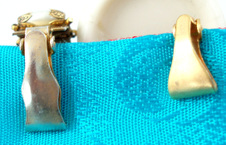 The two styles of unsigned flat clips I have definitely identified as Haskell. The two styles of unsigned flat clips I have definitely identified as Haskell.
|  Unsigned clip back; this is a hoop earring. Unsigned clip back; this is a hoop earring.
|
 Early Haskell screw clips with metal plate covering pierced metal. Unsigned Haskell. Early Haskell screw clips with metal plate covering pierced metal. Unsigned Haskell.
| 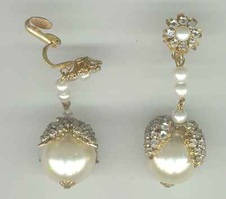 French wire earring back used from the late 1940s. These earrings are unsigned, but on later earrings, the signature would be located on the contact plate on the filigree backing. French wire earring back used from the late 1940s. These earrings are unsigned, but on later earrings, the signature would be located on the contact plate on the filigree backing.
|  French wire clips. Note the metal plate covering the pierced metal on the left and a later version using a filigree back (probably mid-late 1940s but pre-signature). Unsigned Haskell. French wire clips. Note the metal plate covering the pierced metal on the left and a later version using a filigree back (probably mid-late 1940s but pre-signature). Unsigned Haskell.
| 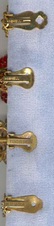 Various styles of signed Haskell clip earring backs (top 2 used starting in 1980s, bottom 2 use started in the early 1950s). Flat clip backs were used up until the mid-1940s, when comfort complaints caused Haskell to start using the french wire style. Haskell transitioned to different flat clipbacks in the early 1950s, after the french styles also proved problematic. Haskell adopted the adjustable screwback earring in 1960-1961. Various styles of signed Haskell clip earring backs (top 2 used starting in 1980s, bottom 2 use started in the early 1950s). Flat clip backs were used up until the mid-1940s, when comfort complaints caused Haskell to start using the french wire style. Haskell transitioned to different flat clipbacks in the early 1950s, after the french styles also proved problematic. Haskell adopted the adjustable screwback earring in 1960-1961.
More recent Haskell flatbacks (starting in the 1980s) are signed HASKELL while the older ones are signed MIRIAM HASKELL.
|
 Signed Haskell earclip showing filigree and construction. Note--there is NO center rivet attaching the clip back to the filigree. Signed Haskell earclip showing filigree and construction. Note--there is NO center rivet attaching the clip back to the filigree.
|  Adjustable screwback clips on these Haskell pearl button earrings. This style was used from 1960-1961 until the 1990s. There are two styles of these adjustable screwbacks, the first showing a patent number on the top bar and the later version with "Haskell" stamped on the top bar. Signature may also appear on the contact area. Adjustable screwback clips on these Haskell pearl button earrings. This style was used from 1960-1961 until the 1990s. There are two styles of these adjustable screwbacks, the first showing a patent number on the top bar and the later version with "Haskell" stamped on the top bar. Signature may also appear on the contact area.
|  Adjustable screwclip earrings in use starting in 1960. These clips have the patent number (2,400,513) stanmped on the top bar of the clip, with the Haskell signature on the small metal circle at the solder point. Adjustable screwclip earrings in use starting in 1960. These clips have the patent number (2,400,513) stanmped on the top bar of the clip, with the Haskell signature on the small metal circle at the solder point.
| 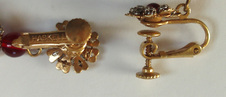 Second version of the adjustable screwclips, marked HASKELL on the top of the earring "bar." Haskell started to use these in 1965. Note how the screw goes through a double loop, making the adjustment more secure. These are patent number 3,176,475; occasionally, you will find these earrings marked solely with the patent number on the flat bar, with no Haskell signature. Second version of the adjustable screwclips, marked HASKELL on the top of the earring "bar." Haskell started to use these in 1965. Note how the screw goes through a double loop, making the adjustment more secure. These are patent number 3,176,475; occasionally, you will find these earrings marked solely with the patent number on the flat bar, with no Haskell signature.
I have also seen 2 pairs of earrings using this finding marked Miriam Haskell in script on the top of the screw mechanism.
|
 Pierced metal back. Pierced metal back.
|  Filigree back of necklace. A filigree is a type of metalwork made by interlacing metal wires and soldering them to one another. Haskell then electroplated the filigree by a process whereby the metal was immersed in a galvanic bath, as the result of which a thin layer of gold, silver or rhodium-colored layer formed on the immersed material. Verdigris (or the dread greenies) happen when the metal or wiring has lost its plating and is corroding. Filigree back of necklace. A filigree is a type of metalwork made by interlacing metal wires and soldering them to one another. Haskell then electroplated the filigree by a process whereby the metal was immersed in a galvanic bath, as the result of which a thin layer of gold, silver or rhodium-colored layer formed on the immersed material. Verdigris (or the dread greenies) happen when the metal or wiring has lost its plating and is corroding.
|  Gilt metal spacer beads. Gilt metal spacer beads.
|  More elaborate metal spacer beads. More elaborate metal spacer beads.
|
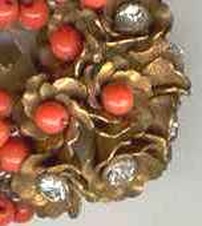 Gilt metal flowers with glass beads and roses montees. Gilt metal flowers with glass beads and roses montees.
|  Metal filigree surrounding a black glass bead. Note metal head pins through beads in background. Metal filigree surrounding a black glass bead. Note metal head pins through beads in background.
|  Gilt metal flower with pearl center and coral-colored glass leaves. Gilt metal flower with pearl center and coral-colored glass leaves.
|  Flower-shaped gilt metal finding with a seed pearl center. These findings have two pieces that hide the wires. Flower-shaped gilt metal finding with a seed pearl center. These findings have two pieces that hide the wires.
|
 Gilt metal flowers with turquoise glass beads in varying shapes. Gilt metal flowers with turquoise glass beads in varying shapes.
|  Gilt metal finding on rose pink glass flower. Gilt metal finding on rose pink glass flower.
|  Silver-tone metal flower with Chinese red glass beads. Silver-tone metal flower with Chinese red glass beads.
|  Silver-tone metal beads, filigree and "dangles." Silver-tone metal beads, filigree and "dangles."
|
 Silver-tone filigree with turquoise glass beads. Silver-tone filigree with turquoise glass beads.
| 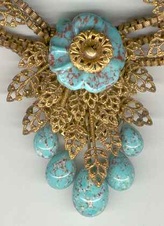 Gilt metal filigree leaves form a layered look with a turquoise art glass flower and filigree center, and oblong turquoise art glass beads. Gilt metal filigree leaves form a layered look with a turquoise art glass flower and filigree center, and oblong turquoise art glass beads.
|  Gilt filigree flowers with turquoise glass beads. Gilt filigree flowers with turquoise glass beads.
|  A (poor) example of roses montees, defined as: : rhinestones cut into a rosette with flat backs and mounted into cup-shaped settings that conceal the wire used to attach it to the support. A (poor) example of roses montees, defined as: : rhinestones cut into a rosette with flat backs and mounted into cup-shaped settings that conceal the wire used to attach it to the support.
|
 Roses montees, gilt floral findings and vaseline glass beads. Roses montees, gilt floral findings and vaseline glass beads.
|  Roses montees formed into a rhinestone ball. Roses montees formed into a rhinestone ball.
|  Pot metal leaves with glued-in rhinestones. It was confirmed by a long-time Haskell employee that Haskell did glue in rhinestones (pre-signature pieces, many from WWII). Pot metal leaves with glued-in rhinestones. It was confirmed by a long-time Haskell employee that Haskell did glue in rhinestones (pre-signature pieces, many from WWII).
|  Another example of pot metal leaves and glued rhinestones. Another example of pot metal leaves and glued rhinestones.
|
