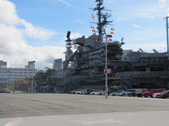
 USS Midway, from pier side. USS Midway, from pier side.
| 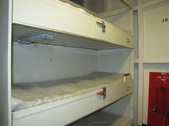 For four long years a bunk (we called them "racks") like this was my home. Now, it needs to be noted that Midway was launched in 1945 and Ranger in 1958. Thus, while the birthing spaces (sleeping areas) were similar, Ranger was definitely better! More room and way better air-conditioning. For four long years a bunk (we called them "racks") like this was my home. Now, it needs to be noted that Midway was launched in 1945 and Ranger in 1958. Thus, while the birthing spaces (sleeping areas) were similar, Ranger was definitely better! More room and way better air-conditioning.
| 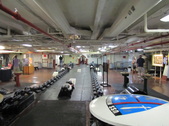 This is a shot of the Focsle. The Focsle's main purpose was to manage the massive ships anchors and chains. But, the focsle was also the place were various ceremonies like promotions or captains mast were held. The Bosun's mates took particular pride in keeping a ships Focsle as clean and neat as possible. This is a shot of the Focsle. The Focsle's main purpose was to manage the massive ships anchors and chains. But, the focsle was also the place were various ceremonies like promotions or captains mast were held. The Bosun's mates took particular pride in keeping a ships Focsle as clean and neat as possible.
| 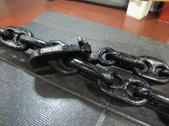 The BIG chain. The anchor for an aircraft is simply huge, Midway's anchors weighed in at 40,000 pounds a piece. Each link of this chained weighed in at 130 pounds each. The BIG chain. The anchor for an aircraft is simply huge, Midway's anchors weighed in at 40,000 pounds a piece. Each link of this chained weighed in at 130 pounds each.
|
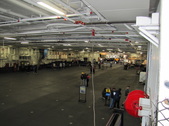 Welcome to the ships hanger bay, view looking forward. Welcome to the ships hanger bay, view looking forward.
| 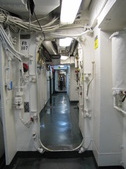 Looking aft down a corridor beneath the hanger bay. The engine rooms are accessed from here. Looking aft down a corridor beneath the hanger bay. The engine rooms are accessed from here.
| 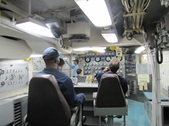 This is Damage Control Central. Normally the operations of the engines and boiler rooms are coordinated from here. It's also where all damage control efforts are coordinated. When a major accident occurs, be it fire, flooding or explosion, all the damage control teams are directed from this room, and all damage to the ship is reported here. This is Damage Control Central. Normally the operations of the engines and boiler rooms are coordinated from here. It's also where all damage control efforts are coordinated. When a major accident occurs, be it fire, flooding or explosion, all the damage control teams are directed from this room, and all damage to the ship is reported here.
| 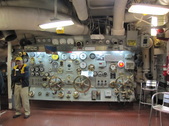 And now we descend to the engine room. If the rack shown earlier was where I spent my sleeping hours, here is where I earned my pay. Days were long, 8 hours on and 8 off, sleep when you can. Conditions were hostile, with temperatures averaging 120 degrees F, and noise levels deafening. And now we descend to the engine room. If the rack shown earlier was where I spent my sleeping hours, here is where I earned my pay. Days were long, 8 hours on and 8 off, sleep when you can. Conditions were hostile, with temperatures averaging 120 degrees F, and noise levels deafening.
On Ranger there was a message painted on the door to number 1 main machinery room. "Abandon all hope, Ye who enter". It was very appropriate, for when you opened that door, a blast of hot air and noise would strike you like a physical blow. It was common for newcomers to cringe and back away when they first experience it.
This shot is of the engine control panel. The 3 big brass wheels control the steam going to the High Pressure, Low Pressure and Reverse Turbines.
This has been a pretty lengthy post, but that guy in the yellow ball cap deserves mention. His name is Gary, and he served on USS Ranger as a Senior Chief Petty Officer at the same time I was aboard.
|
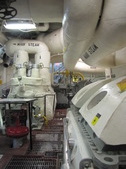 This shot is between the HP and LP Turbine. The HP turbine is on the left. The larger LP turbine on the right. Steam at 800 degrees F and 600 pounds per square inch, blasted down through the pipe going into the HP Turbine. From the rear of the that turbine, the steam would be sent to the LP Turbine. After all it's heat and pressure had been used, the remaining steam, now at below 15 pounds per square inch would go into a condenser, where it would be turned back into water. This shot is between the HP and LP Turbine. The HP turbine is on the left. The larger LP turbine on the right. Steam at 800 degrees F and 600 pounds per square inch, blasted down through the pipe going into the HP Turbine. From the rear of the that turbine, the steam would be sent to the LP Turbine. After all it's heat and pressure had been used, the remaining steam, now at below 15 pounds per square inch would go into a condenser, where it would be turned back into water.
| 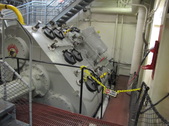 This is the reduction gear aft of the ships turbines. Here the rotating shafts of the two turbines is slowed and then combined into one shaft that leads to the ships propeller. This is the reduction gear aft of the ships turbines. Here the rotating shafts of the two turbines is slowed and then combined into one shaft that leads to the ships propeller.
| 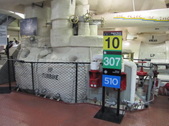 Here's a shot of the High Pressure Turbine. Even though it's smaller, most of the ships power came from this turbine. Here's a shot of the High Pressure Turbine. Even though it's smaller, most of the ships power came from this turbine.
| 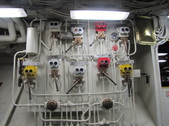 This is a control panel for a Damage Control team. From here a person can open and close various valves for steam, fuel and water lines. This allows the Damage control party to isolate and bypass damaged parts of the ship. This is a control panel for a Damage Control team. From here a person can open and close various valves for steam, fuel and water lines. This allows the Damage control party to isolate and bypass damaged parts of the ship.
|
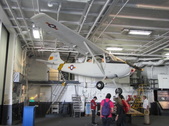 That is a Cessna hanging from the overhead of the hanger bay. Cessna's did not typically operate from aircraft carriers, but this one was special. That is a Cessna hanging from the overhead of the hanger bay. Cessna's did not typically operate from aircraft carriers, but this one was special.
Back in 1973, as the North Vietnam began it's rape of the South, people were fleeing frantically. This particular pilot had put his wife and child in the back of the airplane and flown out over the ocean hoping to find safe haven on a US Aircraft Carrier. Well, he and his family got lucky.
| 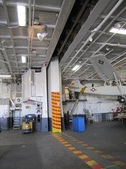 The biggest door on the ship. This massive door is designed to split the hanger bay in two. Thus a fire in the forward section of the bay can be prevented from spreading to the aft section. The biggest door on the ship. This massive door is designed to split the hanger bay in two. Thus a fire in the forward section of the bay can be prevented from spreading to the aft section.
| 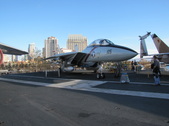 This is an F-14 Tomcat, the mainstay fighter of the US Navy back in the 80's and 90's. Retired for years now, in some ways it's capabilities have not been matched by the current generation of fighter aircraft. This is an F-14 Tomcat, the mainstay fighter of the US Navy back in the 80's and 90's. Retired for years now, in some ways it's capabilities have not been matched by the current generation of fighter aircraft.
| 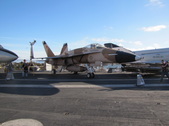 An early version of the F/A 18 Hornet, a fighter that's still the backbone of Naval Air Defense and Attack. This one has an unusual paint job, indicating that it was once used as an "aggressor" aircraft for air combat training. An early version of the F/A 18 Hornet, a fighter that's still the backbone of Naval Air Defense and Attack. This one has an unusual paint job, indicating that it was once used as an "aggressor" aircraft for air combat training.
|
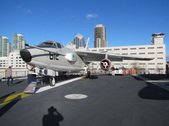 An A-3 Skywarrior. Originally intended as a nuclear bomber, the Skywarrior ended up serving as both a tanker and electronic surveillance aircraft for most of it's career. An A-3 Skywarrior. Originally intended as a nuclear bomber, the Skywarrior ended up serving as both a tanker and electronic surveillance aircraft for most of it's career.
| 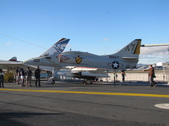 The A-4 Skyhawk. One of the most successful ground attack jets ever. It was used through out the Vietnam war. The A-4 Skyhawk. One of the most successful ground attack jets ever. It was used through out the Vietnam war.
| 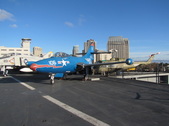 The F9F Panther. The Navy's first successful carrier capable jet. A rather mediocre fighter, it served as a ground attack aircraft during the Korean War. The F9F Panther. The Navy's first successful carrier capable jet. A rather mediocre fighter, it served as a ground attack aircraft during the Korean War.
| 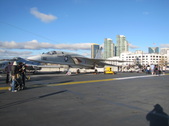 The incredible and awesome A-5 Vigilante!! The incredible and awesome A-5 Vigilante!!
This impressive aircraft was intended to be a nuclear bomber. However that role was taken over by strategic missiles. Despite that, it's impressive speed and range led to the Vigilante to be impressed into service as a reconnaissance aircraft. It was one of the first airplanes capable of supersonic flight WITHOUT afterburner.
|
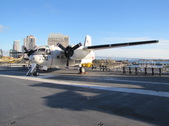 The good old COD, or Carrier Onboard Delivery aircraft. This one is a C-1A Tracker. COD's are basically mini cargo aircraft, delivering passengers , critical small cargo and mail to the ship. The good old COD, or Carrier Onboard Delivery aircraft. This one is a C-1A Tracker. COD's are basically mini cargo aircraft, delivering passengers , critical small cargo and mail to the ship.
| 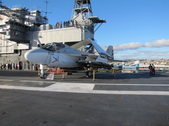 The inimitable A-6 Intruder, last heavy bomber of the United States navy. These aircraft carried the bulk of the bombs dropped on the bad guys from the 1950's until the 1990's when the last of them were retired. Nowadays, their role is filled by F/A 18's. Even though the 18's can't carry half what an Intruder can, with the introduction of GPS guided bombs, Naval attack aircraft are far deadlier today. The inimitable A-6 Intruder, last heavy bomber of the United States navy. These aircraft carried the bulk of the bombs dropped on the bad guys from the 1950's until the 1990's when the last of them were retired. Nowadays, their role is filled by F/A 18's. Even though the 18's can't carry half what an Intruder can, with the introduction of GPS guided bombs, Naval attack aircraft are far deadlier today.
| 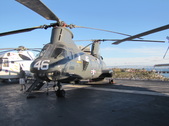 A CH-47 Helicopter. One of these guys delivered me to the USS Ranger in 1980. A CH-47 Helicopter. One of these guys delivered me to the USS Ranger in 1980.
| 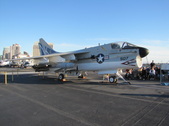 The SLUF or Short Little Ugly F**ker. The A-7 Corsair replaced the Skyhawk as a light attack aircraft, till it in turn was replaced by the F/A 18. The design was based on the F-8 Crusader, but simpler, lighter and no afterburner. They were a neat aircraft, albeit somewhat underpowered. The SLUF or Short Little Ugly F**ker. The A-7 Corsair replaced the Skyhawk as a light attack aircraft, till it in turn was replaced by the F/A 18. The design was based on the F-8 Crusader, but simpler, lighter and no afterburner. They were a neat aircraft, albeit somewhat underpowered.
|
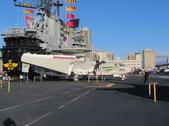 An E-2 Hawkeye. The eyes of the Fleet. With it's massive radar it can track hundreds of targets hundreds of miles away from the Carrier Battle Group. The importance of these airplanes can NOT be overstated. Even during WW2 a single bomb could incapacitate a carrier. Weapons today are far deadlier. Early warning is critical if the Aircraft Carrier is going to be able to survive and fight. An E-2 Hawkeye. The eyes of the Fleet. With it's massive radar it can track hundreds of targets hundreds of miles away from the Carrier Battle Group. The importance of these airplanes can NOT be overstated. Even during WW2 a single bomb could incapacitate a carrier. Weapons today are far deadlier. Early warning is critical if the Aircraft Carrier is going to be able to survive and fight.
| 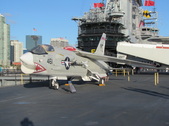 The Last Gunfighter. The F-8 Crusader. With this airplane, the Navy had for the first time a fighter whose performance matched or exceeded their rivals in the Airforce. The Last Gunfighter. The F-8 Crusader. With this airplane, the Navy had for the first time a fighter whose performance matched or exceeded their rivals in the Airforce.
It should be noted that, in part because of experience with the Crusaders guns, she was NOT the last Gunfighter. All modern fighters are designed with guns. Sometimes you just gotta get in close and do it the hard way....
| 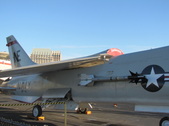 A unique feature of the Crusader was her ability to alter the angle of her wing relative to the fuselage. Note how there is a space between the wing and the fuselage in the picture. A unique feature of the Crusader was her ability to alter the angle of her wing relative to the fuselage. Note how there is a space between the wing and the fuselage in the picture.
This allowed her to maintain a more level attitude during descent and made for a much easier landing.
| 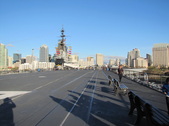 A view of Midway's flight deck looking aft. This picture gives you an idea of just how big she is. A view of Midway's flight deck looking aft. This picture gives you an idea of just how big she is.
|
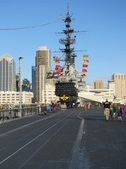 Facing aft, the forward view of Midways island structure. Facing aft, the forward view of Midways island structure.
| 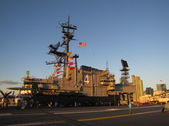 The island from the side. The island from the side.
| 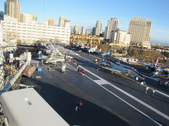 This is a view of Midways flight deck from the "Crow's Nest" in the island structure. On Ranger, I spent a lot of my free time here watching airplanes land and takeoff. This is a view of Midways flight deck from the "Crow's Nest" in the island structure. On Ranger, I spent a lot of my free time here watching airplanes land and takeoff.
| 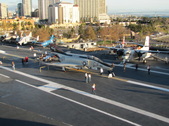 A picture of the F-4 Phantom from the crows nest. Big Fast and powerful, the Phantom epitomized American Airpower in the 1960's. A picture of the F-4 Phantom from the crows nest. Big Fast and powerful, the Phantom epitomized American Airpower in the 1960's.
|
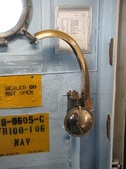 This brass.....thing, was located in the Chart Room. I have NO idea what it is. If YOU do, please leave a comment. This brass.....thing, was located in the Chart Room. I have NO idea what it is. If YOU do, please leave a comment.
| 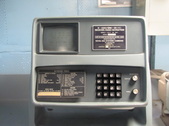 A Loran navigation device. Loran used radio waves transmitted from ground stations. It was only useful near land. A Loran navigation device. Loran used radio waves transmitted from ground stations. It was only useful near land.
| 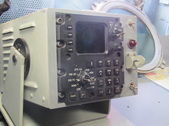 The GPS receiver, which replaced the Loran system. The GPS receiver, which replaced the Loran system.
| 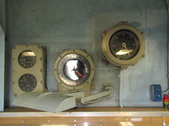 These instruments are above the chart table. From the left, you have Wind Direction above and Wind Speed below. Next is a direction indicator based on the ships gyro compass. Last is the ships speed in knots. (It should be reading zero when the ship is tied up at the pier so it needs a little adjustment.) These instruments are above the chart table. From the left, you have Wind Direction above and Wind Speed below. Next is a direction indicator based on the ships gyro compass. Last is the ships speed in knots. (It should be reading zero when the ship is tied up at the pier so it needs a little adjustment.)
|
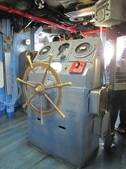 The ships helm. Navy ships still use a big brass wheel for steering, even though it's all done by hydraulics. The ships helm. Navy ships still use a big brass wheel for steering, even though it's all done by hydraulics.
| 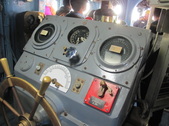 So, from the left, you have a gyro compass, a rudder position indicator (which is showing that the port and starboard rudders are pointed in different directions) and another gyro compass so that you can never be sure which compass is correct. Below the Rudder indicator is another indicator that shows the direction the helmsman WANTS the rudder to point. Obviously, Midway is feeling uncooperative today. So, from the left, you have a gyro compass, a rudder position indicator (which is showing that the port and starboard rudders are pointed in different directions) and another gyro compass so that you can never be sure which compass is correct. Below the Rudder indicator is another indicator that shows the direction the helmsman WANTS the rudder to point. Obviously, Midway is feeling uncooperative today.
That Brass panel behind and to the left of the Helm is the engine order telegraph. That signals to the engine rooms what speed the bridge wants.
| 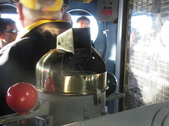 The Helmsman gets his own magnetic compass. So now he's got 3 ways to get confused... BTW, the Mag compass is normally wrong by a few degrees, because the Magnetic North Pole does not lie on the Geographical North Pole. The Helmsman gets his own magnetic compass. So now he's got 3 ways to get confused... BTW, the Mag compass is normally wrong by a few degrees, because the Magnetic North Pole does not lie on the Geographical North Pole.
| 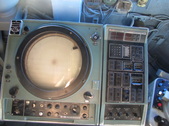 Radar, 70's style. I believe this set is for Navigation and traffic avoidance. Radar, 70's style. I believe this set is for Navigation and traffic avoidance.
|
