How China Precision Sheet Metal Fabricat
Service Uses Visual Docs to Slash Prototype Approval Time & Cut Rework by 40%
Introduction
In the era of global supply chains and remote collaboration, manufacturing engineers and project managers face a pervasive and costly challenge: ensuring that teams thousands of miles apart share a perfectly identical understanding of every detail in a complex sheet metal part. Ambiguous 2D drawings, insufficient verbal descriptions, and low-quality reference photos are the root cause, inevitably leading to costly misunderstandings, repeated engineering confirmations, and project delays. This information asymmetry creates a silent but severe risk to precision, cost, and timeline, often revealing critical assembly or functional flaws only at the final stage before mass production.
This article argues that the systematic adoption of high-resolution industrial photography and process video documentation is far more than a supplementary quality record; it is an indispensable strategic communication tool and risk mitigation measure in modern precision manufacturing. We will detail how building a structured visual documentation system can dramatically enhance efficiency and certainty across the entire workflow, from design review to full-scale production, effectively bridging the communication gap that traditional methods cannot overcome.
Why Are 2D Drawings and Verbal Specs Failing Modern, Complex Sheet Metal Fabrication Projects?
Traditional communication methods struggle to convey the three-dimensional intent and nuanced quality requirements of today's intricate designs, leading to subjective interpretation, rework, and delayed timelines.
- The Three-Dimensional Shortfall of 2D Documentation: Modern sheet metal parts often feature complex multi-bend geometries, welded assemblies, and critical surface finish requirements. A 2D drawing, no matter how detailed, inherently flattens this complexity. It cannot effectively communicate the spatial relationshipsbetween features, the intended sequence of assembly, or the precise visual and tactile expectations for surface quality. For instance, a drawing may call for a "smooth edge," but what constitutes "smooth" to a designer in Germany may differ vastly from a machinist's interpretation in a precision sheet metal manufacturing This ambiguity forces teams to rely on guesswork or costly, time-consuming physical sample shipments for clarification, directly impacting project velocity and cost.
- The Subjectivity Gap in Descriptive Language: Reliance on verbal or written specifications like "burr-free" or "cosmetic finish" introduces significant subjectivity risk. These terms lack the quantitative rigor required for consistent manufacturing execution. In contrast, established standards like ASME Y14.5provide a rigorous, unambiguous language for defining geometric dimensioning and tolerancing (GD&T). High-resolution visual documentation serves as the three-dimensional extension of this precise engineering language. A macro photograph defining an acceptable edge condition or a video showcasing the correct assembly method provides an objective, shared reference that eliminates interpretation errors, establishing a common visual baseline for all stakeholders.
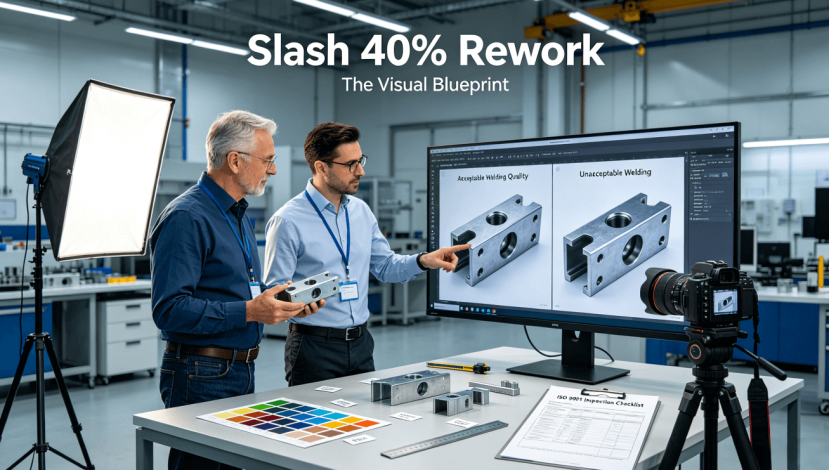
- Building a Shared Visual Vocabulary for Precision: The solution lies in moving beyond text alone. By creating a technical specification image library, companies can build a shared visual vocabulary. This library would contain standardized images of acceptable vs. non-conforming conditions for welds, bends, surface finishes, and coatings. When a drawing calls for a specific powder coat texture, it can reference a high-fidelity, color-calibrated image from this library. This transforms quality assurance from a subjective debate into an objective comparison, ensuring that the final product matches the designer's original intent exactly, which is the cornerstone of successful precision manufacturing visual showcase.
How Can Macro Photography and Cross-Section Analysis Uncover Hidden Flaws Before They Become Costly Failures?
Microscopic visual inspection acts as a pre-emptive diagnostic tool, revealing subsurface and micro-scale defects that evade the naked eye, preventing field failures and ensuring long-term part reliability.
1. Revealing Surface and Subsurface Imperfections
High-resolution industrial photography for manufacturing, especially at macro and microscopic levels, is critical for pre-production validation and first-article inspection. A standard photograph might show a completed weld, but a macro shot can reveal lack of fusion, porosity, or micro-cracks that compromise structural integrity. Similarly, a close-up image of a laser-cut edge can expose excessive dross or heat-affected zone irregularities that could affect coating adhesion or part fit. This level of detail in quality control visual documentation allows engineers to catch and correct process deviations before they escalate into batch-wide quality issues or catastrophic in-field failures, safeguarding both product performance and brand reputation.
2. Validating Material and Process Integrity with Cross-Section Analysis
For the most critical applications, visual evidence must go beyond the surface. Cross-sectional analysis, involving the preparation and photographic documentation of a metallographic sample, provides an incontrovertible view inside the material. This technique is invaluable for verifying heat treatment results, measuring precise plating or coating thickness, inspecting the grain structure of a weld, or checking for internal voids in a casting. Such analysis provides empirical data that complements mechanical testing, offering undeniable proof that internal specifications and international standards have been met. It turns subjective assurance into objective, data-backed verification.
3. Integrating Visual Proof into Certified Quality Systems
The power of this visual evidence is magnified when formally integrated into a quality management system. Standards like ISO 9001 and IATF 16949 mandate objective evidence of conformity and effective control of monitoring and measuring resources. Systematic macro photography and cross-section records provide exactly this: auditable, traceable proof that critical characteristics were inspected and conformed to requirements. Partnering with a china precision sheet metal fabrication service provider that incorporates such standardized visual checks into their First Article Inspection (FAI) reports transforms these documents from simple checklists into powerful, evidence-rich narratives of part quality and process control.
What is the Strategic Value of Process Video Documentation in High-Stakes Industries Like Automotive and Aerospace?
In regulated sectors, process videos provide an immutable, dynamic record of "how" a part was made, serving as irrefutable evidence of process control for internal validation, customer audits, and regulatory compliance.
1. Capturing Dynamic Process Parameters and Sequences
While photographs capture a moment in time, manufacturing process video documentation captures the entire sequence. In industries like automotive (governed by IATF 16949) and aerospace (requiring AS9100D), demonstrating that a process is stable, capable, and followed precisely is non-negotiable. A video recording of a critical welding operation, for example, can permanently document that the correct amperage, voltage, travel speed, and gas flow were maintained throughout the seam. It can show the operator's technique, tool paths, and the order of assembly steps. This dynamic record is far more compelling than a static log sheet, providing undeniable proof that specified procedures were followed exactly as validated.
2. Providing Unbiased Evidence for Audits and Dispute Resolution
When a quality dispute arises or during a rigorous customer or regulatory audit, video evidence serves as an unbiased witness. It can definitively show whether a non-conformance was due to a supplier process error or damage that occurred later in the supply chain. This objective record protects both the customer and the ISO certified metal manufacturers by providing clarity and accelerating root cause analysis. It transforms discussions from "he said, she said" to a factual review of recorded events, building tremendous trust and streamlining the resolution of any issues that may arise.
3. Enabling Training, Standardization, and Continuous Improvement
Beyond compliance, process videos are powerful tools for operational excellence. They can be used to train new operators on the exact, approved method for performing a complex task, ensuring standardization across shifts and facilities. Engineers can review videos to identify opportunities for process optimization, such as reducing non-value-added motion or improving fixture design. This creates a living library of best practices, turning tribal knowledge into a scalable, documented corporate asset that drives consistent quality and efficiency across all production.
Can a Standardized Visual Library Become Your Team’s Single Source of Truth for Materials and Finishes?
A centralized, meticulously curated visual library eliminates subjective interpretation of materials and finishes, accelerating decision-making, reducing sampling costs, and ensuring supply chain-wide consistency.
1. Eliminating Ambiguity in Material and Finish Specifications
Terms like "brushed aluminum," "matte black," or "2B finish" are notoriously open to interpretation, leading to mismatched expectations and rejected batches. A corporate industrial design visual archives solves this by serving as the single source of truth. This digital library would contain high-fidelity, consistently lit photographs of every approved material grade, surface finish, powder coat color, anodizing type, and standard component. When a specification calls for "Stainless Steel 304 with a #4 brushed finish," it links directly to the canonical image in the library. This ensures that designers, procurement agents, suppliers, and quality inspectors are all aligned to the exact same visual standard, eliminating costly guesswork and revisions.
2. Streamlining Procurement and Supplier Qualification
A visual library dramatically accelerates the supplier qualification and onboarding process. Instead of sending physical samples around the world, potential custom sheet metal services partners can be given direct access to the relevant visual standards. This allows for a more accurate and rapid assessment of their capability to meet aesthetic and tactile requirements. It also simplifies the quoting process, as suppliers have a crystal-clear understanding of the finish expectations, leading to more accurate bids and reducing the cycle of "sample and approve." This standardization is a key enabler for efficient supply chain visualization content management.
3. Enhancing Design and Customer Collaboration
For design teams, a visual library is an invaluable tool during the concept and prototyping phases. It allows for rapid visualization of how different material and finish combinations will look, improving decision-making. Furthermore, this library can be shared with end customers or external design firms, providing them with a clear, tangible menu of options. This enhances collaboration, ensures brand consistency across products, and elevates the perceived quality and professionalism of the entire development process, as all parties are working from an identical, high-quality visual reference.
How to Integrate Visual Evidence into a Digital Thread for Full Manufacturing Traceability?
Linking visual assets to part-specific data in a manufacturing execution system creates a powerful digital thread, enabling unparalleled traceability, rapid root-cause analysis, and data-driven continuous improvement.
- Creating a Comprehensive Visual Lifecycle Record: The ultimate application of visual documentation is its integration into a digital manufacturing thread. Each critical visual asset— a macro photo of a weld, a video of a bending operation, a scan of a first-article part — is not stored in a disconnected folder. Instead, it is digitally linked within a Manufacturing Execution System (MES) or Product Lifecycle Management (PLM) system to the specific work order, serial number, material batch, and inspection data. This creates a complete "visual lifecycle record" for every single component or batch. One can trace a finished assembly back to see the exact conditions under which each of its subcomponents was manufactured, providing an unprecedented level of manufacturing transparency and accountability.
- Enabling Rapid Problem Containment and Resolution: When a non-conformance is detected in the field or at final assembly, this integrated visual thread enables lightning-fast root cause analysis and containment. Instead of a lengthy investigation, quality engineers can immediately query the system for all parts from a suspected material lot or production run. They can instantly review the associated visual records from that period— checking for any anomalies in weld appearance, laser cutting and CNC bending tolerances, or surface finish. This allows for precise, surgical containment of potentially affected units, minimizing recall scope, reducing waste, and restoring production confidence much faster than traditional, paper-based traceability methods.
- Fueling Data-Driven Process Optimization: Beyond problem-solving, this rich dataset becomes fuel for predictive analytics and process improvement. By analyzing visual data over time alongside machine parameters and quality metrics, manufacturers can identify subtle correlations. For example, they might discover that a specific tool wear pattern, visible in macro photography, consistently precedes a dimensional drift. This allows for predictive maintenance. Therefore, partnering with forward-thinking sheet metal fabrication services manufacturerswho invest in such integrated digital quality systems is key to building a transparent, intelligent, and continuously improving supply chain.
From Smartphone to Studio: What Are the Practical Best Practices for Capturing Manufacturing Visuals?
Effective visual documentation relies more on methodological consistency and proper technique than on expensive equipment, making it an accessible yet powerful tool for any organization.
1. Establishing Foundational Standards for Consistency
The cornerstone of credible visual documentation is consistency and repeatability. This begins with simple, enforceable standards. Use a neutral, non-reflective background (like a matte grey card) for all part photos. Include a calibrated scale ruler and a color calibration card in every shot to provide spatial and color reference. Establish consistent lighting — using LED light panels or a light tent to eliminate harsh shadows and glare. Crucially, implement a clear file naming convention (e.g., PartNumber_Date_Feature_View.jpg) and a centralized, backed-up storage system. This disciplined approach ensures that images are comparable over time and across different inspectors, transforming random photos into reliable data.
2. Optimizing Equipment for Clarity and Detail
While high-end DSLR cameras with macro lenses are ideal, excellent high-resolution industrial photography can begin with a modern smartphone, a tripod, and clip-on macro lenses. The key is stability (always use a tripod) and controlled lighting. For capturing fine details like surface texture or micro-cracks, a dedicated macro lens is necessary to achieve the required clarity and magnification. For process videos, ensure the camera is fixed on a tripod to frame the key action area steadily. The goal is to capture clear, well-lit, and in-focus images that leave no room for ambiguity about what is being shown, facilitating unambiguous professional engineering content sharing.
3. Developing a Standard Operating Procedure (SOP)
To scale this practice, document it. Create a simple Visual Documentation SOP that outlines the required shots for a First Article Inspection (e.g., overall top/bottom/side views, close-ups of all critical features, shots of serial numbers), the equipment and settings to use, lighting setup, and the process for uploading and tagging images in your digital system. Train all relevant personnel — from quality inspectors to production operators — on this SOP. This institutionalizes the practice, ensuring that valuable visual evidence is captured systematically on every project, by every team member, turning a good practice into a standard, reliable business process.
Conclusion
In the realm of precision manufacturing, high-resolution visual documentation has evolved from a supplementary record-keeping tool into a strategic asset that safeguards quality, accelerates communication, mitigates risk, and ensures compliance. By systematically applying static photography, dynamic video, and standardized visual libraries, organizations can construct a universal language of quality that transcends geographical and departmental silos. This visual thread creates clarity, builds trust, and provides the empirical evidence needed to drive continuous improvement in an increasingly complex and distributed manufacturing world.
FAQs
Q1: What is the minimum resolution and equipment needed to start effective visual documentation for sheet metal parts?
A: A 24+ megapixel camera with a macro lens is ideal. Consistency in lighting and a stable tripod are more critical than maximum resolution. Include scale rulers for reference, and use dedicated cameras for detailed macro work on critical features.
Q2: How do we ensure visual documentation is admissible as objective evidence during supplier audits or quality disputes?
A: Integrate visuals into a controlled quality process with calibrated references and unalterable metadata. Maintain a secure archive and formally link images to inspection records within your QMS. Adherence to standards like ISO 9001 for document control ensures the evidence is systematic and defensible.
Q3: What are the key differences between documentation for prototyping phases versus mass production?
A: Prototyping focuses on design validation with extensive, multi-angle photos to compare intent versus reality. Mass production shifts to statistical process control, using sampled inspections and process videos to prove consistent, capable output over time and volume.
Q4: Can automated vision systems replace manual photographic documentation?
A: No, they serve complementary purposes. Automated systems excel at high-speed, quantitative checks of predefined features. Manual photography remains vital for qualitative, investigative work like root cause analysis and documenting unexpected defects or overall assembly context.
Q5: How should we organize and store thousands of manufacturing images and videos for easy retrieval years later?
A: Implement a strict file naming convention and use a Digital Asset Management (DAM) system with robust tagging. Enrich files with metadata like part numbers and process codes. Crucially, integrate this archive with your ERP or QMS to link visuals directly to work orders, creating a searchable digital thread.
Author Bio
This article is based on insights from an engineering expert with extensive experience in precision manufacturing and supply chain visualization. The expertise is applied to help global clients mitigate manufacturing risks through clear visual communication. If you are looking to establish a more robust visual quality protocol for your next sheet metal project, the team at LS Manufacturing can provide a complimentary precision sheet metal visual inspection checklist. Contact them today to receive your customized copy. |
0 Images0 visitsAlbum by meher Sidi |
