 1 1
Two is company!
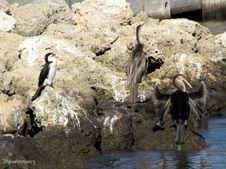
12 June 2011. Pied Cormorant (Phalacrocorax varius) and Darter (Anhinga melanogaster) on the Swan River.
|  2 2
Sunbaking on the Rocks
12 June 2011.
|  3 3
Darter looking to the Left
12 June 2011. Darter drying feathers in the Sun.
|
 4 4
Darter looking to the Right
12 June 2011.
| 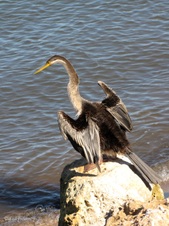 5 5
Darter looking into the Water
12 June 2011.
|  6 6
Pied Cormorant with two Darters
12 Jnue 2011.
|
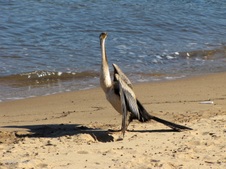 7 7
Darter on river bank
12 June 2011.
|  8 8
Magpie-lark (Grallina cyanoleuca) searches for food
12 June 2011.
|  9 9
Crow holding a crust of bread
12 June 2011. It put the bread in its mouth and flew off.
|
 10 10
The whole Family!
29 May 2011. Pair of Black Swans (Cygnus atratus) with five cygnets at Queens Gardens, Perth.
|  11 11
That's my Baby!
29 May 2011.
Black Swan with cygnet.
| 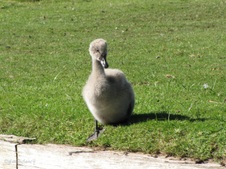 12 12
Cygnet about to go swimming
29 May 2011.
Queens Gardens, Perth.
|
 13 13
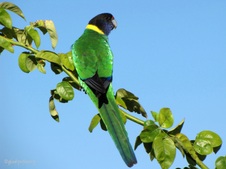
Ringneck Parrot on my Rose Bush
21 March 2011. (Barnardius zonarius). It is lovely to have them in my garden, but they bite off the new shoots and drop them on the ground!
|  14 14
Parrot is wary of the Camera
21 March 2011.
|  15 15
Ringneck Parrot close-up
21 March 2011. Barnardius zonarius.
In Western Australia, these parrots are known as 'Twenty Eights' from their contact call, a whistled 'twen-ty-eight' in the forests of the south-west.
|
 16 16
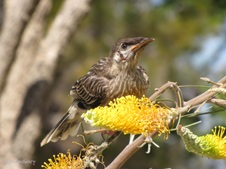
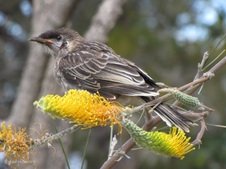
Red Wattlebird (Anthochaera carunculata)
14 September 2010. Wattlebirds gather nectar from the Flame Grevillea (Grevillea excelsior).
|  17 17
Wattlebird shouts a Warning
|  18 18
Wattlebird eyeing the Camera
|
 19 19
Wattlebird glaring at the Camera
|  20 20
Wattlebird deciding to stay
|  21 21
Grevillea Nectar is tempting the Wattlebird
|
 22 22
Wattlebird enjoying the Nectar
|  23 23
Juvenile Wattlebird thinks it is hidden
|  24 24
Galah at The Pinnacles
Nambung National Park.
|
 25 25
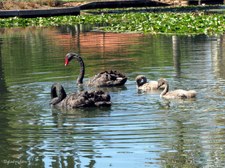
Family of Black Swans
Cygnus atratus at Queens Gardens, Perth.
|  26 26
Black Swan with Three Cygnets
Cygnus atratus at Queens Gardens, Perth.
| 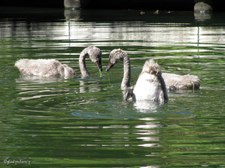 27 27
Three large Cygnets
Cygnus atratus at Queens Gardens, Perth.
|
 28 28
Dusky Moorhen (Gallinula tenebrosa)
05 February 2009.
Nature walk at Karrinyup Waters Resort Caravan Park.
|  29 29
Pacific Black Duck
(Anas superciliosa)
|  30 30
Eurasian Coot
(Fulica atra)
|
 31 31
Eurasian Coot
(Fulica atra)
|  32 32
Great Egret
(Ardea alba)
| 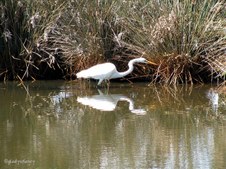 33 33
Great Egret
(Ardea alba)
|
 34 34
Three Sacred Ibis
(Threskiornis aethiopica)
| 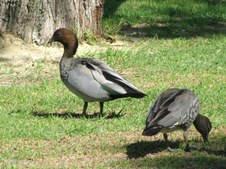 35 35
Maned (Wood) Duck
(Chenonetta jubata)
| 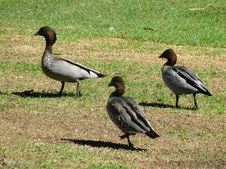 36 36
Maned (Wood) Duck
(Chenonetta jubata)
|
 37 37
Australian Magpie-lark
(Grallina cyanoleuca)
|  38 38
Emus at Rest (Dromaius novaehollandiae)
Two Emus resting at East Coast Natureworld. The Emu is Australia's largest bird and although flightless, the powerful legs can give them speeds up to 50 kph.
|  39 39
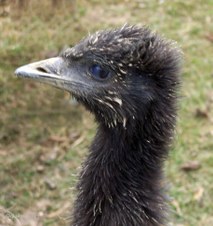
Young Emu
This young Emu with mud on his head was eyeing off my camera.
|
 40 40
Young Emu
East Coast Natureworld operates as an animal rescue centre. Injured and orphaned animals, birds and reptiles are rehabilitated for return to the wild. If this is not possible then a safe and happy home is provided for the rest of their lives in as natural a setting as possible.
|  41 41
Emu Portrait
At East Coast Natureworld, expert veterinary input, full-time animal behaviourist and dedicated carers ensure that the welfare of the animals is never compromised.
|  42 42
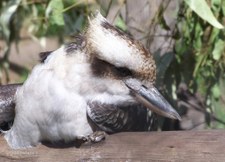
Laughing Kookaburra
The Laughing Kookaburra (Dacelo novaeguineae) has been introduced to Tasmania from mainland Australia.
|
 43 43
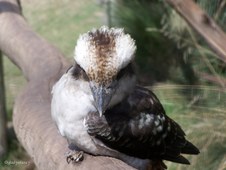
Laughing Kookaburra
Laughing Kookaburra at East Coast Natureworld, Tasmania.
|  44 44
Laughing Kookaburra
East Coast Natureworld operates as an animal rescue centre. Injured and orphaned animals, birds and reptiles are rehabilitated for return to the wild. If this is not possible then a safe and happy home is provided for the rest of their lives in as natural a setting as possible.
|  45 45
Laughing Kookaburra
Injured wildlife receive veterinary input and rehabilitation by dedicated carers at East Coast Natureworld.
|
 46 46
Wattlebird
In the aviary at East Coast Natureworld.
|  47 47
Black Swan
Black Swan (Cygnus atratus) is a protected species in Australia.
|  48 48
Pacific Black Duck
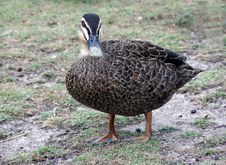
(Anas superciliosa) ..The Pacific Black Duck measures 50 to 60 cm in length. It is mostly mid-brown in colour, with each feather edged buff. The head pattern is characteristic, with a dark brown line through the eye, bordered with cream above and below and a dark brown crown. The upperwing colour is the same as the back, with a bright glossy green patch in the secondary flight feathers. The white underwing is conspicuous in flight. Young Pacific Black Ducks are similar to the adults in plumage.
|
 49 49
Pacific Black Duck
The Pacific Black Duck is one of the most versatile of the Australian ducks. It frequents all types of water, from isolated forest pools to tidal mudflats, and is found in all but the most arid regions of Australia. Outside Australia, its range extends throughout the Pacific region.
|  50 50
Tasmanian Native Hen
Tasmanian native hen (Gallinula mortierii) is found only in Tasmania, being distributed throughout the state except for the west and southwest. It ranges from the coast to areas 1000 m above sea level.
|  51 51
Chestnut Teal
Pair of Chestnut Teal at East Coast Natureworld.
|
 52 52
Chestnut Teal
The Chestnut Teal (Anas castanea) is more often found in the estuarine, occasionally coastal areas, than most species of ducks. They feed by dabbling or up-ending, often grazing and also taking plant seeds and leaves as well as some insects and crustaceans. They are usually seen in small groups although larger flocks may congregate at times.
|  53 53
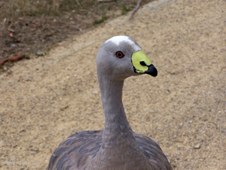
Inquisitive Cape Barren Goose
Cape Barren Goose, (Cereopsis novaehollandiae).
|  54 54
Cape Barren Goose
It kept coming closer! The Cape Barren goose is a handsome bird about the same size as a domestic goose. Its plumage is pale grey, with black markings near the tips of its wing feathers and tail. It has pink legs and black feet. Its most striking feature is the bright greenish yellow cere on its short black bill.
|
 55 55
Cape Barren Goose
Closer and Closer!!
|  56 56
Cape Barren Goose Feathers
Too Close!! At least I got the Feather Detail.
|  57 57
Female Masked Owl
Masked Owl (Tyto novaehollandiae) The female masked owl is larger than the male, measuring about 47 cm in length, where as the males are about 37 cm in length. They are a robust owl with a crouched posture. The eyes are black eyes inside a round, dark-bordered face mask which is a dark chestnut colour. The back is dark brown with fawn patches and white flecks, while the undersides are buff coloured with dark spots.
|
 58 58
Female Masked Owl
If cornered or threatened, masked owls sway from side to side spread their wings and hiss and snap their beaks.
|  59 59
Female Masked Owl
They live in forests and woodlands. During the day the owls roost in hollows in trees or rock crevices. They are distributed around coastal Australia within a few hundred kilometres of the sea. In Tasmania where there are no other large owls, masked owls are the biggest and darkest of all. With no owl competitors, they occupy a wider variety of habitat and occur in greater numbers than anywhere in Australia.
|  60 60
Female Masked Owl
The breeding season varies according to food supplies. They prefer the big hollows of trees to nest, usually at a considerable height. They lay two or three pearly-white, oval-shaped eggs. The female stays in the nest initially with the male ferrying food to her and the chicks. It is three months before the young learn to fly.
|
 61 61
Male Masked Owl
The masked owl eats small mammals, reptiles and occasionally birds. Due to its larger size, the Tasmanian race feeds regularly on rabbits.
|  62 62
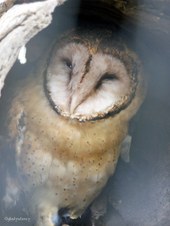
Male Masked Owl
Male Masked Owl (Tyto novaehollandiae) at East Coast Natureworld.
|  63 63
Male Masked Owl
Male Masked Owl (Tyto novaehollandiae) at East Coast Natureworld.
|
 64 64
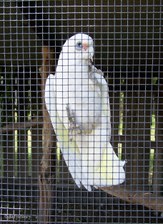
Little Corella
Little Corella (Cacatua sanguinea).. Little Corellas are mostly white, with a fleshy blue eye-ring and a pale rose-pink patch between the eye and bill. In flight, a bright sulphur-yellow wash can be seen on the underwing and under tail. The sexes are similar in plumage, and young birds look like the adults. The adults measure 35cm - 39cm; young birds are slightly smaller.
|  65 65
Tasmanian Native Hen
The Tasmanian native hen is a distant relative of the domestic hen.
|  66 66
Black Swans
Black Swan (Cygnus atratus). The Black Swan has a body length of up to 142 cm, with the females being smaller than the males. In adults, the body is mostly black, with the exception of broad white wing tips, which are visible in flight. The bill is a deep orange-red, paler at the tip, with a distinct narrow white band towards the end. Younger birds are much greyer in colour, and have black wing tips. It is the only entirely black-coloured swan in the world.
|
 67 67
Pacific Gull (immature)
The Pacific Gull (Larus pacificus) is one of the largest gulls.
|  68 68
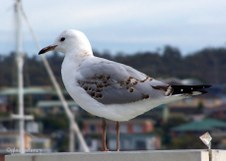
Silver Gull (immature)
The Silver Gull (Larus novaehollandiae) is the most familiar of Australian Gulls.
|  69 69
Silver Gull (immature)
Sivler Gull at St Helens.
|
 70 70
Cape Barren Geese
Cape Barren Goose (Cereopsis novaehollandiae). The Cape Barren goose is a handsome bird about the same size as a domestic goose. Its plumage is pale grey, with black markings near the tips of its wing feathers and tail. It has pink legs and black feet. Its most striking feature is the bright greenish yellow cere on its short black bill.
|  71 71
Cape Barren Geese
Cape Barren Geese live mostly on small, windswept and generally uninhabited offshore islands, but venture to adjacent mainland farming areas in search of food in summer. Their ability to drink salt or brackish water allows numbers of geese to remain on offshore islands all year round.
|  72 72
Cape Barren Geese
These geese are grazing birds, and eat predominantly the common island tussock Poa poiformis as well as spear grass and various herbs and succulents they also eat pasture grasses including barley grass and clover. Geese lay eggs in nests in the tussocks found in the open grassland areas in which they live. Each pair of geese establishes a territory in autumn, prepares a nest site and defends it noisily and determinedly against other geese. About five eggs are laid and the eggs take about a month to hatch. The goslings develop rapidly during the winter, and by the end of spring are able to fly. At this time they join the flocks of non-breeding geese which have also spent the winter on the breeding island.
|
 73 73
Cape Barren Goose
In 1968, a small number of geese were introduced to Maria Island. Their numbers have increased steadily, and in 1995 there were over 100 birds established there. Since the formation of the Tasmanian National Parks and Wildlife Service in 1970, an ongoing priority has been the study and management of the Cape Barren goose population. The aim has been to keep the goose population at acceptably high levels while not allowing increasing numbers to create problems for farmers.
|  74 74
Tasmanian Native Hen
Tasmanian Native Hen (Gallinula mortierii) is a distant relative of the domestic hen. It is found only in Tasmania, being distributed throughout the state except for the west and southwest.
|  75 75
Tasmanian Wedge-tailed Eagle
The Wedge-Tailed Eagle (Aquila audax) is found in a wide variety of habitats. It is almost black when mature, has feathered legs and a long wedge-shaped tail. It is a massive bird which can weigh up to 5 kg, with a wing span of up to 2.2 m or just over 7 feet. They use very traditional nests almost always in very large eucalypts sheltered from the wind. They are very shy nesters and will often desert their nests if disturbed by land clearing, particularly early on in the breeding season, which is August to January. Breeding eagles need over 10 ha of surrounding forest especially uphill of a nest tree. The Tasmanian wedge-tailed eagles have been isolated for 10,000 years from their mainland counterparts and have become a separate subspecies. With only about 130 pairs successfully breeding each year in Tasmania, the wedge-tailed eagle is listed as endangered. The major threats to the species include habitat loss, nest disturbance, collisions and electrocutions with powerlines and persecu...
|
 76 76
Ringneck [Port Lincoln] Parrot (Barnardius zonarius)
Pemberton, Western Australia.
|  77 77
Ringneck Parrots eating Seed
|  78 78
Hand-feeding Parrot at Pemberton
Western Australia.
|
 79 79
Western Rosella (Platycercus icterotis)
|  80 80
Western Rosella (Platycercus icterotis)
|  81 81
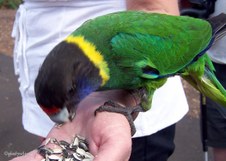
Ringneck [Port Lincoln] Parrot (Barnardius zonarius)
|
 82 82
Masked Owl with Handler
Wildlife Rehabilitation Centre.
|  83 83
Jedda the Wedge-tailed Eagle
Eagles Heritage Raptor Wildlife Centre is dedicated to the Preservation and Rehabilitation of Wildlife.
|  84 84
Jedda the Wedge-tailed Eagle is 15 years old
|
 85 85
Boobook Owls
|  86 86
Tawny Frogmouths
|  87 87
Black Kite waits for Food from Handler
|
 88 88
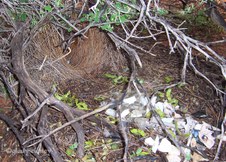
Bower Bird's Chamber
Wooleen Station, Western Australia.
|  89 89
Bower Bird's Chamber
Wooleen Station, Western Australia.
|  90 90
Black Swan (Cygnus atratus)
|
 91 91
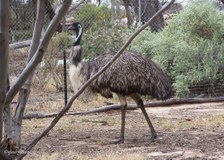
Emu (Dromaius novaehollandiae)
Hyden Wildlife Park, Western Australia.
|  92 92
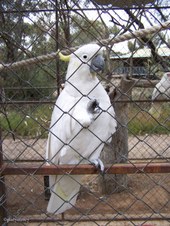
Sulphur-Crested Cockatoo
|  93 93
Red-Tailed Black Cockatoo Female
|
 94 94
Red-Tailed Black Cockatoo Male
|  95 95
Tail Feathers of Female
|  96 96
Male and Female
Red-Tailed Black Cockatoo.
|
 97 97
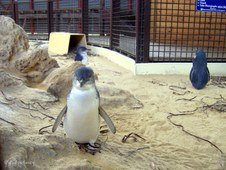
Little Penguins (Eudyptula minor)
Discovery and Rehabilitation Centre, Penguin Island, Western Australia.
|  98 98
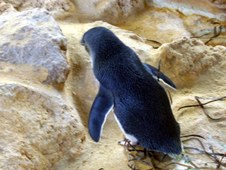
Beautiful Blue Feathers of Little Penguin
(Eudyptula minor)
|  99 99
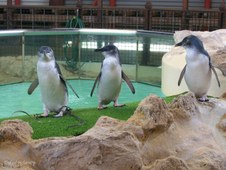
Three Little Penguins
(Eudyptula minor)
|
 100 100
Hand Feeding Little Penguins
Whitebait and Anchovies for Lunch.
|  101 101
Little Penguins in the Pool
|  102 102
Little Penguin in Nesting Box
(Eudyptula minor)
|
 103 103
Little Penguin Preening Feathers
|  104 104
Buff-banded Rail (Gallirallus philippensis)
|  105 105
Immature Bridled Tern
(Sterna anaethetus)
|
 106 106
Bridled Tern (Sterna anaethetus)
|  107 107
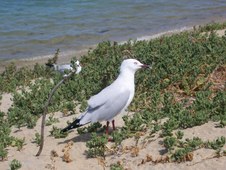
Silver Gull (Larus novaehollandiae)
|  108 108
Crested Terns and Bridled Terns
Penguin Island Jetty.
|
 109 109
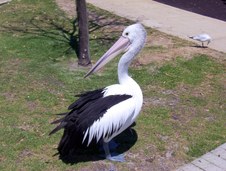
Australian Pelican (Pelecanus conspicillatus)
Mandurah Foreshore.
|  110 110
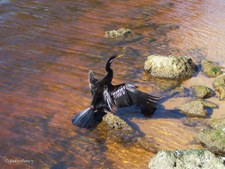
Darter (Anhinga melanogaster)
The Darters spread their wings to dry in the sun.
|  111 111
Darter in Shallows
Darter (Anhinga melanogaster). Long pointed bill. Snake-shaped neck. Long rounded tail. Habitat: Lakes, Rivers, Swamps. Often immerses in water up to neck. Holds wings out 'to dry' when perched.
|
 112 112
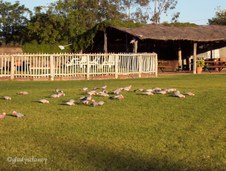
Galahs on lawn at Tilmouth Well Camping Ground
Northern Territory.
|  113 113
Major Mitchell Cockatoo (Cacatua sanguinea)
|  114 114
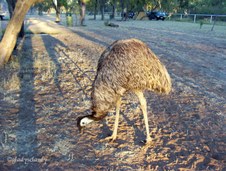
Emu in the Camping Grounds
Dromaius novaehollandiae at Tilmouth Well, Northern Territory.
|
 115 115
Black Kite (Milvus migrans) flying overhead
|  116 116
Nine Pelicans in Flight Formation
|  117 117
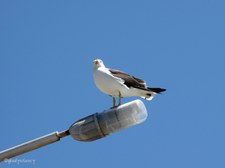
Pacific Gull (Larus pacificus)
Taylor St Jetty, Esperance.
|
