ImageEvent
Adam Warshaw>
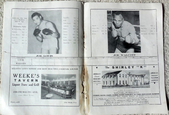
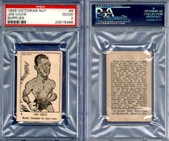
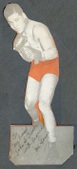
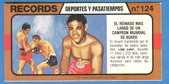
Why Joe Louis?  Not only was he the greatest heavyweight of all time [don't take my word, Bert Sugar picked him; "Ringside: The Ten Greatest Heavyweights," ESPN Classic, 1991], he was the most important boxer of the 20th Century.  

The century was bookended by two very influential fighters, Jack Johnson [the first black heavyweight champ] and Muhammad Ali.  However, Louis is the boxer who changed the white public's perception of a black heavyweight champion.  Johnson was a polarizing figure and at the end of his reign he was hated and blacks were hated just the same as before.  Ali was...Ali, but he built himself on the shoulders of Joe Louis.  If there is no Louis, there is no Ali.  Also consider this: Joe Louis became the first black man to be allowed to contend for the heavyweight title in a generation and he did so 10 years before Jackie Robinson set foot in Ebbetts Field.  

Joe Louis was born in Alabama, moved to Detroit as a child, and grew up boxing there.  He won the Golden Gloves tournament and went pro in 1935.  He took the title from Jim Braddock in 1937 and defended it a record 25 times.   

It was as a man where Joe Louis stood out.  He was acutely aware, as were his advisors, that he was a representative of his race and that if he did anything inside or outside the ring that offended the white public he would never get a shot at the title.  His trainers and advisors made him the model of rectitude in public.  Where Johnson was outspoken and flaunted his money and his white wives, Louis was made to be quiet and non-controversial, marrying a black woman, never taunting downed opponents, and never, ever speaking out against the nonsense he had to endure.    

His second fight with Max Schmeling in 1938 was the turning point in white America's view of the black man as athlete.  In 1936 as an up and coming heavyweight he was matched with ex-champion Schmeling who was seen as more of a gatekeeper than a real threat.  Schmeing studied Louis's fights and realized that Louis had a technical flaw in his style: he dropped his lead hand and exposed his jaw when he threw a certain combination.  Schmeling cryptically remarked that he saw something in Louis's style and KO'd Louis in their 1936 bout by exploiting it.  

Schmeling had his own demons to contend with.  After beating Louis he returned to Nazi Germany a national hero, meeting with Hitler and being used by the regime for its racist propaganda.  Schmeling was not a Nazi party member and was not a supporter of their positions [it came out many decades after the fact that he had hidden Jewish children in his Berlin apartment during an officially sanctioned antisemitic riot, at considerable personal peril].  His willingness to be used by the Nazis led to a string of events where the Americans who controlled boxing decided that they would not allow Braddock to risk sending the title to Germany.  Rather than getting a shot at title holder Braddock, Schmeling was denied and the chance was given to Louis, though Louis's management had to cede 10% of their fighter's future earnings to Braddock to get the shot.  

Louis beat Braddock but stated that he did not consider himself the champ until he beat Schmeling.  That bout took place in 1938.  It almost never occurred.  The Nazi regime wanted Schmeling to fire his [Jewish] American manager, but he refused, convincing the Germans that without Joe Jacobs as his manager he stood no shot at getting a title bout.  World War II was less than a year away and to many Americans Schmeling was a symbol of the Nazis.  

The American public reaction to the Schmeling-Louis bout was amazing given the context of the times.  In 1910 Jim Jeffries had been drafted out of retirement to win back the title from Johnson for the white race and after he lost there were race riots across the country.  Many 'white hopes' then were sent to do the job.  The Federal government went after Johnson for allegedly violating the Mann Act by transporting a woman across state lines for immoral purposes.  He ended up roaming around the world fighting, ultimately agreeing to a bout in Havana where he lost the title to Jess Willard, came home, and was thrown in Leavenworth.  In 1938 while preparing for the Schmeling bout, Louis was invited to the White House as a guest.  President Roosevelt heralded him as having the strength America would need to beat the Nazis.  Much of the American public agreed and openly rooted for a black man in a previously unimaginable manner.  

The fight itself stands a a testament to Louis's skills and power.  He had trained out the flaw in his style and perfected his techniques in the two years since the first fight.  Louis simply tore Schmeling to pieces.  Check out the bout on Youtube if you have a chance; it only runs 2 minutes.  The beatdown was so devastating that it put Schmeling in the hospital for ten days with several cracked vertebrae.

When World War II broke out he donated the purses of his title fights to war relief charities and while in the Army was transported all over the world with a team of boxers [including Sugar Ray Robinson] and referee Ruby Goldstein, entertaining the troops in all the theaters of operations.

After the war he fought a few more times then retired as champion.  Louis was forced back into the ring by financial woes, which is when time finally caught up with him.  He went into various ventures like pro wrestling, and lent his name to a variety of products.  Eventually he found his way to Las Vegas, where he worked as a casino host/greeter for a number of casinos and bars until finding a permanent home at Caesar's Palace. where he worked until his death.  A statue of Louis stands in the entry to the casino at Caesar's in tribute to him to this day.
November 29, 2014150 Images77202 visitsAlbum by Adam Warshaw
Enlarge photo 11
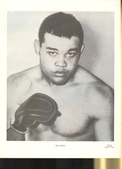
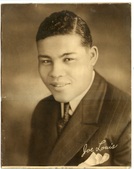
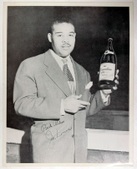
June 21, 1935 Acme Newsphoto.  An early and iconic image of Louis, it has appeared in many books on boxing history.
Enlarge photo 22
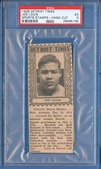
1935 Detroit Free Press: This premium was issued in the summer of 1935 and can be pinned down to a precise week of issue by advertising from the era.
Enlarge photo 33
1935 Brown & Bigelow Joe Louis premium. B & B issued a number of Louis related pieces.  The first two are my personal favorite Louis items.  They are roughly a foot square, on cardboard, and sometimes are found with advertising specially printed on them.
Enlarge photo 44
A variation with a caption.  Also 1935.
Enlarge photo 55
1935 Pattreiouex Joe Louis.  Widely understood to be his first insert card.
Enlarge photo 66
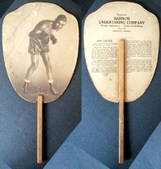
Brown & Bigelow also made fans using the Louis artwork, and sold them to various businesses for use as promotional products.
Enlarge photo 77
Enlarge photo 88
Enlarge photo 99
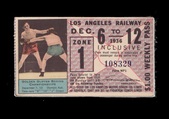
This is a December 1936 light rail ticket from Los Angeles depicting Louis and advertising the Golden Gloves tournament. Louis fought in Los Angeles in 1935.
Enlarge photo 1010
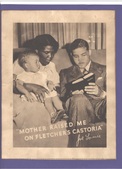
In 1935 Louis started working as a pitchman for Fletcher's Castoria, a laxative. This premium is ca. 1935-36 and is one the earliest Louis endorsement pieces I've seen
Enlarge photo 1111
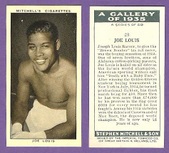
1936 Mitchell's
Enlarge photo 1212
Enlarge photo 1313
Enlarge photo 1414
Enlarge photo 1515
An interesting piece circa 1937 made by an Oakland photogravure artist purportedly for a Louis appearance.
Enlarge photo 1616
One of the things that intrigues me is that an item like this survives all these years.  This mailer was intended to be hung on doorknobs of newsstands to solicit sales of a newspaper special on the fight.  Someone saved this circular all these years...fascinating, no?
Enlarge photo 1717
1938 [G.S. series] Ardath
Enlarge photo 1818
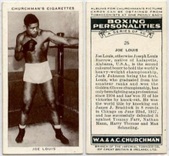
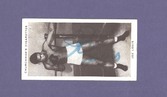
1938 Churchman's Joe Louis
Enlarge photo 1919
How freakin' cool this is!  A betting slip from Louis-Schmeling II.  It gives the bettor a chance at a specified outcome.  BTW, there was no commission--the seal is a fraud.  Betting on the match was entirely illegal.
Enlarge photo 2020
Enlarge photo 2121
Enlarge photo 2222
Enlarge photo 2323
Enlarge photo 2424
Enlarge photo 2525
Enlarge photo 2626
Enlarge photo 2727
Enlarge photo 2828
Enlarge photo 2929
Enlarge photo 3030
Enlarge photo 3131
Enlarge photo 3232
Enlarge photo 3333
Enlarge photo 3434
Enlarge photo 3535
Enlarge photo 3636
Enlarge photo 3737
Enlarge photo 3838
Enlarge photo 3939
Enlarge photo 4040
Enlarge photo 4141
Enlarge photo 4242
Enlarge photo 4343
Enlarge photo 4444
Enlarge photo 4545
Enlarge photo 4646
1930s Lucky Heart Co. Joe Louis premium.
Enlarge photo 4747
Enlarge photo 4848
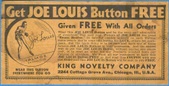
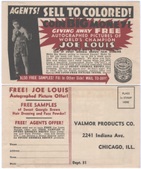
Circa 1937 advertising piece for cosmetics products using Joe Louis photos as a promotional aid.
Enlarge photo 4949
Enlarge photo 5050
Advertisement for Lucky Heart Co. offering the Louis premium, from The Chicago Defender newspaper on June 5, 1937.  Thanks to collector Arthur Rich for his research in finding this ad.
Enlarge photo 5151
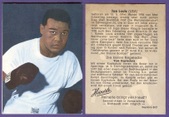
One of a series of Joe Louis cards issued by Cincinnati manufacturer Orcajo.
Enlarge photo 5252
Two more of the same.  Variations are known of the card of Joe and his wife, and non-Orcajo cards with the boxing pose also are known.
Enlarge photo 5353
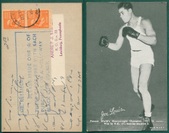
Joe Louis visited Camp Beale during WWII and the California-based military installation issued a series of postcards to commemorate the visit.  This one shows him with Sugar Ray Robinson.  I have seen four different; there are apparently at least 11 since all are numbered.
Enlarge photo 5454
Another Camp Beale Louis
Enlarge photo 5555
And another.
Enlarge photo 5656
1950s giant sized PC of Joe Louis from the Moulin Rouge in Las Vegas.  The first integrated casino, it lasted less than a year, accounting for the rarity of the PC.
Enlarge photo 5757
A very tough die-cut Joe Louis restaurant PC from the 1950s.
Enlarge photo 5858
Enlarge photo 5959
Enlarge photo 6060
Enlarge photo 6161
Enlarge photo 6262
Enlarge photo 6363
Enlarge photo 6464
Enlarge photo 6565
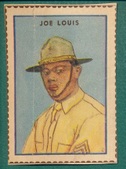
1942 Chicago Tribune Joe Louis, from a set of 70 WWII related strip cards issued in the newspaper with corresponding album.
Enlarge photo 6666
Coney Island Louis and Johnson.  The pictures in the set were sourced from a variety of other issues and publicity photos.
Enlarge photo 6767
1948 Leaf Joe Louis.  Printing quality is the biggest condition concern with 1948 Leaf cards.  The card stock itself is fairly thick and holds up well, but the printing can vary from atrocious to breathtakingly nice.  Front image registration is the single worst problem with the set.  The set was printed in three passes -- black, red and blue – and relatively few of the cards actually align perfectly for all three phases.  When the printing lines up exactly, the result is a crisp, sharp image and a very nice card indeed, but if any phase misses the mark by even a millimeter, the entire image is thrown off.  Many collectors of this issue will sacrifice corner sharpness or centering to get a properly printed card.  The card fronts also suffer from inking irregularities.
Enlarge photo 6868
Joe Louis made after his retirement as the date "1946-" has been removed from the card.
Enlarge photo 6969
In 1935 Louis started working as a pitchman for Fletcher's Castoria, a laxative. This premium is ca. 1935-36 and is one the earliest Louis endorsement pieces I've seen
Enlarge photo 7070
Joe Louis Wittone premium.
Enlarge photo 7171
A very early premium for a 'snake oil' called Wittone.  It is the size of a snapshot and is photographic.  There are other premiums that resemble postcards.
Enlarge photo 7272
Another Wittone premium, this one much larger, with the ad cut off the bottom.  You can just make out the top of the "TONE".
Enlarge photo 7373
Same image as the Wittone, but this one for Murray's hair pomade.  Over a foot square and very damaged from framing but the only one I've ever seen.
Enlarge photo 7474
Enlarge photo 7575
A handbill for a Joe Louis fight film.
Enlarge photo 7676
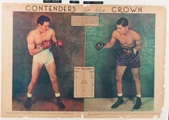
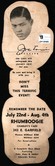
This fantastic premium is a full newspaper page in size but printed on glossier paper with a blank back, for insertion into several papers that served the black community in the 1930s.
Enlarge photo 7777
A newspaper premium before the Baer-Louis fight.
Enlarge photo 7878
A Joe Louis printed pin-up that is a full page in a Life magazine.
Enlarge photo 7979
Don't know the ID of the issuer of this Louis piece.
Enlarge photo 8080
A blank-backed Louis premium from the 1930s.
Enlarge photo 8181
In the late 1940s Louis lent his name to a ring novelty item.  This premium/advertising piece is from that endeavor.
Enlarge photo 8282
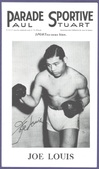
Issued in conjunction with a French-Canadian radio show at various times from 1943-47, the Parade Sportive issue is known for its hockey cards but there were boxers issued as well.  The premiums are usually blank backed, paper stock.  Sizes vary between series.
Enlarge photo 8383
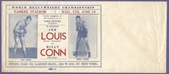
Ticket envelopes and correspondence envelopes were commonly made for fights.
Enlarge photo 8484
Enlarge photo 8585
Enlarge photo 8686
Enlarge photo 8787
Joe Louis shilling for Canadian Ace beer.  The company was long a front for organized crime and was trying to go legit when this was issued in the 1950s.
Enlarge photo 8888
1950s Joe Louis Milk Co. premium.  PC sized.
Enlarge photo 8989
1950s Joe Louis Milk Co. premium.  PC sized.
Enlarge photo 9090
A cut from a Joe Louis broadside or other promotional item.
Enlarge photo 9191
Enlarge photo 9292
Enlarge photo 9393
Enlarge photo 9494
Enlarge photo 9595
Enlarge photo 9696
Enlarge photo 9797
Enlarge photo 9898
Enlarge photo 9999
1946 newspaper premium for the Louis-Conn II bout.
Enlarge photo 100100
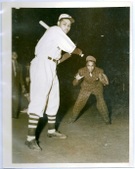
1930s press photo of Joe Louis and Hank Armstrong.  Louis had his own baseball team for exhibitions.
Enlarge photo 101101
Enlarge photo 102102
Enlarge photo 103103
Enlarge photo 104104
Enlarge photo 105105
Enlarge photo 106106
Enlarge photo 107107
Enlarge photo 108108
Enlarge photo 109109
Enlarge photo 110110
Enlarge photo 111111
Enlarge photo 112112
Enlarge photo 113113
Enlarge photo 114114
Enlarge photo 115115
Enlarge photo 116116
Enlarge photo 117117
Enlarge photo 118118
1938 NX5 Joe Louis.  Issued in Manila in 1938.
Enlarge photo 119119
1938 Churchman's Joe Louis
Enlarge photo 120120
Enlarge photo 121121
Enlarge photo 122122
Enlarge photo 123123
Enlarge photo 124124
Enlarge photo 125125
Enlarge photo 126126
Enlarge photo 127127
Enlarge photo 128128
This is a known secretarial autograph.  Not signed by Louis.
Enlarge photo 129129
Enlarge photo 130130
Enlarge photo 131131
Enlarge photo 132132
Enlarge photo 133133
Enlarge photo 134134
Enlarge photo 135135
Enlarge photo 136136
Enlarge photo 137137
Enlarge photo 138138
Enlarge photo 139139
Enlarge photo 140140
Enlarge photo 141141
Enlarge photo 142142
Enlarge photo 143143
Enlarge photo 144144
Enlarge photo 145145
Enlarge photo 146146
Enlarge photo 147147
Enlarge photo 148148
Enlarge photo 149149
Enlarge photo 150150
 
Send a Comment
Your message is sent directly to the album owner.