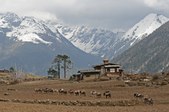
Photos from my recent trip trekking in northern Bhutan. More photos at imageevent.com/eclectic/bhutanall
Album by Eric Gerber. 1 - 37 of 37 Total. 1167 Visits.
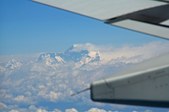
1 Mt Everest from the plane window. Nepal is just a few hundred miles away from Bhutan in the Himalayas.
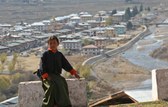
2 Girl sitting on bluff over the town of Paro. Paro was the only place flat enough in Bhutan for a landing strip so the airport is situated there.
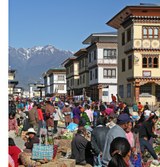
3 Market in Paro. Paro is one of the larger cities in Bhutan with a population of around 30,000 people.
4 Hand scales are used for weighing out purchases.
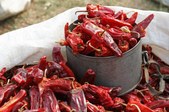
5 Chiles, both red and green, are a staple in Bhutanese diet and form the basis of the national dish Ema Dhatsi/
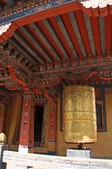
6 Bhutan is a strongly Bhuddist country with a benevolent monarchy. This large prayer wheel was at the dzong or fortress / monastary in Paro.
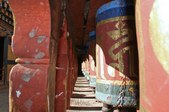
7 Prayer wheels must be spun in a mindful manner in a clockwise direction to carry the prayer to the heavens.
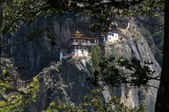
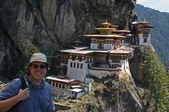
8 The Taktshang Monastery is perched on the side of a cliff and made a good day hike for the group before setting out on the trek. Paro is at about 7000 ft and the remote monastery is at about 9600. The monastary dates back over a thousand years.
9 The monastary was damaged by fire a few years ago but quickly rebuilt. It is one of the most holy places in the Himalayan world. Our guide, Tschering, was able to make special arragnements for us to enter this ancient site but photography was not allowed.
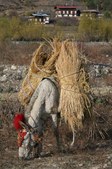
10 Although there are some cars in the towns, mules and donkeys are far more common. The red hat indicates this one is the lead responsible for guiding the pack train home.
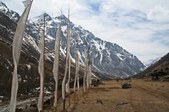
11 The trek begins by ascending up the Paro Valley with our pack train. 108 white flags on poles are placed in a remote place to carry the prayers to the winds when someone dies.
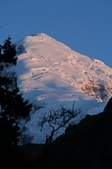
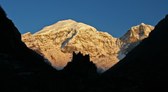
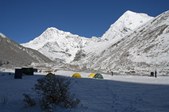
12 Early light on Jumolhari. Jumolhari is one of the most sacred peaks in Bhutan and marks the border with Tibet. The top of the peak rises 10,000 ft above our 14,000 ft camp.
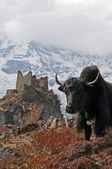
13 After another day's hiking and we come to the base of Jumolhari. Yaks are plentiful from this elevation upwards. A yak goes for about $400 US dollars.
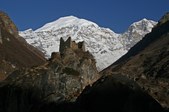
14 Early light on Jumolhari with the remains of a dzong/fortress in the foreground. The dzong was destroyed by Tibetan raiders 400 years ago.
15 By travelling in late winter, the mornings were clear and we had outstanding views of the peaks which are normally hidden in clouds. By late afternoon, cold wind and snow were common though.
16 A late season snow storm had kept the passes closed. Our yak herder/horse leader begrudingly agree to take us on the next part of the trek after much arm twisting from Tschering. We were the first people through the passes, tourist or otherwise since last fall.
17 While descending from the first pass, a snow storm developed. The next morning was bright and warm with a half foot of new snow everwhere.
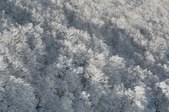
18 Snow on trees with morning light. The snow would melt within minutes.
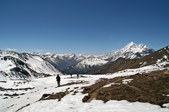
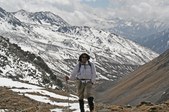
19 Days passed with us travelling between 13 and 16 thousand feet in sublime alpine environments. Everything is still brown - growth comes with the snow melt and the monsoon rains in the summer.
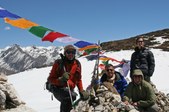
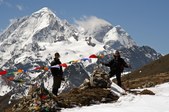
20 Bruce, Dave, Joe and myself at the third pass. Tschering brought consecrated prayer flags that we put up on all the passes. That and a lot of incense and mantras assured an outstanding trip.
21 Ageap, our horseman, believes we have received several good omens and happily descends into the next valley leading our horse train.
22
23 It is almost impossible to capture the size of the peaks in photos. Most of the peaks are over 22,000 ft.
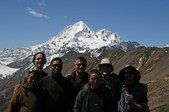
24 Our team. From left; Karma the lead cook, Joe, Tschering, Dave, Ti Ley the assistant, myself and Bruce.
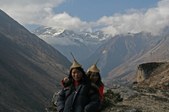
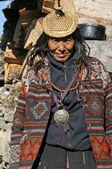
25 After pass 3 we left the Lingshi people and cross into the land of the Laya peoples. In this area, the women wear traditional small woven hats.
26 Bruce on top of the last pass at 16,500 ft. The air was thin but the whole team made it just fine.
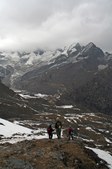
27 Descending down from the last pass with out typical clowdy afternoon weather. From here we drop down 4000 ft to the village of Laya.
28 As we descend, spring starts to become more apparent.
29 Our pack train coming into the village of Laya at 12000 ft.
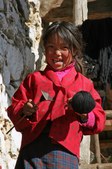
30 Girl spinning yak wool thread.
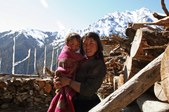
31 Laya woman with her infant child.
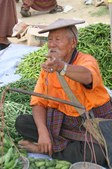
32 Laya elder with traditional hat and Tibetan necklace.
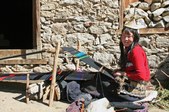
33 Weaving at the loom. Notice the belt made of raw leather.
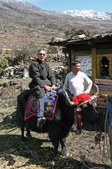
34 Tschering arranges for us to go on Yak rides in Laya. Dave, wearing a traditional yak fur jacket, isn't sure this is a good idea.
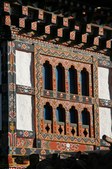
35 Bhutanese architecture is stunning with intricate woodwork and beautiful painting.
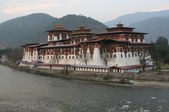
36 The ancient dzong at Punakha and the end of our trip. We fly home a few days later.
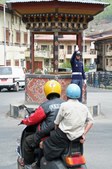
37 This is the capital city of Thimphu (pop 80,000). Bhutan installed its only traffic light on this intersection but no one liked it so they went back to having a traffic cop. This is the busiest intersection in the country.
Stunning photos Eric..but I think the horses had the right idea..what are you nuts going up in all that snow! See you in Appleland soon...CK - Christine, Mon, 13 Aug 2007 9:58PM
Eric, I've decided to become your trek-disciple. Your photographs are marvelous. If all works according to plan, Joseph, Jack James and I should be going to Bhutan. - Sean Orr, Fri, 3 Aug 2007 8:58PM
Have to say you take some amazing photos.. You'll have to give me some tips on taking photos for my trip to africa next year. (what camera to use and stuff like that). - Michael Maynarich, Wed, 2 May 2007 5:27PM