9
| 
10
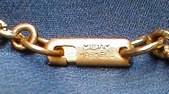
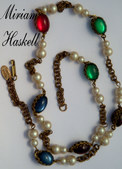
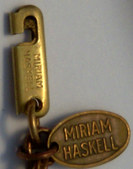
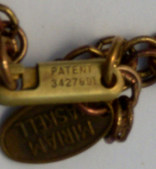
This is the info from the "Miriam Haskell Jewelry" book by Cathy Gordon & Sheila Pamfiloff, page 63, on this particular style clasp.
" Slide Clasp - In 1975, Haskell introduced the slide clasp, a flat oblong coupling device providing a secure clasp for the necklaces & bracelets. Invented by James R. Johnson, its US patent was granted in 1969. The clasp is marked with Miriam Haskell on one side and the patent number on the other. The advent of this clasp is an important dating milestone, as Haskell pieces using this clasp could not have been made before 1975 unless the original clasp has been replaced with this gold plated model. The slide clasp was discontinued in the 1980s."
| 
11
| 
12
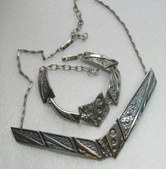
Bracelet and necklace by Darveau of Montreal. Both pieces close with a "slide clasp"
Courtesy of:
Linda Jo D. Mitchell, Private Collection
|
13
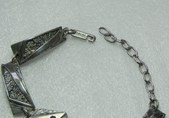
Slide clasp, a pull-hook catch seen on Canadian necklaces and bracelets from Montreal designers Guy Vidal (70s) and Jean-Claude Darveau (70s to 90s for cj, still making fine j, I think). On this Darveau bracelet and on the matching necklace, the clasp is marked with number 3,984,900.
On a Vidal bracelet of mine, the clasp is marked with the US patent number 3427691 on one side and VIDAL on the other.
Works "backwards"
Courtesy of:
Linda Jo D. Mitchell, Private Collection
| 
14
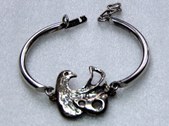
Bird bracelet by Guy Vidal that uses the "slide clasp" patented by James R. Johnson in 1969 in the US. On this bracelet, the US patent number is marked one side, the other side is marked VIDAL.
Courtesy of:
Linda Jo D. Mitchell, Private Collection
| 
15
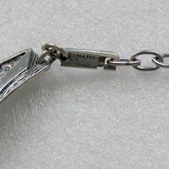
Slide clasp, closed.
Marked with number 3,984,900
I also have this type of clasp on a Vidal bracelet marked
PATENT 3427691. The US patent was given to James R. Johnson in 1969.
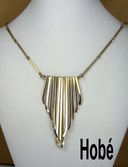
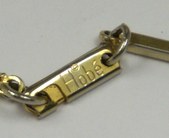
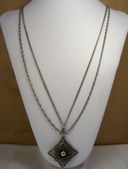
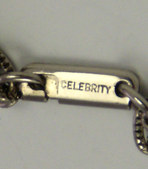
The same "slide clasp" with this US patent number was used by Miriam Haskell for necklaces and bracelets from 1975 til sometime in the '80s. Also has been seen on items from Celebrity and Hobe.
Works "backwards". You insert the loop into the hook, then pull the loop end away from the hook, pulling the 'gate' across the opening of the hook.
Courtesy of:
Linda Jo D. Mitchell, Private Collection
| 
16
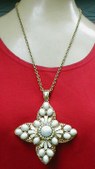
The pendant itself, although executed on very Haskelleque filigree, does not
have the MH stamp on the back. Only the clasp identifies it as MH.
Courtesy of Liz Bryman
http://www.lizjewel.com/
http://www.jewelcollect.org/
|