 | 1.
Highlights Some of the more interesting of the bunch - the bunch being around 1500 images.
The majority of these are from sequences (even if I have not indicated so). If you want to see the entire sequence, go to the album of that particular date.
As of July 14, 2007 selected images from the date albums will be moved into Highlight album(s). If an image appears in a highlight album, it will have been deleted from the date albums.
Clicking on any image will bring up an enlargement window. The default enlargement is not much bigger as it is the same size as the RealPlayer image. There are other enlargement options in the menu at the bottom of the enlargement window. The size will increase but the images will become pixelated.
All images in all albums are downloadable. |
| 72 Items
Shared Album | |
|
 | 2.
August 6 (Album 16)| Weather has cleared. Fish scarce, bear activity diminished. Astonishingly beautiful weather. |
| 54 Items
Shared Album | |
|
 | 3.
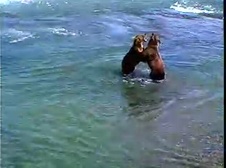
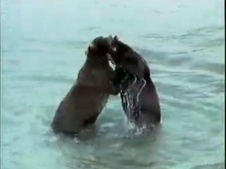
August 7 (Album 17)"The two little guys (relatively little) are indeed playing. I call it playing, not play-fighting because it is play not fighting. These guys are about 5 or 6 years old and are probably not siblings. Sibs do run together after leaving mom but only for 1-2 years. 3 or beyond would be really unusual. Lots of bears play if the conditions are right. Mom is long gone for these fellas. Aren't they fun?"
- Larry Aumiller |
| 53 Items
Shared Album | |
|
 |
|
 | 5.
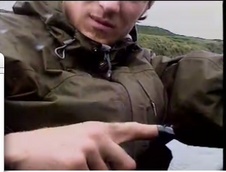
August 11 (Album 19)Camera repair by kind human.
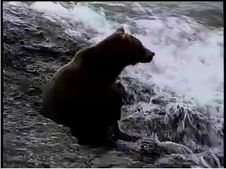
"There are still probably Chum (also called dog salmon) in the river but they are probably spawning so you won't see them trying to get above the falls now. There are some new silver salmon (also called coho salmon) in the system and they can be seen jumping (and swimming) the falls. They are big, up to 15 lbs. and heavy bodied. You might also see a much smaller slender fish jumping, especially on the near side (left) of the falls. They are Dolly Vardens, (a resident char) who are fall spawners and are also headed up stream to spawn."
Larry Aumiller |
| 32 Items
Shared Album | |
|
 |
|
 | 7.
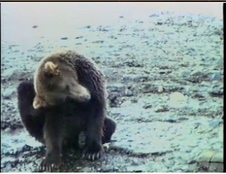
August 18 - 19 (Album 21)| Several days were missed as I was away from a computer. |
| 31 Items
Shared Album | |
|
 | 8.
August 20 (Album 22)August 20
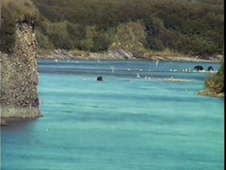
"We are at the bitter end of the chum run in the McNeil River, although most of the fish we saw caught yesterday appeared to be chums. The lifeless fish retrieved by some of the bears are most likely chum that have spawned, died and drifted downriver with the current...not as tasty probably, but nutritious nonetheless. Other fish in the river may include Dolly Vardens that are feasting on salmon eggs, pink salmon that may be entering the estuary downriver and apparently a few silver salmon make an appearance downriver. The pinks and silvers do not come in great enough numbers to be considered "runs," but they do provide late season food. In other areas along Cook Inlet - Silver Salmon Creek in Lake Clark National Park, for example brown bears gather for the silver salmon run.
"The groups of birds you see in the river are most likely common mergansers, fishing ducks commonly seen on salmon streams. I tried to get a close up of them today, but they are too far downriver...consult a bird book for an idea of what they look like.
"The bear that caught so many fish yesterday appeared to only catch about three today. He was often on the far bank. I don't think he is injured, but you may have seen something I didn't. I haven't seen the bear with the injured foot for weeks.
"Other wildlife in the area include the bald eagle we had on screen today, wolves, foxes, and moose (who are there when the bears aren't!). I wouldn't say the other animals use the river as a watering hole per se like Pete's Pond. Alaska and the McNeil River area has many streams and wetland areas. Congregations of animals in Alaska are more food related than water related.
"I'll be back at 1pm tomorrow. Yes, this is a labor of love in addition to being my job. It's as hard for me to tear myself away from the bears as it is for you!"
Elizabeth Wasserman |
| 44 Items
Shared Album | |
|
 | 9.
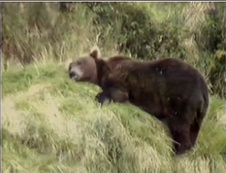
August 21 (Album 23)| This one has a bear eating (and then rolling around in) grass, human visitors down the river, and a bald eagle that has just caught a fish. |
| 79 Items
Shared Album | |
|
 | 10.
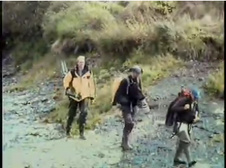
August 22 #1 (Album 24 a)Lots of playing around today. Most of it will be in the next 3 albums of August 22 (in progress).
From today's NG Blog:
You’ve asked some really good questions. Few of them have easy or clear answers.I’m going to try answer you questions again, because I don’t know when or if we’ll hear from Larry. You wrote:
"I have no sense of how much land and space the sanctuary covers."
According to the Alaska Department of Fish & Game website http://www.wildlife.alaska.gov/index.cfm?adfg=mcneil_river.main states that the sanctuary covers about 200 square miles. It appears to cover the watershed of the McNeil River and is roughly 10 miles wide and 20 miles long.
"Where do the majority of the bears go after feeding on the fish for the season?
It is not known for sure where exactly the majority of bears reside when not within view at the Sanctuary, but read on.
"How far do they travel away from the immediate area to forage for food?"
The 1996 McNeil River Management Plan http://www.wildlife.alaska.gov/management/planning/planning_pdfs/mcneil_river_plan.pdf cites a 1994 study by Sellers and Aumiller, noting that bears tagged in May in areas as far away as 48 and 73 miles away from the falls were later observed at the McNeil River Falls in July 1989. The McNeil Management Plan further states that “prior to 1989, the greatest distance a known McNeil bear was killed or observed from McNeil Falls was about 32 miles.”
Elizabeth Wasserman |
| 56 Items
Shared Album | |
|
 | 11.
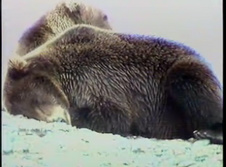
August 22 #2 (Album 24 b)More from the NG Blog today:
"Roughly how many bears live in a square mile?"
"How many bears can be found in the sanctuary/and or surrounding area?"
Again, citing Seller and Aumiller 1994, the McNeil Management Plan states that “During the peak of the chum salmon run, brown bear density within the core four square miles around the falls was over 28 bears per square mile…Over 100 individual bears have been observed in this core area on several different days. This represents a minimum number, as it does not take into consideration less tolerant bears that fish at McNeil falls during hours when humans are not present nor is a bear counted unless it is one that staff is confident of recognizing a second time (Aumiller, pers. comm..).”
"What types of foods will they continue to eat until they hibernate?"
Salmon (chum - spawned out and live, pink, silver), vegetation (grass, Cow Parsnip, Angelica, sedge), berries.
"How many acres of land does a bear need to maintain a quality of life?"
The answer to this question depends on the quality of the habitat and how concentrated food resources are within that habitat. Bears need large areas of unfragmented habitat to get what they need to live and survive as a population (home range). Bears living along the coast have access to more concentrated food resources and may have relatively smaller home ranges compared to bears living in the interior habitats where food resources are more dispersed. Here’s an example from a recent study estimating brown bear population densities just north of McNeil in Lake Clark National Park & Preserve (Lake Clark NPP). The Alaska and Aleutian mountain ranges meet within Lake Clark NPP and split the park into coastal and interior habitats. Brown bear populations in the interior portion of the Lake Clark watershed were estimated at 326+ 125 individuals with a density of 39+11 bears per 1,000km2. The coastal population of brown bears living within Lake Clark NPP was estimated at 466+ 232 individuals with a density of 147+72 bears per 1,000km2."
-Elizabeth Wasserman |
| 62 Items
Shared Album | |
|
 | 12.
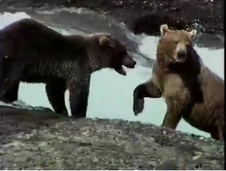
August 22 #3 (Album 24 c)| There are a ridiculous amount of images from today. I suppose a certain amount of panic from the pending end of the live feed. |
| 74 Items
Shared Album | |
|
 | 13.
August 22 #4 (Album 24 d)"Apparently, they are experiencing terrible weather in Homer and our partners from SeeMore are concerned about getting out to McNeil to break down the camera system, since they need to fly out to the site on a small plane. Their pilot has identified a window of opportunity to get them out to the site on Thursday for a Friday shutdown. The safety of our wonderful partners is definitely of paramount importance to us at NGM, so we have advised the SeeMore crew to take advantage of this window and do what needs to be done.
"How does this affect the timeline laid out a few days back? Only slightly. The techs will be flown out on Thursday, but will not head out from their base camp to the falls until Friday morning Alaska time (this is all 'weather permitting,' of course... apparently, the wind is really howling quite hard up there...).
"If all goes according to plan, they will be shutting the system down at around 10 a.m. Alaska time on Friday, which translates to around 2 p.m. for east coast [U.S.] viewers. So you will have approximately 4 hours on Friday to enjoy the live feed before it is closed down for the season."
-John Kondis, National Geographic |
| 39 Items
Shared Album | |
|
 | 14.
August 23 (Album 25)"I was on the road at 4:40 Alaska time. The Pratt staff is running the cam for these last days. But based on the last week's viewing I would guess that two of the three young bears playing yesterday were Braveheart/Grasshopper (small, dark) and Reno (blonde with a large scar above his tail). I haven't been able to recognize that other bear."
- Elizabeth Wasserman
(From NG blog) |
| 74 Items
Shared Album | |
| |
