50 some years of commercial fishing Date(s): December 6, 2009. Album by John Stelling. 1 - 24 of 60 Total. 808 Visits.
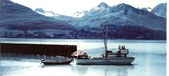
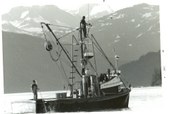
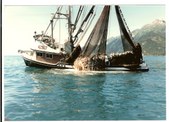
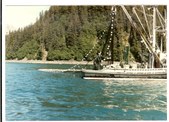
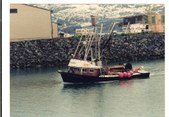
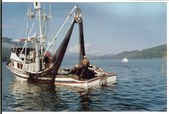
1 This is may dads boat around late 50's early 60's Notice the seine net sits on a turn table and there was no power block on the boom.The skiff and "kicker" was used to hold the net in the approximate location it was cut loose. The seine was set in a circle around the salmon and then the bottom of the net was pursed with the deck winch behind the cabin. The net was hauled back by hand over the side of the boat and stacked back on the turn table which had a roller to make it "easy".
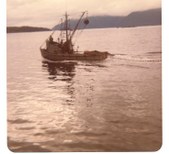
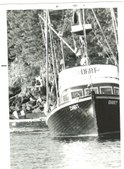
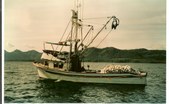
2 The "DART" was my first boat. I bought into the business in 1972. She was wood and was an "earthquake boat", built as a replacement boat for one destroyed in the 1964 quake. Note the power block in the rigging. This was a major advancement to seining. The seine is set over the stern and pursed over the side, then hauled back and stacked on deck using the block powered by hydraulics.
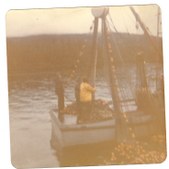
3 The rings are up, they are on the right side of the photo, and are on the bottom of the net. Heres another pic of the power block in action, hauling the gear back and crew stacking it back on deck. This block was home built by Don Statter and was a clone of the Marco "Puretic" power block. Marco had patented the design and so it didnt take long for the patent folks to shut Dons bootleg manufacturing operation down. He used fiberglass, plywood and Model T Ford parts in his design.
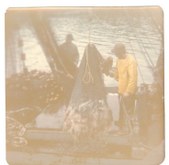
4 The nets all stacked back and the last of it is the "Money bag" or Bunt. Bringing the bunt aboard in this fashon is called strapping. All the lifting is done with the hydraulic deck winch, using a rope double block.
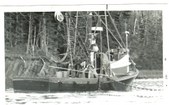
5 This is late 70's early 80's. By this time I had invested in a Marco power block and a radar. Fishing was improving and in order to compete is was necessary to invest back. The wood boat was getting very hard and time consuming to maintain and the processors were making noise about quality.
6 The boat had no insulation to protect from engine heat and the fish layed on the wood in the fish hold. It was necessary to completely scrub and wash down every night after delivery to keep things from stinking up too bad. We used a "piew" to unload the fish. It was a pitch fork looking affair with only one tine. That was the first thing to go---the processors didnt want the fish with rusty holes.
7 The long pole is a "plunger". Nothing more than an aluminum cup on the pole, used to cup air and shove it under water to scare the salmon back into the net. After the net is closed they figure somethings wrong and will come under the boat through a hole left until the rings are up. Here were fishing a three man crew.
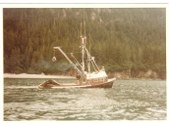
8 First set with a brand new boat---a load of dog (chum) salmon, a boat load. This was 1982, I had the "Glacier Island" built in Marysville Washington and ran her up the inside passage to Alaska and Valdez. In these days we fished from 6AM Monday until 9PM friday night. Usually managed to get three or fours sleep a night. I learned to catch a five minute cat nap and was good for a few hours.
9 The "Glacier Island" had lots of hydraulics and I could roll a couple of thousand fish aboard without slowing down to brail. I simply dipped the rail down to waters edge by taking weight with the power block and spilled the fish into the hold. We were gaining speed and efficiency.
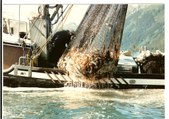
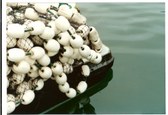
10 The brown mess is jelly fish oozing through the web from the weight of the fish. If you were seining you were in jelly fish of all sorts. The white ones didnt sting but the reds, yellows and purples varied from painful to unbearable. You soon found just how tender the inside of your wrists are! AND you'd better wash your hands real good before you take a wee!!!
11 The "Glacier Island" was all fiberglass and insulated but it was a dry hold, meaning it didnt have referigeration. By this time the processors were paying a 12 cent per pound bonus for chilled fish. A dry hold meant the fish were delivered to a tender every night to get them chilled. By the way all of the fish were pitched by hand. We jumped down into the hold and grabbed each and every one and threw them into the tenders brailer for weighting.
12 Now heres a boat load---- "The price of fish varied w..." View Comments...
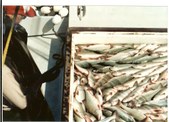
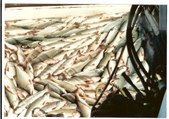
13 We probably could have got another 300 fish in there---The Glacier Island packed 30,000 pounds.
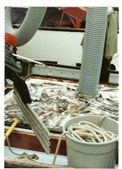
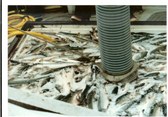
14 In the early 80's fish pump technology was developing. First was the dry pump which was nothing more than a giant vacuum, but it damaged the fish. Soon after was the wet pump. We had to flood the hold with sea water and in went the pump---it got most of them.
15 Did I mention it was a lot less work compared to pitching by hand?
16 A load down to the rail!!!!
17 Here were set up to fish Halibut with snap on gear. I fished halibut, salmon seine, herring gillnet and salmon gillent with the Glacier Island.
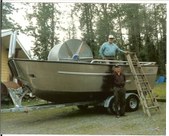
18 This is my new seine skiff. It was all aluminum and had a 200 hp diesel. Plenty of power to tow the net around.
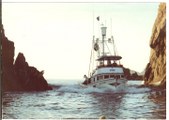
19 By the end of the 80's and early 90's I was catching enough fish the 12 cent refrigeration bonus would make a boat payment. It was time to up grade to the 44 foot Hansen built "Evie". This was the "Cadillac" of the Chignik style seiners. All I had to do was install the hydraulics and chillers.
20 Now were ridin' in style---however as soon as I bought the boat the processors dropped the 12 cent bonus to 6 cents. We've come a long way from the old wood boats, in a short time. She had a generator to run lights a freezer and a microwave oven.
21 A boat load with a bag along side waiting for a tender to pump them off. A nice day to fish!!! They all werent that way!!!!
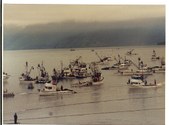
22 For a few years in the 80's fishing wild stocks was slow. The Fish and Game management, managed a "terminal" harvest strategy whereby all the seine boats were in a postage stamp sized area in front of the hatcherys. As you can see it was a "derby". It was a free for all but you'd better not cross the line!!!!
23 Heres what happened when this guy tried to roll too much fish and wasnt set up properly. A man lost his life in this incident.
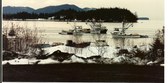
24 This is waiting for herring in the spring. The Evie is in the center of the photo and is rigged for herring gill netting. The other boats are seiners.