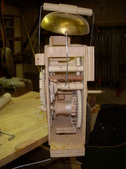
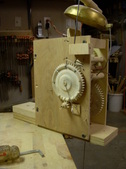
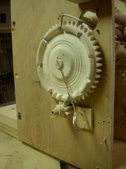
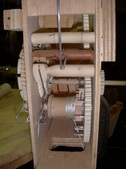
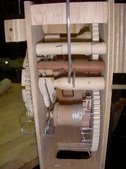
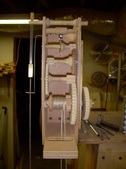
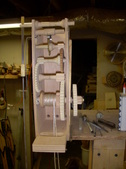
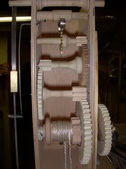
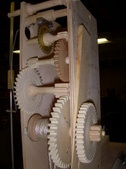
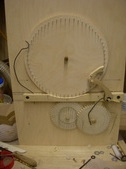
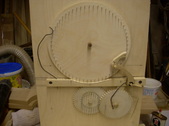
This is the clock movement that I built. It represents a late 1700s type tall clock movement. Just for clarification-a clock must strike the hours, timepieces do not so our use of clock is really a very incorrect and imprecise word when in most cases the item being called a clock is correctly a timepiece.
Date(s): February 27, 2011. Album by Reid Heilig. 1 - 13 of 13 Total. 1964 Visits.
1 This shows the strike side in a set of test plates. The bell on top is struck on the hour the number of times needed to indicate the hour. Only a clock strikes the hours in proper terminolgy. A time piece is a means of showing the time but it does not strike the hours.
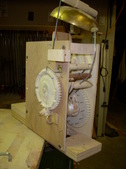
2 Here one can see the hammer that strikes the bell. The number of strikes is controlled by the "count wheel" near the center of the picture. The count wheel's inner circle is divided into 78 units that represents the sum of the 12 hours.Then slots are cut into this wheel's inner rim at distances apart so the distance apart equals the hour to be struck.
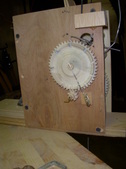
3 A better view of the count wheel and the slot spacing.
4 Notice the ever increasing distance between the hour slots.
5 Count wheel.
6 Drive wheel of strike side.
7 Strike side
8 Time side showing pendulum, escape wheel and anchor.
9 Drive wheel for time side,
10 Escape wheel and anchor.
11 Time side of clock
12 Moon dial mock up.
13 Moon Dial. This represents 2 lunar months of 59.5 days.