1
Full length view of M95 Stutzen, bayonet and chargers.
| 
2
Full length view of M95 Stutzen, bayonet and chargers.
| 
3
Buttstock.
| 
4
Action view.
|

5
Forestock, note the grasping grooves.
| 
6
Muzzle area.
| 
7
Muzzle area, note the stacking swivel typical of the Stutzen short rifle.
| 
8
Forestock area.
|

9
Action area.
| 
10
Buttstock.
| 
11
Top view of receiver.
| 
12
Top view of action.
|

13
Buttplate tang. Note the unit markings. (5PB 746)
| 
14
Rear sight ladder graduated to 2400 Schritt. (Schritt = Pace = 0.75 meters)
| 
15
Receiver markings (Steyr M95).
| 
16
Top view of front sight.
|

17
View of bayonet lug.
| 
18
Front sling swivel.
| 
19
Magazine assembly, note the opening by which empty clips fall out of the action.
| 
20
Rear sling swivel.
|

21
Buttplate.
| 
22
Note the magazine assembly and the austrian-style pistol grip.
| 
23
Bolt body, underside.
| 
24
Bolt body, top view.
|
25
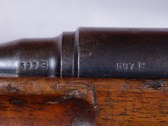
Note the matching serial numbers on the barrel and receiver.
| 
26
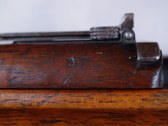
Note the last two digits of the serial number stamped into the handguard.
| 
27
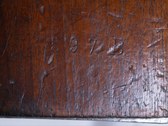
Note the serial number stamped into the buttstock.
| 
28
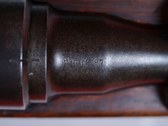
Note the barrel proof mark dating the stutzen to 1897.
|
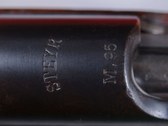
29
Receiver ring markings, Steyr M.95
| 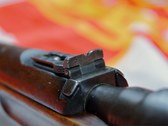
30
Note the "5" on the battle sight for 500 Schritt. (375m)
| 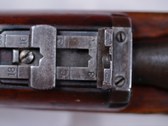
31
Note the lowest ladder sight setting, 300 Schritt. (225m)
| 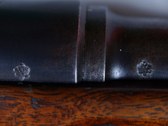
32
Note the proof marks on the receiver and barrel consisting of the Austrian two-headed eagle.
|
33
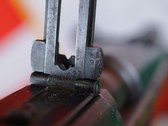
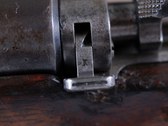
Note the matching last two numbers of the serial number on the sight ladder and slide.
| 
34
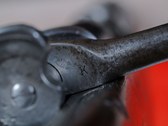
Note the "K" mark, indicating the safety was made by Steyr (as opposed to FEG in Budapest).
| 
35
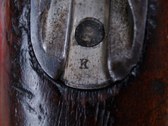
The Steyr "k" proof.
| 
36
Steyr "K" on the receiver tang.
|
37
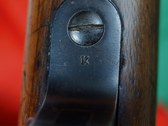
Steyr "K" on the magazine tang.
| 
38
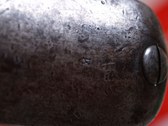
Steyr "K" on the buttplate.
| 
39
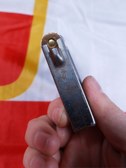
Note the Austrian two-headed eagle on the spine of the magazine clip.
| |