 | 1.
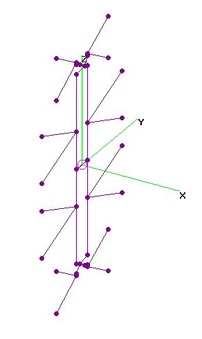
NEW-UHF Free-Form 4-Bay + NoRefl (28Jul2017)NEW-UHF [470-608 MHz] Free-Form 4-Bay with No Reflector analyzed using 4nec2
after finding "Best" Dimensions using nikiml's Python Optimization Scripts.
UHF Raw Gain = 10.9 to 12.8 to 12.7 dBi and SWR (300-ohms) under 2.5.
Hi-VHF Raw Gain = 3.5 to 3.4 dBi and SWR (300-ohms) = 3.4 to 4.1 [A bit Excessive].
DIMENSION STATEMENTS: [May Round to nearest 1/4-in]
' Radius (in inches) of BOWTIE elements:
SY Rbow=0.051 [AWG10]
' Radius (in inches) of FEEDLINE wires:
SY Rfeed=0.051 [AWG10]
' Separation at Crossover:
SY Hop=1.0
' Conductivity (Copper=3.0e7, Alum=2.0e7, StainlessSteel=1.67e7):
SY Cond=3e+07
' Distance between the centers of the two INNER bowties:
SY ZBowII=13.62
' From center of INNER bowtie to center of OUTER bowtie:
SY ZBowOI=12.55
' INNER Bow Whisker Length (lose some in bend):
SY BowLeni=12.97
' OUTER Bow Whisker Length (lose some in bend):
SY BowLeno=8.17
' INNER Bow Forward Sweep distance at tip of the whisker:
SY BowSwpi=0 [Not used in this model]
' OUTER Bow Forward Sweep distance at tip of the whisker:
SY BowSwpo=0 [Not used in this model]
' INNER Bow Tine Separation:
SY TineSepi=8.54
' OUTER Bow Tine Separation:
SY TineSepo=7.61
' Separation between two FEEDLINE wires:
SY FeedSep=3.85
' From Center of Feedline Cross-Over to Center of OUTER Bowtie:
SY ZCross=1.25
UPDATE (26Nov2017): Uploaded Images with improved viewability (esp. Thumbnails)
with NO Change to content.
UPDATE (17Aug2019): Added Dimension Statements. |
| 3871 Visits
16 Images
Shared Album | |
|
 |
|
 | 3.
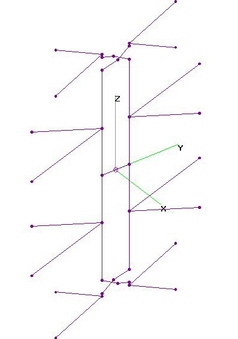
UHF Free-Form 4-Bay Bowtie - NO Refl (2 Nov 2013)UHF Free Form 4-Bay Bowtie (FF4 - NO Reflector) analyzed using 4nec2 after using nikiml's
Python Optimization Scripts to determine "best" dimensions for UHF (Only). Essentially ALL
parameters were allowed to independently vary over a wide range of values in the Optimization.
Height=38.4-inches, Width=26.8-inches.
ONLY Constraints were Element & Feedline Radius (AWG10), Conductivity (Copper), "Hop=1-in"
Wire Separation at the Feedline Crossover point, same Feedline Separation Top-to-Bottom,
NO Forward Sweep in the (FLAT) Bowties and Left/Right plus Top/Bottom Symmetry, allowing
different Inner & Outer Bowties.
UHF Raw Gain = 9.7 to 12.6 dBi and SWR (300-ohms) under 2.6.
Hi-VHF Raw Gain = 3.5 dBi and SWR (300-ohms) = 2.2 to 3.9 [A bit Excessive except Ch7-8.]
ASSUMED DIMENSIONS (All in inches):
Rbow=0.051 = AWG10 Element Wire size [AWG12 thru AWG8 are also good]
Rfeed=0.051 = AWG10 Feedline Wire size [AWG12 thru AWG8 are also good]
Hop=1.0 = X-Axis Separation at Crossover
OPTIMIZED DIMENSIONS (All in inches, may round to nearest 1/8-in):
ZBowII=12.57 = Distance between the Centers of the two INNER Bowties
ZBowOI=9.86 = From Center of INNER Bowtie to Center of OUTER Bowtie
BowLeni=11.60 = INNER Bow Whisker Length (lose some in bend)
BowLeno=8.01 = OUTER Bow Whisker Length (lose some in bend)
TineSepi=6.61 = INNER Bow Tine Separation
TineSepo=6.14 = OUTER Bow Tine Separation
FeedSep=4.39 = Separation between two FEEDLINE wires
ZCross=1.25 = From Center of Feedline Cross-Over to Center of OUTER Bowtie |
| 7744 Visits
22 Images
Shared Album | |
|
 | 4.
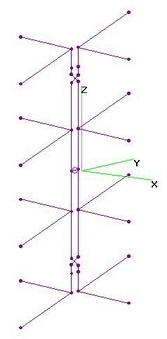
mclapp's M4 (10.0x9.5) 4-Bay - NO Refl. (6 Aug 2012)Somewhat larger Super M4 (10.0" x 9.5") 4-Bay Bowtie, per mclapp's drawings, analyzed using 4nec2:
http://m4antenna.eastmasonvilleweather.com/Drawings/PDF%20Drawings.html
Height=34-inches, Weight=20.5-inches. See 4nec2 File for dimensional details.
UHF Raw Gain = 9.0-12.3 dBi and SWR (300-ohms) under 3.5.
Hi-VHF Raw Gain = 3.5 dBi and SWR (300-ohms) under 3.2.
BowLength = 10.0-in (AWG8), Bowtie Spacing = 9.5-in, Tine Separation = 5.5-in.
Feedline Separation = 1.25-in, with 1.0-in at Crossover (AWG10).
Center of Crossover 3.125-in from Center of Outer Bowties.
Small increase in UHF Gain, but Hi-VHF Gain remains same as in 9.5" x 9.0" version. |
| 13983 Visits
15 Images
Shared Album | |
|
 | 5.
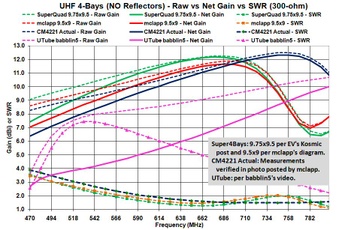
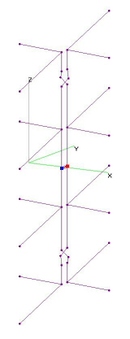
UHF Kosmic SuperQuad (9.75x9.5) NO Refl. (2 Mar 2010)Kosmic SuperQuad 4-Bay (if NO Reflector) analyzed using 4nec2.
Dimensions from EV's Kosmic SuperQuad thread:
http://www.dtvusaforum.com/dtv-hdtv-reception-antenna-discussion/8629-kosmic-antennas-superquad-4-bay-bowtie.
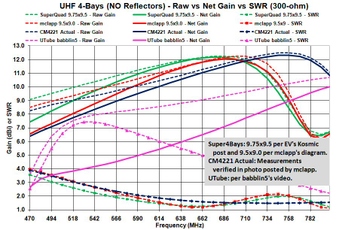
UHF Raw Gain = 9.1 to 12.2 dBi and SWR (300-ohms) under 3.5.
Hi-VHF Raw Gain = 3.7 dBi and SWR (300-ohms) under 4.5.
BowLength = 9.75-in (AWG8), Bowtie Spacing = 9.5-in, Tine Separation = 5.0-in. Simulated SOURCE wire.
Feedline Separation = 1.5-in, except 1.25 at Crossovers (AWG8). Crossovers = 4.75-in from Outer Bowties. |
| 24735 Visits
16 Images
Shared Album | |
|
 | 6.
mclapp's M4 (9.5x9.0) 4-Bay - NO Refl. (6 Sep 2009)mclapp's M4 (9-5x9) Super-4-Bay Bowtie, with No Reflector, optimized for New UHF Band (Ch14-51):
http://m4antenna.eastmasonvilleweather.com/Computer%20models/Computer%20models.html
http://m4antenna.eastmasonvilleweather.com/Drawings/PDF%20Drawings.html
http://www.youtube.com/watch?v=M8jsDxNgHn4
UHF Raw Gain is 8.5-12.2 dBi and SWR under 4.0.
Hi-VHF Raw Gain is 3.5 dBi and SWR under 2.7.
FYI: Performance comparisons (No Reflectors):
http://www.frontiernet.net/~mclapp/Antennas/4baystuff/no%20reflector%20antenna%20test.GIF
And various with Reflectors:
http://www.frontiernet.net/~mclapp/Antennas/plots/4%20bay%20compare11-23-08.xls
BowLength = 9.5-in (AWG8), Bowtie Spacing = 9.0-in, Tine Separation = 5.5-in.
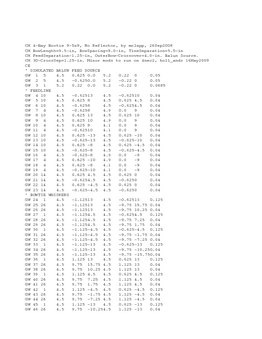
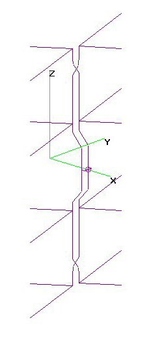
Feedline Separation = 1.25-in, including at Crossover (AWG10). Simulated Balun with 0.44-in SOURCE wire.
Sweeping Bowties Forward was ineffective in increasing Gain, other than a small increase above Ch51. |
| 24814 Visits
25 Images
Shared Album | |
|
 | 7.
mclapp M4 (9.5x9.0x8.5) 4-Bay - NO Refl (27Feb2009)mclapp's 4-Bay Bowtie "9-5x9" (actually 9.5x9.0x8.5), with No Reflector, optimized for New UHF Band (Ch14-51):
http://www.frontiernet.net/~mclapp/Antennas/Computer%20Models/
Filename run here is "4bay bow 9-5x9.nec"
UHF Raw Gain = 8.4 to 12.2 dBi and SWR (300-ohms) under 3.9.
Hi-VHF Raw Gain = 3.7 and SWR (300-ohms) = 12 to 2.2.
Higher SWR on Ch7-9 will degrade Net Gain and EVM, but may still be usable for strong stations.
Note that mclapp's posted 4nec2 file above has 8.5 rather than 9.0-in Inner-Outer Bowtie Separation shown here:
http://www.frontiernet.net/~mclapp/Antennas/diagrams.html
FYI: Performance comparisons (No Reflectors):
http://www.frontiernet.net/~mclapp/Antennas/4baystuff/no%20reflector%20antenna%20test.GIF
And various with Reflectors:
http://www.frontiernet.net/~mclapp/Antennas/plots/4%20bay%20compare11-23-08.xls
BowLength = 9.5-in, Inner-Inner Bowtie Spacing = 9.0-in, Inner-Outer Bowtie Spacing = 8.5, Tine Separation = 5.5-in.
Feedline Separation = 1.25-in, including at Crossover. Simulated Balun with 0.44-in SOURCE wire.
CONCLUSION: (9.5x9.0x8.5) has more Gain than M4 (9.5x9.0) on Ch52-69, but Hi-VHF SWR is worse.
EDIT (23Aug2009): Clarified difference between mclapp's 4nec2 file run here (9.5x9.0x8.5) versus his
posted dimensions for a 9.5x9.0(x9.0) design. |
| 13131 Visits
9 Images
Shared Album | |
|
 | 8.
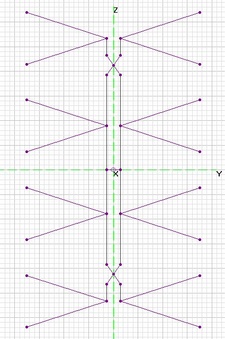
UHF CM4221HD (Hacked) - No Reflector (18 Oct 2013)UHF CM4221HD (Hacked) and NO Reflector analyzed using 4nec2.
CM4221HD measurements per fol. smpowell55 posts:
http://www.digitalhome.ca/forum/showthread.php?p=863127
http://www.digitalhome.ca/forum/showthread.php?p=863559
UHF Raw Gain = 7.4 to 12.2 dBi and SWR (300-ohms) under 2.6.
Hi-VHF Raw Gain = 4.1 to 4.2 dBi and SWR (300-ohms) = 17 to 1.1.
SWR on Ch7-10 degrades Net Gain & EVM (Error Vector Magnitude), but may be adequate for strong stations.
NOTE: As-shipped PCB Balun KILLS VHF. Above Hi-VHF performance presumes replace with
conventional Transformer (Cylindrical) Balun.
BowLength = 7.9-in, Inner-Inner Bowtie Spacing = 9.84-in, Outer-Inner Bowtie Spacing = 8.46-in,
Tine Separation = 3.94-in. Feedline Separation = 1.18-in, with 0.8-in at Crossover (2" from Outer Bowtie).
16 Rod Reflectors: 23.6" Long with 1.93" Spacings for Total Height = 30-in. Separation from Bowties = 4.25-in.
It is presumed that anyone interested enough to view this webpage will
implement the "Hacked Balun" modifications per photo in fol. rabbit73 post
(flip over the Feedlines going into the Balun plus an additional offset):
http://www.digitalhome.ca/forum/showthread.php?p=1167870 |
| 9735 Visits
21 Images
Gallery Album | |
|
 | 9.
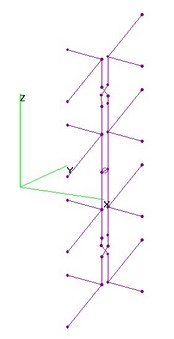
CM4221 Actual Measurements - if NO Refl (23Aug2009)CM4221 per Actual Measurements analyzed using 4nec2 (verified against a photo posted by mclapp):
http://www.frontiernet.net/~mclapp/Antennas/CM4221/CM4221%20front.jpg
BowLength = 8.5-in, Bowtie Spacing = 8.9-in, Tine Separation = 5.25-in. All AWG8.
Feedline Separation = 1.4-in, with 0.8-in at Crossover. All AWG8 wire size (0.125" O.D.).
Center of Crossovers 2.75-in from Center of Outer Bowties. |
| 12132 Visits
11 Images
Shared Album | |
|
 | 10.
CM4221a.ez 4-Bay Bowtie - if NO Refl (26 Feb 2009)CM4221a.ez EZNEC file 4-Bay Antenna with Reflector removed. Illustrates one of the BETTER 4-Bay Antenna designs.
Dimensions from Ken Nist's cm4221a.ez NEC file are SAME as HALF of cm4228a.ez (Demi-CM4228).
Long feed (simulating twin-lead?) was changed to simple Balun Source (BS) or simple Wire Source (WS) to fix VHF AvgGainTest.
BowLength = 7.8-in, Bowtie Spacing = 8-in, Tine Separation = 5.5-in.
Feedline Separation = 1.25-in, with 0.8-in at Crossover.
In fol. 4nec2 simulation, per Ken Nist's EZNEC file, a simple 1.25-in SOURCE wire (SW) interconnects the feedlines.
Runs with a Simulated Balun SOURCE (BS) feed yield very similar results.
UHF Raw Gain increases with frequency from 6.5 dBi to 12 dBi. SWR under 5.0 at low freqs, decreasing at highest freqs to 1.5.
VHF Raw Gain is constant 4.1 dBi. EXCESSIVE SWR decreases with frequency. Ch13 may be usable but ineffective on Ch7-12. |
| 9862 Visits
16 Images
Shared Album | |
|
 | 11.
Antennacraft U-4000 - NO Reflector (9 Jun 2013)UHF Antennacraft U-4000 4-Bay Bowtie with NO Reflector analyzed using 4nec2.
Based on a 4nec2 file posted by user 300ohm. |
| 5451 Visits
18 Images
Shared Album | |
|
 | 12.
A-D DB-4 4-Bay Bowtie NO Reflector (13 May 2014)Antennas Direct (Old ) DB-4 4-Bay Bowtie with NO Reflector analyzed using 4nec2.
Dimensions per mclapp's 4nec2 file with holl_ands modifications to adjust AGT=1.0 and various FR & RP statements:
http://www.frontiernet.net/~mclapp/Antennas/Computer%20Models/
Whisker Length=6.17-in, BowInner-Inner=7.85-in, BowInner-Outer=7.9-in,
Tine Separation=1.2-in, Feedline Separation=1.8-in, Hop=1.0-in.
Raw Gain falls off on lowest frequencies. High SWR on low and mid frequencies. |
| 5803 Visits
15 Images
Shared Album | |
|
 | 13.
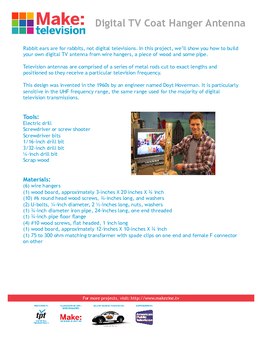
UTube 4-Bay Bowtie - NO Reflector (27 Jan 2009)UTube 4-Bay Bowtie Antenna (without Reflector) per Maker Workshop UTube video and makezine.tv pdf file:
http://www.youtube.com/watch?v=0rDPZZzIXIc and http://cachefly.oreilly.com/make/television/04/DTV_Antenna_FINAL.pdf
They said to use a 3"x20" mounting board, with just over 2" Feedline Separation. Coat Hangers are cut down to 8", but
extend inside feedline, so (after bend loss) are 7.5" to 7.75" whiskers. Bowtie Spacings = 5.75" and Tine Spacing = 3".
Nearly identical (earlier?) Make:TV pdf file I found via Google search is here: http://current.org/ptv/ptv0821make.pdf
Note John Park points to a commercial 4-Bay Bowtie Antenna (with Reflector) and incorrectly calls it a "Hoverman".
This error is repeated in both of the above pdf files.
Most popular UTube "Coat Hanger HDTV Antenna", is a 4-Bay Bowtie without Reflector (1+ Million views!!!) from babblin5:
http://www.youtube.com/watch?v=EWQhlmJTMzw
He says to use a 2.5"x20" mounting board, with a smaller 1.5" Feedline Separation.
Coat Hangers start out as 14", so (after bend loss) are shorter 6.75" whiskers.
Uses same 5.75" Bowtie Spacings and 3" Tine Spacing as above.
So "UTube TV Antenna" dimensions vary as follows: BowLength = 6.75 to 7.75-in (after bend), Bowtie Spacing = 5.75-in.
Tine Separation = 3-in, Feedline Separation = 1.5 to 2.0-in, with only about 0.15-in at Crossover (wire center to wire center).
Crossover is equidistant between Bowties, unlike other 4-Bays. Moving Crossover closer to the end yields better Gain and SWR.
In fol. 4nec2 simulation, a simulated SOURCE Wire feeds the antenna, with SOURCE wire radius chosen for best UHF & VHF Average Gain Test.
Poor UHF Raw Gain below 520 MHz (Ch14-21). And very poor SWR mid-band reduces Net Gain.
Hi-VHF Raw Gain is constant 3.2 dBi. However VERY EXCESSIVE SWR on Ch7-13, although Ch13 isn't as bad as lower channels.
RECOMMENDATION: START OVER WITH A DIFFERENT DESIGN WITH MORE SEPARATION BETWEEN BOWTIES.
EDIT (24Aug2009): Error in 4nec2 model calculations resulted in whiskers being 1.4-in shorter than specified.
New results replace old charts. Low Freq UHF Gain loss is still present, but not as severe. EXCESSIVE SWR remains a big problem. |
| 14040 Visits
15 Images
Shared Album | |
| |
