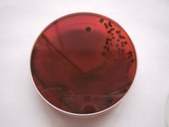
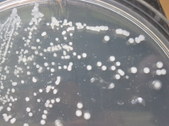
43 Alpha hemolytic streptococci; a green halo around a small colony
44 Beta hemolytic streptococci - with complete lysis around a small colony.
45 Compare alpha and beta hemolytic streptococci.
46 Throat swab on blood agar. Alpha hemolytic streptococci present.
47 Streptococcus Gram stain from colony on plate.
48 Neisseria sp, Gram - cocci in 2s
49 Streptococcus salivarius from a tongue swab, forming capsules and smooth colonies on sucrose-gelatin agar.
50 Close up, Streptococcus salivarius colonies with capsule. Non-capsulated Streptococcal colonies are pin-point in size.
51 Streptococcus Gram stain from broth.
52 Tellurite glycine agar, with Staphyloccus aureus colonies
53 Staphylocococcus aureus colonies on Tellurite-glycine agar
54 Comparison of Staphylococcus epidermidis (left) with Staphylococcus aureus (right) on tellurite glycine agar.
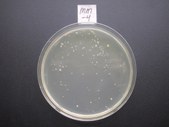
55 Phage plaques on lawn of host E. coli cells
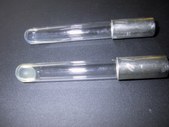
56 Coagulase test with rabbit plasma. Still liquid on left = coagulase negative; clot formation on right = coagulase positive.
57 Another view of coagulase positive reaction (bottom) by Staphylococcus aureus
58 Coagulase Positive (top) and Negative (bottom)
59 Colilert test for both total coliforms and E. coli. If media turns yellow, ONPG +, coliform bacteria present. Beta galactosidase is produced.
60 With a long-wave UV light, fluorescence indicates the hydrolysis of MUG by beta glucuronidase of E. coli.
61 E. coli count Petrifilms. Coliform bacteria besides E. coli produce red colonies with gas bubbles (from lactose fermentation). E. coli produced blue colonies from glucuronidase action, and gas bubbles from lactose fermentation.
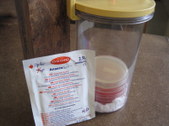
62 Can bacteria from Colilert + tube penetrate toilet paper?
63 Yes they can! Wash hands after using the restroom.
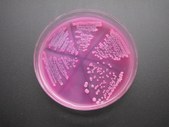
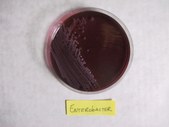
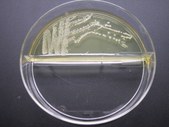
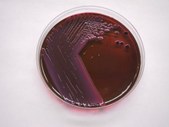
64 EMB colony appearance of three genera of coliform bacteria.
65 Klebsiella produces a gummy capsule on EMB.
66 Coliform isolate on EMB agar, top appearance.
67 Top view of coliform bacterium on EMB agar.
68 Sauerkraut fermentation, 7th day.
69 Leuconostoc, heterofermenter, first to dominate in sauerkraut
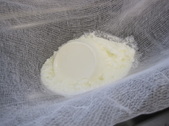
74 Starter culture bacteria, Streptococcus lactis, used to make these cheeses.
75
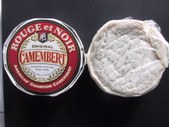
76 Penicillium camemberti grows on the surface of camembert cheese. The proteases and lipases it produces slowly ripens the cheese. It produces white conidia.
77 Penicillium camemberti, the mold which ripens Camembert and Brie cheese from the outside.
78 Penicillium roqueforti, which ripens Roquefort and blue cheese.
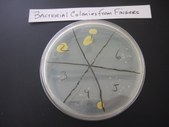
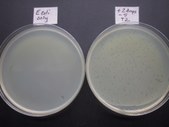
79 Transformation test. BHI agar on left, Minimal lactate agar on right. Juni auxotroph alone in #1, Juni + DNA from wild type Acinetobacter in #2; Juni + DNA from Pseudomonas sp. in #3.
80 Conjugation test. Recombinant cells growing on Mineral Glucose agar after conjugation.
81 Agglutination reacton. Antigen and antibody combine to form a white precipitation, on the left.
82 Lymphocyte has a large nucleus. Responsible for antibody production. Non nucleated red blood cells also present.
83 The Monocyte is larger than the lymphocyte, and is phagocytic.
84 Segmented nuclei in neutrophils, phagocytic white blood cells.