document.writeln(''); document.writeln('');document.writeln('
'); document.writeln(''); document.writeln('') document.writeln(''); document.writeln('
Fultons Enfield No.1 Mk3 Rifle
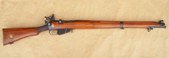
Enfield No.1 Mk3 Rifle
As accurized by G Fulton (and others).

Album by RJW NZ

"You may leave a general comment by signing the guest book, at the bottom of this album page."
Album by RJW NZ. Photos by RJW NZ. 1 - 98 of 98 Total. 149 Visits.
Start Slideshow 
Enlarge photo 1
1
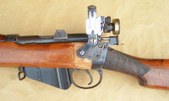
BSA civilian contract, approx 1930\'s no1 mk3, \'Regulated by Fulton\'.

Enlarge photo 2
2
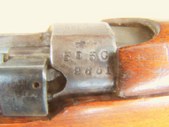
Many Fulton\'s rifle are marked \'Regulated by Fulton\', in this case its simply marked \'G Fulton\'.

Enlarge photo 3
3
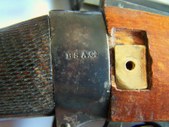
9651 is the rifles original serial number, 505C appears to be the Fulton\'s number. This is the only place it appears.

Enlarge photo 4
4
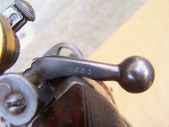
Matching bolt but not nosecap or barrel.

Enlarge photo 5
5
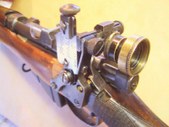
The Rolls Royce of enfield aperture sights; AJP (Parker Hale) Model TZ, or \'twin zero\' sight, with Parker Hale iris/6 filter combination unit, also equipped with 1.25 inch large filter or lens holder.

Enlarge photo 6
6
Stock repair where wood had been removed for the large square Central No4 sight mounting plate.
Wrist checkering is \'flat top diamonds\', a stock British military style, but probably added by a subsequent owner, not by Fultons. Not suitable for service rifle matches but OK for open competition.


Enlarge photo 7
7
Rifle is a 1930\'s civilian contract rifle by BSA.
A split fore end has been reinforced with a through bolt and a threaded brass plate on the receiving end, repairs in process.


Enlarge photo 8
8
Right side BSA civilian contract approx 1930\'s no1mk3, \'Regulated by Fulton\', H barrel equipped, marked with MA and Lithgow stars but undated..

Enlarge photo 9
9
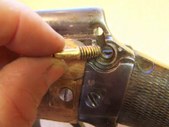
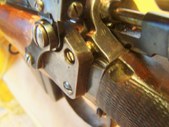
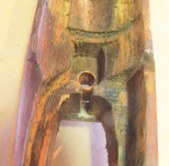
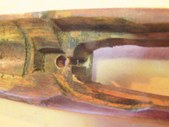
The receiver\'s inner safety bearing has been threaded. The post in hand was shaped from a brass bolt.
Most likely this was to provide a much more secure anchor for the aperture sight. I\'ve taken this one step further and threaded the upper end for an anchor nut to pull down on the sight mounting plate as well, its going nowhere under recoil.


Enlarge photo 10
10
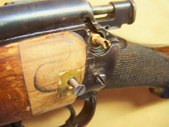
Brass post in place where the safety once was, anchored with loctite. The inner end had to be slightly shaped to permit smooth movement of the bolt in the channel.
Through bolt for stock repair/reinforce is partially seated. Wood repair from a badly fitted Central sight almost finished.


Enlarge photo 11
11
A nice fit around the wrist, with no room for the safety mechanism, a step  halfway along the post stops the plate from folding inwards.

Enlarge photo 12
12
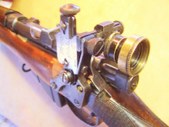
Aperture sight is a 1930\'s Model TZ or Twin Zero by Parker, eyepiece is an iris with 6 hole/filter unit. The larger brass unit is a 1.25 inch filter or lens holder.

Enlarge photo 13
13
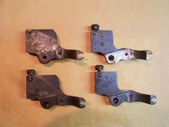
4 Parker Hale PH5a sight mount plates, all except the lower right show evidence of being reshaped to fit the rifle they once attached to.
If you\'re fitting aperture sights to your enfield try your best to mount the plate accurately, with spacers if needed, before contemplating cutting into the wooden stock.


Enlarge photo 14
14
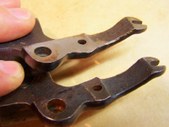
PH5a mount plates, upper is modified to fit a rifle, the lower one is in near new manufactured shape. The U shaped hump in the middle is a factory supplied high spot to help the sight mount clear of the fore end. This ends up being reshaped by gunsmiths and others.

Enlarge photo 15
15
There\'s some bedding material where the receiver rests, and some also evident in the magazine well to broaden the rail where the receiver rests.
The fore end sides around the lower portion of the knox have been widened away from the metal, except for a 1/2 inch bearing surface left and right of the screw post, and the main bearing in the barrel channel.


Enlarge photo 16
16
A different angle to emphasize the patches where the receiver presses down.
The trigger screw bushing is in place and of stock dimension.


Enlarge photo 17
17
H or heavy profile barrel, MA marked on the left side, and Lithgow stars on the right side, no date, an aftermarket addition by some unknown shooter, post ww2.

Enlarge photo 18
18
Mid barrel bearing, situated just aft of the barrel band, bearing appears to consist of a hard wood block with a square base inserted into a hollow in the fore end and glued in place, with the upper shaped to fit the barrel.
Note that the barrel channel clears the barrel sides by at least 1/8th inch for the full length of the barrel.


Enlarge photo 19
19
The mid barrel bearing, 2 inches long, about 1/2 inch behind the barrel band, and in this case about 1/16th inch proud of the barrel channel. A thin paper will not pass between the barrel and the bearing due to downwards pressure.
This downward pressure remains if the barrel front is raised to its shooting position in the nosecap.


Enlarge photo 20
20
Rear bearing, appears to be a hardwood block glued into a recess, 1 inch long and shaped for the barrel, 3/4 wide approx, sits slightly proud of the surrounding wood.

Enlarge photo 21
21
Previously installed and now removed bearing mid way between knox and the barrel band. Consists of a square block epoxied into the barrel channel, grooved through for the barrel.
Obviously tried and not enjoyed.


Enlarge photo 22
22
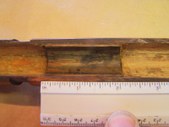
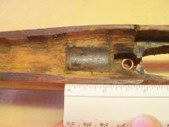
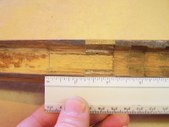
A reference for lengths between the bearings.

Enlarge photo 23
23
A few traces of epoxy or similar bedding material shows the action is/was bedded to the receiver.
Fore end has been widened at the forward end to accommodate the metal addition to the receiver.


Enlarge photo 24
24
Slight traces of bedding material along the sides of the magazine well and towards the knox area.
Fore end wall has been widened in the forward area to accommodate the metal additions on the receiver.


Enlarge photo 25
25
Note striations on the metal and the grooves made in the wood.
Bedding material evident here too.


Enlarge photo 26
26
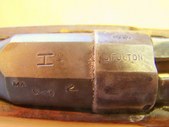
A clear view of the H for heavy barrel, plus GE Fulton.
Note how the fore end sides are well clear of the barrel and the knox, the only contact is well down in the channel, on the bearing and 1/2 inch left and right of the screw post.


Enlarge photo 27
27
Striations;
At the forward and rear sections of the receiver are little ridges in the steel. They are not grooves, and how they\'re made I don\'t know.
They are pronounced ridges and leave grooved marks in the wood.
Possibly a way to tighten the receiver/fore end fit by making the metal bite into the wood.


Enlarge photo 28
28
Under the band are old layers of hard paper and folded cotton strands to pack it tightly to the fore end.

Enlarge photo 29
29
The nose cap has been fully bedded with epoxy or similar, from the tip of the fore end and over this entire under surface. In this pic. it has leaked out a little.
Possibly a stiffening aid, and certainly a means of keeping the sight ears in the same place relative to the sight post by locating the nose cap accurately in position.


Enlarge photo 30
30
With a standard nose cap almost in position the down ward positioning of the barrel is evident, if the nosecap were pushed fully on then there would be significant upwards pressure on the barrel.
The stock piston and spring has been removed entirely.


Enlarge photo 31
31
The under side of the nosecap area showing the bedding material. It had also been carefully packed into the nosecap so that (internally) there\'s no air gap between the nosecap and end of the fore end.

Enlarge photo 32
32
The for end fit is tight to the wrist and a thin paper only goes in a short way.

Enlarge photo 33
33
The fore end is a snug and firm fit to the receiver and will only come off with a tap on a block of wood with the hammer.

Enlarge photo 34
34
Recoil blocks have been reinforced with brass caps, held in place with a 5/8 or similar brass wood screw, ala Lithgow rifles circa WW2.
The upper surfaces behind the brass blocks show signs of bedding material and of being carefully shaped/sanded.
The vertical sides are tight to the action with bedding material.


Enlarge photo 35
35
The metal plate inserted in the rear of the for end to anchor the butt bolt has been removed and replaced with a counter grained piece of hardwood and anchored with epoxy or similar.
Protruding bolt ends show their exit point towards the wrist.


Enlarge photo 36
36
Along side the receiver, the fore end is a careful fit. At the front 2 inches(here,left side) there is ample space around the sides, an easy hacksaw blade thickness.
Towards the rear/right it is a firm and tight fit, and shows signs of bedding material to close the gap. A thin paper might be able to go in, but barely.


Enlarge photo 37
37
Right side, same receiver to fore end fit. At the front 2 inches there is free clearance but rear of this point it is closed much more tightly.
The rear of the charger bridge here appears open but its an illusion caused by the lip of the wood being sanded away.


Enlarge photo 38
38
Another view of the left side receiver/fore end fit, plus the shape of the metal pad added to the receiver at the right end.

Enlarge photo 39
39
Note the striations across the receiver.
On the left and right side of the receiver pieces of 1/8th steel plate have been shaped and added to the receiver sides, possibly to increase anti rocking leverage/bedding area.
There is ample epoxy or similar in this area, either a home builders way of attaching the pads without having to heat and solder them on to avoid heat damaging the strength of the receiver, perhaps a way of smoothing the appearance or anchoring the plates when they\'ve come adrift.


Enlarge photo 40
40
Left side plate, mild steel, 1.5 inches long, 1/2 high, plenty of epoxy or similar.

Enlarge photo 41
41
Right side additions, crudely executed, plenty of epoxy or similar.
The cut off slot has been partially filled, possibly as a stiffener, the 1/8th plate over the top, plus the cut off screw has been kept.


Enlarge photo 42
42
Left side plate profile.1.5 inches long, 1/2 inch high and 1/8th inch thick.

Enlarge photo 43
43
Right side, underneath, metal profile.
Note also the striations in this area.They are pronounced at the front and rear of the receiver\'s undersides.


Enlarge photo 44
44
Striations; Note how they bite into the wood and have left marks, and their corresponding origins on the receiver beside the recoil lug.

Enlarge photo 45
45
Striations plus note shapes of metal additions, widening of fore end in this area.

Enlarge photo 46
46
Another view of the rear striations and the traction marks they leave in the wood.

Enlarge photo 47
47
Bedding material on the wood in this area.

Enlarge photo 48
48
Trigger guard is a firm and accurate fit within the wood, with no pressure points pushing it sideways.

Enlarge photo 49
49
In the grooves either side of the magazine release are strips of hard paper or similar to pack out clearances relating to the trigger guard fit and correct fitting of the draws.

Enlarge photo 50
50
Another view of the \'paper\' packing material.

Enlarge photo 51
51
Trigger guard \'pad\'. 1/8th mild steel, one inch wide, one inch deep, rounded at the front and rounded on the upper edges.
The bushing is non enfield, copper tube.There is about 1/16th inch or more clearance between it and the pad.


Enlarge photo 52
52
Pad in place located in grooves made in the wood.
Pad is a carry on from the similar concept on L 42 sniper rifles.


Enlarge photo 53
53
Profile of pad and located in its grooves.

Enlarge photo 54
54
Trigger guard is a close, careful fit to the fore end.
It doesn\'t bind, or force the receiver left or right, and lays flat in position, allowing the rear bolt to slide home without forcing it in the hole.


Enlarge photo 55
55
In the early 1960\'s a Canadian shooting team pioneered a method of anchoring the fore end to the wrist by drilling holes from the magazine well backwards and installing long bolts.

Enlarge photo 56
56
The bolts are tightened from the butt stock end but the drawback with this accurizing method is that the fore end can\'t be removed without first removing the butt stock too.

Enlarge photo 57
57
The moderately tensioned nuts and washers are safely recessed below the magazine pathway.

Enlarge photo 58
58
This front sight post with sloping sides and a flat top is called a \'barleycorn\', and was a popular choice.

Enlarge photo 59
59
The reverse end of the sight post had to be partially shaved back to allow smooth passage of the bolt.

Enlarge photo 60
60
Enfield no4mk1/2 - This is an enfield with the trigger pivot engineered to the wrist instead of the trigger guard.
Globe front sight attached with track and short screws into the barrel, after market not Fultons.


Enlarge photo 61
61
Stock military barrel with bayonet lugs. This end of the barrel is floating, a lot of wood has been removed here, and despite a mid barrel bearing, it has been cleared out full length to the receiver barrel bearing.

Enlarge photo 62
62
Barrel bearing/s, in fore end straddling the mid band position, plus another in the upper handguard that begins at the end of the lower bearing.
Both bearings are cork sheet with a surface layer of bedding compound.


Enlarge photo 63
63
Front bearing/raised area in the fore end has been removed and this forward section of barrel is fully floating.

Enlarge photo 64
64
Handguard bearing, cork sheet with a surface layer of bedding compound.

Enlarge photo 65
65
Trigger guard; despite all accurizing opinion to the contrary this hand guard has significant spring tension built into it and shows up when the rear screw is left in place and the front screw removed.
This would indicate strong upper pressure at the trigger end into the drawers area, which in turn would lower the fore end tip away from the barrel.


Enlarge photo 66
66
Trigger guard, a 1/16th inch thick approx plate has been soldered onto the front inner surface of the guard in the same manner as enfield L 42 sniper rifles.

Enlarge photo 67
67
Trigger guard plate side view, 1/16th inch thick approx.
There is NO screw guard bushing, the hole through the hardwood block is the same diameter as the large trigger guard screw, so there is no provision for one to be installed.


Enlarge photo 68
68
Trigger guard plate, top view, its apparently soldered on but almost any thing would do, epoxy even.

Enlarge photo 69
69
A Fultons signature - dowel ends; this is commonly seen on Fulton\'s rifles. They have two known purposes. In this case its an anchoring pin to make a block added to the interior side more stable and strong.
Depending on the location they are also seen in positions that stop the receiver rocking left/right. If it was 3/4 inch higher it would contact the sides of the receiver and stop laterla movement.


Enlarge photo 70
70
A hardwood block approx one inch square and 1.5 inches long has been inserted and epoxied in place where the main trigger guard screw clamps down. On the under side shown it is a tidy and simple installation.

Enlarge photo 71
71
Its not easy to see but there\'s ample white\'ish epoxy compound all around the forward end of the magazine well.

Enlarge photo 72
72
The mid band has been packed with paper/card to ensure the band is a very firm fit to the wood.

Enlarge photo 73
73
Either side of the trigger slot/magazine release has paper/card strips added to increase the upwards pressure when the trigger guard is tightened.

Enlarge photo 74
74
Left side front receiver/fore end; from the hand guard ring back about 2 inches there is at least 10 thousandths clearance between the metal and the wood.

Enlarge photo 75
75
On the right side receiver/fore end the same generous clearance is seen.

Enlarge photo 76
76
The area between the pencils is so tight to the receiver that a thin paper won\'t go between the receiver and the wood.

Enlarge photo 77
77
Right side, the area between the pencils has generous clearance.

Enlarge photo 78
78
Right side rear of receiver/fore end; the clearance here between the pencils is so tight to the receiver that a thin paper won\'t go between them.

Enlarge photo 79
79
Right rear receiver, you can just see the top of bedding compound generously filling the gap.

Enlarge photo 80
80
Looking towards the left side interior vertical side wall at rear of fore end; plenty of bedding compound has been used to reduce clearances.

Enlarge photo 81
81
Stock military barrel dated 1956, about 10 years after the rifle was made as a no4 mk1/2, or in other words a no4 mk1 thats been converted to a trigger mounted on the wrist rather than in the trigger guard.
This barrel could be by Fultons or a private installation.


Enlarge photo 82
82
Inverted arrows with S on the barrel top may be \'sold out of service\' marks.

Enlarge photo 83
83
Looking towards the right side rear of the fore end, showing the ample amounts of bedding compound used to reduce clearances.

Enlarge photo 84
84
Hardwood block.

Enlarge photo 85
85
The hardwood block requires some clearance to make room to get it in position. Its about 3/4 inch square and 1 1/4 inch long.

Enlarge photo 86
86
On top of the drawers are thin layers of brass shims. This would apply downwards pressure when the trigger guard is closed, increasing up pressure on the barrel tip.

Enlarge photo 87
87
rear barrel bearing, sheet cork with bedding compound, side to side in the barrel channel.
Also; where the receiver post sticks downwards has been fully bedded to stop all movement, for and aft, left and right.
Additionally, the receiver rests on the fore end on a shoulder strip about 1/2 inch wide on both sides of this post.
The only receiver and barrel contact back here around the knox form area is the barrel bearing and these little shoulders.


Enlarge photo 88
88
Looking into the recoil blocks which are a slightly pale colored wood against the reddish fore end. Both standard recoil blocks have been entirely removed, new ones reshaped in hardwood and generously epoxied and pegged in place with dowels.

Enlarge photo 89
89
A most unusual place for the rifles serial number.

Enlarge photo 90
90
Fultons no4mk1/2 circa 1950\'s - top; Fultons no1mk3 circa 1930\'s bottom.

Enlarge photo 91
91
Fultons no4mk1/2 is fitted with a Parker hale PH5c rear aperture target sight, with 6 hole drum shaped eye piece.
Fultons no1 mk3 is fitted with a Parker hale model TZ or Twin Zero rear aperture target sight, with iris aperture and large filter holder.


Enlarge photo 92
92
The trigger pull is two stage with a moderate first pull and a light, quick release. The top/second trigger bump shows modification and is lower and wider than the first stock one. The sear and bolt show no apparent changes.

Enlarge photo 93
93
Trigger pull is two stage and slightly lighter than a stock enfield. It has a long, medium first stage and a light, quick release.
Inspection of the wear surfaces and contact points reveals no apparent changes from a stock rifle.


Enlarge photo 94
94
This is a spare nose cap the rifle came with. The nose cap hole has been opened up approx 1/8 inch larger than the barrel diameter.
This was a popular change down unda on rifles that had a bearing at the mid band, technically a semi floated barrel.


Enlarge photo 95
95
After the nose cap had been opened up then a short length of rubber rubbing was often inserted. Whether it was to act as a bushing to dampen barrel vibrations, or simply to keep the bugs out is not known. If it is to dampen barrel vibration then it\'s working counter to the semi floated barrel idea.
It\'s a light to moderately tight fit in the hole and over the barrel.


Enlarge photo 96
96
The interior of the fore end tip; the plunger and spring tensioner have been removed, the nose cap inner nut has been glued to the wood and overall the wood has been removed down the front nose cap through bolt.

Enlarge photo 97
97

Enlarge photo 98
98
Another pic of the fore end mid bearing. It appears to be a square based block glued in, rounded for the barrel and surfaced using bedding compound with the barrel in position.


  Sign the Guestbook. Displaying 8 of 8 entries.
Thanks so much for the very informative picture monologue! The info on the No.1 MkIII was priceless. I have a No.4 MkII that I have rebarreled and bedded for match shooting with cast bullets. I also have a Lithgow No.1 MkIII* that I am planning on restoring this winter. Great Site!................
 - 
Ray Titcombe | Lee-Enfield Online, Mon, 16 Jan 2012 4:48PM
just found your site
you have some mount plates for a PH5A sight.
have been looking for a mount
my mount has been cut back to fit a 310 martini
everything else is in good condition
can you help ?
Jim
 - 
Jim, Wed, 7 Jul 2010 3:49AM
information I have been looking for, for so long absolutely invaluable and worth it\'s weight in life itself
 - 
George Russell, Tue, 17 Nov 2009 9:57AM
An excellent presentation,and food for thought.
 - 
Kevin Speer, Mon, 2 Nov 2009 5:20AM
An excellent piece of work. Thank you.
 - 
Darryl, Mon, 10 Aug 2009 11:28AM
Many thanks - pics make it a lot easier to understand the "black art of bedding".
 - 
Alan de Enfield, Tue, 4 Aug 2009 2:49PM
Good work Rodger.
 - 
Stuart, Mon, 3 Aug 2009 9:00PM
Couldn“t have found this wealth of information anywhere else!

Am very grateful.
 - 
Patrick Villiers, Mon, 3 Aug 2009 10:57AM
 
Album Properties. Email Album. Send Invitation. Share URL
');